PLS, MIN, IGO, LTR shares in focus after Zimbabwe’s shock lithium export ban
Zimbabwe’s shock lithium export ban could tighten global supply overnight — and send prices higher. Here’s what it means for ASX investors.


Source: Market Index using ChatGPT 5.2
Mentioned
KEY POINTS
- Lithium’s recovery was already underway, with improving demand and constrained supply setting the stage for a potential price rebound in 2026.
- Zimbabwe’s sudden export ban removes a meaningful slice of global supply, potentially shifting the market from balanced to deficit.
- We break down the policy shift, early market reaction, broker insights — and what it means for lithium prices and ASX stocks.
Earlier this week we outlined lithium’s improving setup — demand holding up, supply still constrained, and prices rebounding sharply from the bear-market lows. But late-evening Sydney time on Wednesday, a new and far more definitive supply-side catalyst emerged, one that could materially tilt the balance further toward sustained lithium price strength.
To understand what this means for lithium prices — and for ASX investors — we need to unpack exactly what Zimbabwe has announced, how the market has responded so far, and how it could shift the global supply-demand balance. To help frame the outlook, we’ll also draw on breaking expert analysis from Canaccord Genuity.
A structural reset of African lithium supply?
The Zimbabwe Ministry of Mines and Mining Development left little room for ambiguity: “Government has suspended export of all raw minerals and lithium concentrates with immediate effect until further notice… [including] all minerals currently in transit.”
The order will result in an instantaneous halt to supply, including cargoes already moving through the export chain. A key takeaway is that this is not just a ban — it is a restructuring of how Zimbabwe’s mineral exports will operate going forward.
The government is explicitly targeting tighter control and greater economic capture, stating its commitment to “transparency, in-country value addition and beneficiation, compliance, and accountability” in mineral exports. At the heart of the move is a desire to retain as much of the value created by Zimbabwe’s raw materials in-country.
Only miners with approved beneficiation capacity will be allowed to export, while “agents and third-party traders are not authorised to export minerals”. Export applications must now disclose mineral composition, with the government reserving the right to test and verify shipments. Zimbabwe has indicated that regulators will strictly enforce compliance, with breaches risking loss of permits and even mining titles.
The policy signals a deliberate shift toward vertical integration within Zimbabwe’s borders, forcing producers to process locally rather than export raw material into global supply chains.
For lithium, that has immediate implications: Zimbabwe has become an increasingly important supplier of spodumene concentrate into China. Any disruption — particularly one this abrupt and broad — reverberates quickly through the system.
Market response so far: equities move first, commodity to follow
At the time of writing, Chinese lithium markets are yet to react, with trading expected to resume around midday AEDT. That means the direct impact on lithium carbonate and spodumene pricing is still to be revealed.
But equity markets have already made their judgement.
Overnight, global lithium stocks rallied sharply as investors moved to price in a tightening supply backdrop. US-listed names led gains, with Sigma Lithium surging more than 20%, Albemarle rising over 6%, and SQM gaining close to 5%.
The move is also being reflected locally on the ASX. At the time of writing, Australia’s largest lithium producers are pushing higher, with PLS Group (PLS) up 6.8%, Mineral Resources (MIN) gaining 4.9%, and IGO Limited (IGO) rising 4.0%.
%20chart%2026%20Feb%202026.png)
PLS Group (formerly Pilbara Minerals) chart
The next step — the commodity price response — is critical. If Chinese converters and traders interpret this as a sustained constraint on feedstock availability, we would expect to see a rapid tightening in spot markets, especially in spodumene, where marginal supply often sets the clearing price.
Impact of Zimbabwe’s lithium export ban: expert view
Canaccord’s initial assessment is clear: “we think this will have a material impact on the lithium market in the short term.”
The broker also quantifies the scale of the disruption. Zimbabwe’s key lithium operations, including Arcadia, Bikita, Sabi Star, Kamativi and Sandawana, collectively have the capacity to produce up to 1.5 million tonnes per annum of concentrate at full production rates.
Based on Canaccord’s estimates, the export suspension could remove more than 100,000 tonnes per annum lithium carbonate equivalent ("LCE"), which corresponds to roughly 6–7% of global supply in 2026.
In a finely balanced market, that’s enough to shift the market balance — particularly when combined with ongoing uncertainty around Chinese lepidolite supply. Canaccord highlights how significantly the Zimbabwe news could shift the dial in the short term, noting its 2026 lithium market forecast has moved from broadly balanced to a “deficit”.
And that’s where the price implications become clear. Lithium doesn’t require a large deficit to move higher — it simply needs the removal of marginal supply in a system where demand remains structurally supported. With EV demand resilient and battery energy storage continuing to scale, any constraint on raw material flows into China’s conversion system tightens the entire value chain.
Canaccord also points out that recent price strength has already been supported by restocking and improving demand conditions, and that this latest development should reinforce those dynamics through the near term.
For ASX investors, the broker’s preferred exposures reflect this tightening thesis. It favours producers with strong leverage to rising prices such as PLS Group and Elevra Lithium (ELV), alongside developers including Wildcat Resources (WC8), Patriot Battery Metals (PMT) and Ioneer (INR).
Conclusion: the simplest equation always wins
Strip everything back, and the lithium story returns to first principles: demand versus supply equals price.
Lithium has been a textbook example of the commodity cycle — a surge in demand, an overshoot in supply, a collapse in prices, and now the early stages of recovery.
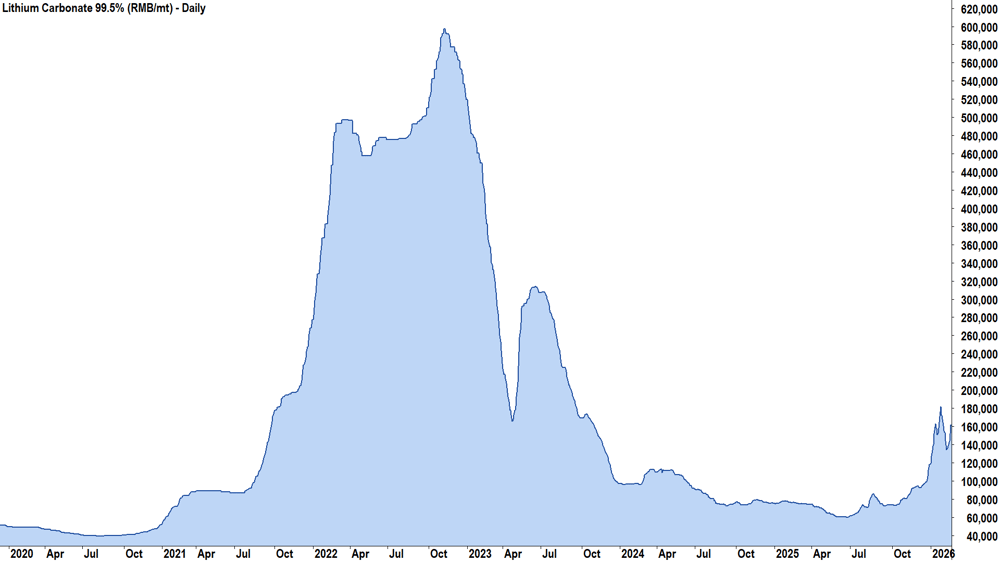
Lithium carbonate spot, 5-year chart
This Zimbabwe development cuts directly at the supply side of that equation. If demand from EVs remains resilient, and the rapid growth in battery energy storage systems continues, then a sudden and enforced disruption to supply — particularly one that is structural in nature — shifts the balance.
When the balance shifts, so do prices. What looked like a recovering market just days ago may now be evolving into something tighter — and potentially more durable — than investors had anticipated.