Lithium's reign under threat as China backs sodium: Latest for PLS, MIN, LTR, ELV & CXO
Beijing's new battery tax gives sodium a leg-up over lithium – yet most brokers still see value in ASX lithium stocks after the sell-off.

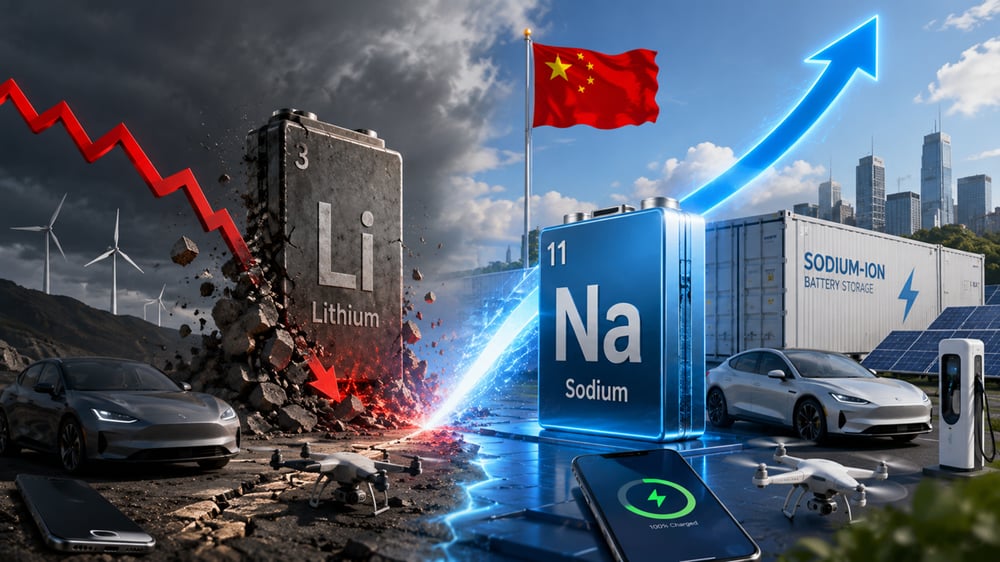
Source: ChatGPT
Mentioned
KEY POINTS
- Lithium has been on a wild ride – a near-90% crash through 2022-25, a furious rebound until May, and now a spectacular pullback that's hammered ASX producers even harder than the metal itself, erasing a third to half the value of some names since June.
- Two threats explain the fear: sodium-ion batteries advancing on lithium's turf – now with Beijing's tax code tilting their way – and the return of supply from CATL's giant Jianxiawo mine.
- Yet the latest expert research tells a more nuanced story – both threats look real but manageable, demand is recovering, and analysts remain constructive. Here's the latest on lithium.
There's an elephant in the room for lithium investors. Ahem, actually – there are two.
The first is the threat from fast-developing battery technologies, chiefly sodium-ion, that promise to chip away at lithium's dominance in the cells powering everything from phones to power grids.
The second is the return of supply from CATL's massive Jianxiawo lepidolite mine in China, which came back online this month after 11 months offline.
Each poses a distinct and very real threat to lithium prices and, therefore, to the ASX-listed companies that seek to produce it.
Together, they've sent the lithium price tumbling and ASX producers reeling, with some shedding a third to nearly half of their value since June.
_20%20July%202026.png)
Australian Spot Spodumene Concentrates (US$/mt) short-term chart
Spodumene – the hard-rock concentrate that feeds most of the world's lithium – has retreated to around US$2,200 a tonne from a May peak near US$2,945 a tonne. The question is whether the panic is warranted.
In this update, I'll weigh each of lithium’s elephants in turn – sodium on the demand side, Jianxiawo on the supply side – before turning to what the latest institutional research makes of the wreckage in ASX lithium producers.
Latest lithium demand dynamics: the sodium question
The first elephant is the one generating the most noise: sodium-ion batteries. Before looking at the latest demand data, it's worth being frank about what sodium can – and can't – do.
The case for sodium is real:
Cost: Sodium is abundant and cheap – it's in seawater and rock salt. Producers claim sodium-ion cells could run 30-40% cheaper than equivalent lithium iron phosphate (LFP) cells. In price-sensitive, high-volume uses, that's a serious lever.
Safety: Sodium is less electrochemically reactive than lithium, making its cells less prone to overheating – a genuine edge where fire risk dictates how and where batteries can be sited.
Cold-weather performance: Sodium cells hold up better at low temperatures, useful for grid storage in harsh climates.
But the case against is just as real:
Energy density: This is the big one. Sodium stores meaningfully less energy per kilogram – roughly 160 Wh/kg or less, against 160-180 Wh/kg for mainstream LFP and up to 280 Wh/kg for high-nickel lithium chemistries. More weight and bulk for the same charge.
An immature supply chain: Of some 300 GWh of announced sodium capacity, only around 90 GWh has actually been built, and the feedstock chain for battery-grade sodium barely exists at scale. Ramping to meaningful volume is a matter of years, not months.
Cost, in practice: That scale problem has a sting in its tail: for all the theoretical savings, sodium cells aren't actually cheaper than lithium-ion today. Until production reaches serious volume, the 30-40% cost advantage over LFP remains on the drawing board.
Put those together and sodium's natural home comes into focus. Where weight and size barely matter – in stationary battery energy storage systems (BESS) and the cheapest short-range city runabouts where range is not a major factor – sodium's cost and safety edge could win it real share from lithium over time. But where energy density is everything – consumer electronics, drones, and the mainstream and premium electric vehicles that sell on range – lithium's grip looks secure. You can't put a heavier, bulkier battery in a phone, drone, or long-haul EV and expect the same size-versus-performance benefits.
Which makes Beijing's weekend intervention all the more pointed. According to CnEVPost, China will levy a 2% consumption tax on lithium-ion batteries from 1 September 2026, rising to 4% a year later, while exempting sodium-ion and solid-state cells through to the end of 2028. It's a modest cost delta – but a clear thumb on the scale. The state is nudging industry towards the chemistries it wants China to lead globally over the next 5-10 years.
Even so, perspective matters. Lithium-ion still dominates utterly, accounting for the lion's share of the 335.6 gigawatt-hours of power batteries installed in Chinese vehicles in the first half alone, up 12% year-on-year on CnEVPost's figures. A few per cent of tax won't change that in a hurry.
On the demand that actually moves the needle today, the picture is quietly improving. Macquarie's read of June figures showed Chinese battery-electric vehicle sales of 685,000 units, up 4% on a year earlier and 7% on May, with plug-in penetration holding around 63%.
The strength is uneven, mind you. On Macquarie's numbers, domestic passenger EV sales were still down almost 17% year-to-date, with exports – up a remarkable 120% – doing the heavy lifting. Its auto team expects a further pickup in July as new models ship.
One caveat sits on the storage side. BESS has been a runaway source of lithium demand – and the hype around its future growth was arguably a major driver of the price surge in April-May. But David Tuckwell of ETF Shares warns some of that strength may be flattered by buyers rushing orders forward before China trims its export tax rebates again – borrowing from tomorrow's demand.
Latest lithium supply dynamics: the Jianxiawo question
The second elephant is heavier, and it has a name: Jianxiawo.
CATL is not just the world's largest battery manufacturer – it's also, through that business, one of the largest consumers of lithium on the planet. Restarting its own Jianxiawo mine hands it something the ASX miners can only envy: renewed optionality over its input costs and its supply chain, the ability to self-supply when it suits.
That matters for how the mine gets run. As Tuckwell points out, because CATL consumes far more lithium than it produces, it isn't "net long" the metal – so, unlike a pure-play miner, it has little reason to hold tonnes back to protect the price. Its supply decisions answer to its battery business, not to the spot market.
To see why that unnerves investors, you have to understand what Chinese lepidolite did to this market between late 2022 and mid-2025. High-cost and marginal, China's lepidolite mines were the swing supply that kept lithium in glut through that brutal bear market – the very tonnes that had to leave for the price to recover.
%20CNY-mt_20%20July%202026.png)
Lithium Carbonate 99.5pct Battery Grade (China, Japan & Korea) CNY/mt long-term chart
And leave they did. It was only once Jianxiawo was shuttered in August 2025 over environmental permitting that lithium could finally stage its rally – a turn Tuckwell dates to the moment CATL stopped producing. Jianxiawo, in other words, sat at the very centre of the recovery. Small wonder its return has rattled nerves, and small wonder the price has pulled back so hard.
The restart itself is now confirmed. Macquarie reports Jianxiawo resumed in early July, with first ore reaching the 30,000-tonne Wanzai refinery on 5 July and a second refinery, Lopal, potentially back to its full 40,000-tonne annual capacity by late July. But two of the mine's three refineries were fully shut during the 11-month idling – so recommissioning and rehiring will take time – and an environmental approval for the accelerated restart remains under review.
On the tonnes, the fear looks overdone. Canaccord Genuity frames the return as a balancing factor rather than a surplus-maker, at roughly 3% of the 2026 global market. Macquarie's estimate for how much extra carbonate could reach buyers this year spans a wide range of 18,000 to 40,000 tonnes, depending on the ramp.
Nor is Jianxiawo the only tap reopening. Canaccord notes higher prices have already coaxed idled Australian capacity back on, with restarts underway at Mineral Resources' (MIN) Wodgina, PLS Group's (PLS) Ngungaju and Core Lithium's (CXO) Finniss.
Here's what ties both elephants together. Neither sodium's slow encroachment nor Jianxiawo's measured return is, on the evidence, a knockout blow. But they've landed on investors still nursing fresh wounds – bulls who watched lithium fall almost 90% through the last bear market, dragging ASX producers down with it.
And CATL, which loves nothing more than a splashy product launch – witness its recent TENER storage system – will keep the sodium threat firmly front of mind as new products are inevitably unveiled.
Latest lithium price forecasts
So, where does all this leave lithium price forecasts? The pattern across the latest investment bank research notes is striking – near-term estimates trimmed, versus longer-term views held firm or even lifted.
UBS, which remains overweight the sector, recently cut its 2026 spodumene forecast by around 9% and its 2027 number by roughly 12%, to US$2,855 and US$3,750 a tonne respectively, while leaving its longer-dated assumptions untouched. Its verdict: fundamentals remain strong, near-term wobbles notwithstanding.
Canaccord took a similar tack earlier this month, tempering near-term forecasts while nudging its long-term spodumene price up to US$1,800 a tonne. Importantly, the firm still models the market in deficit through 2028, averaging around US$2,572 a tonne for spodumene over 2026-28.
Broker | Price basis | 2026e (US$/t) | 2027e (US$/t) | 2028e (US$/t) | Long-term (US$/t) |
|---|---|---|---|---|---|
UBS | FOB Australia | 2855 | 3750 | 3250 | 1400 |
Macquarie | FOB Australia | n/a | 2320 | 2170 | 1350 |
Canaccord Genuity | FOB Australia | 2650* | 2688 | 2400 | 1800 |
Barrenjoey | CIF China | 3200** | 2250 | 1050 | 1500 |
Consensus (via Barrenjoey) | CIF China | 2299** | 1921 | 1616 | 1385 |
Combined major investment bank spodumene concentrate 6% (SC6), US$/t forecasts table. Price basis is not uniform across houses: UBS, Macquarie and Canaccord quote FOB Australia, while Barrenjoey and the consensus it cites quote CIF China (which includes freight) – so figures are indicative across brokers, but not strictly like-for-like. *Canaccord 2026e is the average of its Sep Qtr (US$2,500/t) and Dec Qtr (US$2,800/t) forecasts. **Barrenjoey and consensus figures are H2 2026. Australian spodumene concentrate closed at US$2,200/t on 20 July. Long-term reflects each house's terminal assumption.
Last week, Macquarie, for its part, left its medium-term deck largely unchanged and described the recent share-price weakness as disproportionate to fundamentals, arguing the physical market should stay tight through the second half. Its long-run spodumene assumption of US$1,350 a tonne, it notes, sits below a market consensus of US$1,400-1,500 a tonne.
The tell, as Tuckwell observes, is that even amid the gloom, the analyst trend has been to revise long-term spodumene prices up, not down. Read together, the message is that the pullback looks like a near-term repricing – not a downgrade of lithium's structural case.
ASX lithium stocks the big brokers are calling a buy
Which brings us to ASX lithium stocks. Since June, the falls have been savage, prompting Macquarie to describe the weakness as disproportionate and driven more by sentiment and near-term earnings downgrades than fundamentals.
Macquarie offers a neat explanation for the gap. The futures market, it argues, is fixed on a still-tight second half of 2026, while equity investors are increasingly looking through to 2027 – when the restart and a wave of announced expansions could loosen the balance. One market, two time horizons; hence the disconnect.
The upshot is that ASX lithium stocks are now priced for a commodity far cheaper than the one actually trading. On Barrenjoey's analysis, with spot spodumene around US$2,200 a tonne, the market is valuing Wildcat Resources (WC8) as if the price were just US$1,125 a tonne, Liontown (LTR) nearer US$1,375, and PLS and IGO (IGO) closer to US$1,425-1,450 a tonne.
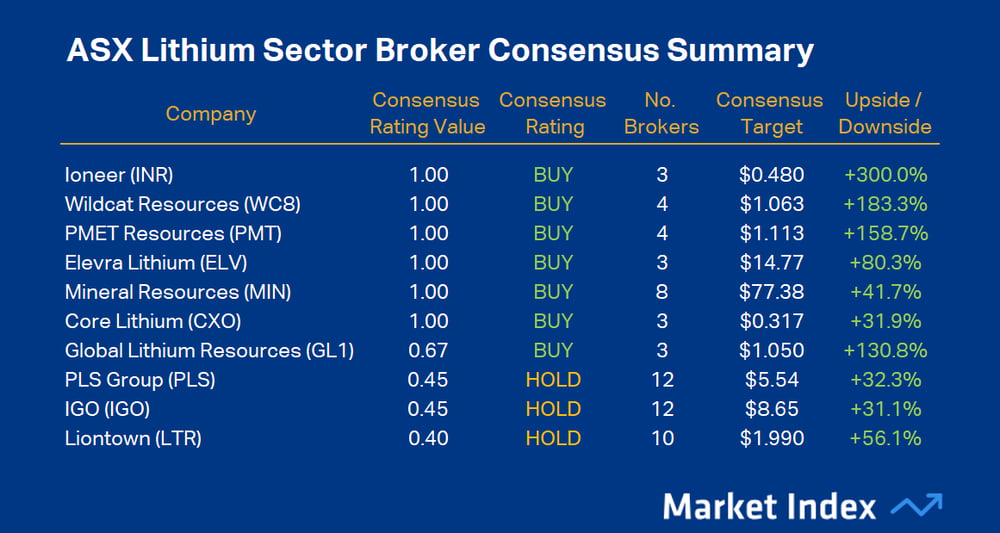
ASX Lithium Sector Broker Consensus Summary 20 July 2026. Source: Market Index Broker Consensus. To obtain a stock’s Broker Consensus Rating, we assign a value of +1 to any rating better than HOLD/NEUTRAL/MARKETWEIGHT, a value of 0 for any rating equivalent to HOLD/NEUTRAL/MARKETWEIGHT, and a value of -1 to any rating worse than HOLD/NEUTRAL/MARKETWEIGHT. We then take the average of all assigned rating values and assign a Broker Consensus Rating of BUY to values greater than +0.5, a rating of HOLD for values between -0.5 and +0.5, and a rating of SELL for values less than -0.5. The Broker Consensus Target is simply the average of the target prices we have on file for each broker. Typically, brokers define their target prices as 12-month forecasts. Each target price is based on fundamental valuation assumptions. Upside/Downside data are based on closing prices on 20 July 2026.
Look familiar? If you followed this sector through the last bear market, no doubt the right-most column will bring back some painful and confusing memories. 300% upside for INR? 183% for WC8? The big brokers have a habit of ratcheting up their target prices on the way up, only for those targets to be left feeling a little out of touch when the lithium price does an about-face and drags the prices of ASX lithium stocks with it.
For what it's worth – and I am merely reporting the facts and news that I have at hand here – the big brokers tend to be quite bullish on the ASX lithium sector. It is worth noting, however, that the greater the coverage, the more modest the Broker Consensus Rating tends to be – MIN being the exception. Still, at just shy of the 0.50 cutoff for consensus buy, arguably PLS, IGO, and LTR qualify as 'consensus strong holds', particularly given their attractive upside to their respective Broker Consensus Targets.
Conclusion: follow the money
Here's the number that captures the whole strange episode. With spodumene changing hands at roughly US$2,200 a tonne, the share market is valuing Australia's lithium producers as though it were closer to US$1,200 a tonne – a discount of roughly 45% to the metal they’re actually selling. Either the lithium price is going to nearly halve, or ASX lithium stocks are substantially undervalued.
So, who’s right? The bears’ case is a strong one: two real elephants – a chemistry openly favoured by Beijing's tax code, and a supply base that could loosen the 2027 balance – are genuine questions for lithium's next chapter.
But the bulls’ resolve is unlikely to be eroded: lithium battery chemistries will continue to be the vast bulk of units produced over the next decade – no hyped CATL launch is going to change that any time soon.
On the brokers' own numbers, today's share prices already assume a far gloomier world than the one in front of us. Whether capital now rotates back towards the lithium names – closing that gap between price and value – is exactly the kind of turn I'll be watching for in ChartWatch – so stay tuned.
This article draws on institutional research from Barrenjoey, Canaccord Genuity, Macquarie and UBS (all July 2026), market commentary from David Tuckwell (ETF Shares), and reporting from CnEVPost on China's new battery consumption tax (July 2026).