CSL drove ASX healthcare’s stellar reporting season, but what’s next?
Healthcare boomed in August on results that beat analyst’s estimates, but can the sector sustain momentum through FY27?


Mentioned
KEY POINTS
- Three years of downgrades had left healthcare unloved, despite the defensive tag it usually trades on.
- August reversed that, with beats from CSL, Ansell and Ramsay driving the sector's outperformance compared to the broader market.
- This article looks at whether the major ASX healthcare stocks can sustain their positive momentum going into FY27.
Healthcare has been the ASX's problem child for the best part of this decade, leaving the market's most defensive sector as one of its worst performers. Between 2020 and 2025, the ASX 200 Healthcare Sector Index (XHJ) returned 4.3% including dividends – an amount not even worth annualising.
But last year, things took a sudden turn for the worse, as a slew of downgrades and disappointments sent the sector’s biggest blue chips – from CSL (CSL) to Cochlear (COH) to Resmed (RMD) tumbling. Between 31 Jan 2025 and 3 June this year, the XHJ lost over half of its value, again, even after accounting for dividends.
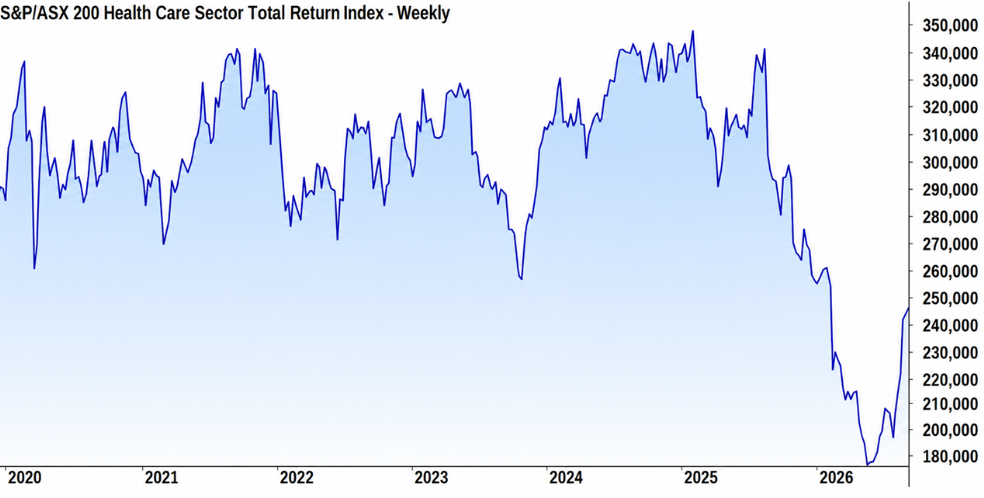
ASX 200 Healthcare Sector Total Return Index (XHJA) 2020-2026. Source: Norgate Data
August changed that, with the sector delivering the strongest performance during reporting season. In total, the XHJ is now an impressive 44.1% above its June low, easily beating the benchmark S&P/ASX 200, which added just 3.7% over the same period.
This article examines what has driven the healthcare sector’s extraordinary market beating run, including better than expected results from CSL, Ansell and Ramsay — and a major shift in investor sentiment..
The big names that drove the rally
CSL did the heavy lifting, with the stock gaining 40% over the month after plasma product sales for the June half came in ahead of what analysts expected. Management guided to higher gross margins in CSL Behring, the plasma division that has been the source of its problems in recent years. In a recent health sector note, UBS said the August result left it more confident the worst was behind the company ahead of a CEO transition in 2027.
Ansell (ANN) rose 23.2% on a result that beat expectations, with guidance implying double-digit earnings per share growth in FY27 at the midpoint. UBS is more cautious, however, on whether Ansell can keep that up, noting its protective equipment and healthcare businesses are exposed to broad economic conditions.
Ramsay (RHC) added 16.2% after FY26 numbers that came in ahead of expectations, helped by UK operations that did better than feared. The company’s new management team guided to further margin expansion in FY27 on the back of more predictable agreements with private health insurers, better use of operating theatres and procurement savings.
The gains ran deeper than the three headline results, with Cochlear rising 13.5%, Telix Pharmaceuticals (TLX) 10.1%, ResMed 9.9% and Fisher & Paykel Healthcare (FPH) 7.1% in August, leaving eight of the ten largest names in the sector higher for the month.
What was working in ASX healthcare’s favour
Expectations had been cut hard through the year, so the bar was low going into August reporting season. Companies then cleared it, mostly by controlling costs rather than growing sales. Healthcare was also the only sector where more companies guided above expectations for the year ahead than below, according to a recent Macquarie note.
The timing helped, with housing slowing and rising interest rate expectations putting consumers under further pressure – investors wanted earnings that hold up whatever the economy does. Healthcare ticked that box, and for many investors, it finally looked cheap enough to be worth buying. Macquarie noted that healthcare was the reason defensive stocks beat expectations for the first time in three years.
Will the good times continue?
August was a good month, but FY27 is the harder question. The companies themselves are optimistic about FY27, but analysts overall are less sure, cutting FY27 forecasts for the sector by more than 2% over the month, according to Macquarie.
Healthcare stocks also got more expensive through the month, with the sector's forward P/E ratio expanding to 24x expected FY27 profits, up from ~20x in July. That means investors are paying $24 for every dollar of profit the sector is forecast to earn. The average ASX 200 stock trades on 18x, leaving healthcare at a premium of roughly a third, one it has not carried in three years.
Conclusion: back from the dead, but not off life support
The recovery now has to arrive for healthcare names: CSL needs the plasma turnaround it has promised, Ramsay needs the margins it says its Australian hospitals can deliver, and Ansell needs the growth its new CEO is targeting. August reporting suggests all three, and others in the sector, are back on track. But the sector isn’t as cheap as it was at its June lows – the basement bargain allure is gone. Now the hard work begins: confirming renewed investor optimism about ASX healthcare’s turnaround.