Why your ASX stocks never hit analyst target prices
Broker consensus targets sat above eventual share prices far more often than below, with misses outweighing beats almost two to one.


Source: Shutterstock
Mentioned
KEY POINTS
- Just 42 of 217 ASX stocks finished within 10% of their April 2025 consensus target price, with the typical target off by around 45 percentage points in either direction.
- Downside surprises outnumbered upside beats almost two to one, reflecting a long-documented optimism bias in analyst forecasts, while 26 stocks finished more than 50% below target.
- Gold and critical minerals names dominated the biggest beats, led by Lynas, Liontown and Evolution Mining, as conservative commodity price assumptions were overtaken by the high-flying gold price.
Analyst target prices offer a quick insight into where the stock should go, but realistically – they're wildly inaccurate and should always be taken with a grain of salt.
I undertook a pretty straightforward exercise, grabbing Market Index's broker consensus data for about 200 stocks (most S&P/ASX 200 constituents and some smaller ones) from a year ago and compared those target prices with today's prices.
At a glance
Only 19.4% (42 stocks) of the year-old targets landed within a +/- band of where the stock actually sits today.
.png)
How 217 ASX stocks performed vs. consensus targets set on 8 April 2025 (measured against 16 April 2026) | Source: Market Index
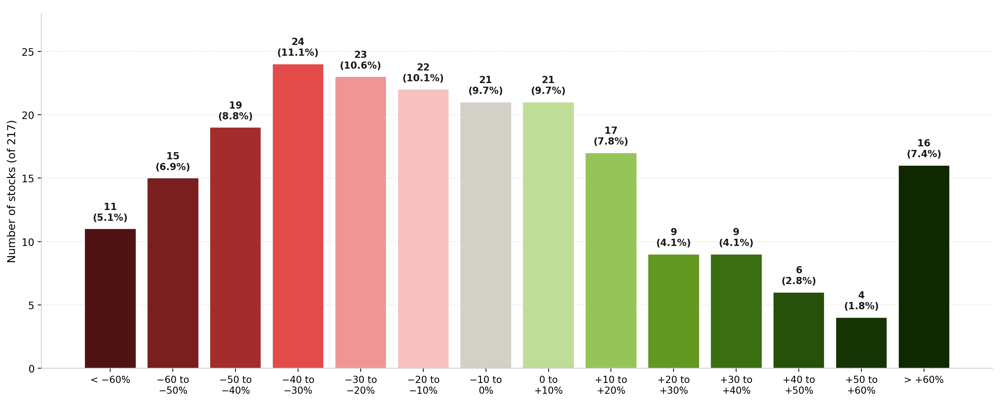
Here's another version that breaks down the beats/misses in tighter, 10% intervals.
Source: Market Index
A closer look
The miss side is much heavier than the beat side. 52.5% of stocks undershot the target by more than 10% vs. 28.1% that overshot. This suggests almost twice as many "downside surprises" as "upside surprises". In other words, analysts' targets sat above the eventual share price far more often than below it, which is the classic optimism bias that's been documented in analyst behaviour for decades.
One in eight targets were catastrophic. 26 stocks (12%) are now sitting more than 50% below where analysts thought they'd be a year ago. The worst five are Bapcor (−88%), G8 Education (−83%), HMC Capital (−78%), Audinate (−75%) and IDP Education (−74%).
The biggest beats were concentrated in resources. The top 10 outperformers are dominated by gold and critical-minerals names: Lynas Rare Earths (+203%), Liontown (+188%), Evolution Mining (+152%), Resolute Mining (+138%), Regis Resources (+138%), Pilbara Minerals (+106%), Genesis Minerals (+101%), Newmont (+101%).
The dispersion is enormous. The standard deviation of the error is 45%. In plain English, this means the typical target is off by roughly 45 percentage points in either direction!
The biggest misses
The biggest misses are all companies hit by rather catastrophic catalysts, most of which are company-specific. It's understandable why consensus target prices missed so badly, but many of these names were already challenged businesses to begin with.
Bapcor has the largest miss but if you rewind back to April 2025, the stock was already down around 45% from its June 2021 high. The decline wasn't driven by a single catalyst but by a rolling series of earnings downgrades, operational issues and competitive failures. In late 2021, long-serving CEO Darryl Abotomey had his retirement brought forward, triggering five years of leadership instability. Bapcor also rejected a takeover proposal from Bain Capital at $5.40 per share in June 2024. The latest trading update proved the nail in the coffin, featuring an emergency $200 million capital raise at a 65% discount.
Other stocks including HMC Capital, Audinate, Treasury Wine and Coronado were also stuck in steep, often multi-year drawdowns. The path of least resistance here probably wasn't betting on a turnaround or trusting a lofty target price that leaned on value in the underlying business.
Code | Company | 12-month target (as of Apr-25) | Last close | Beat/miss |
|---|---|---|---|---|
BAP | Bapcor | $5.38 | $0.66 | -88% |
GEM | G8 Education | $1.56 | $0.26 | -83% |
HMC | HMC Capital | $11.11 | $2.45 | -78% |
AD8 | Audinate Group | $10.36 | $2.63 | -75% |
IEL | IDP Education | $14.61 | $3.79 | -74% |
AX1 | Accent Group | $2.43 | $0.68 | -72% |
TWE | Treasury Wine Estates | $13.59 | $3.97 | -71% |
CRN | Coronado Global Resources | $1.09 | $0.32 | -71% |
LOT | Lotus Resources | $4.60 | $1.54 | -67% |
WTC | Wisetech Global | $129.19 | $44.90 | -65% |
The ten largest misses against consensus target prices from 8 April 2025 vs. closing price on 16 April 2026 | Source: Market Index, author's own calculations
Stocks that surprised
Gold miners dominate the list of stocks that surged past analyst targets. A year ago, most analyst models assumed FY24-25 gold prices of around US$2,000/oz. While these target prices have no doubt crept higher throughout the year, they reflect a classic conservative approach to commodity price expectations.
Code | Company | 12-month target (as of Apr-25) | Last close | Beat/miss |
|---|---|---|---|---|
LYC | Lynas Rare Earths | $6.86 | $20.78 | 203% |
LTR | Liontown Resources | $0.72 | $2.07 | 188% |
EVN | Evolution Mining | $5.50 | $13.85 | 152% |
RSG | Resolute Mining | $0.60 | $1.43 | 138% |
RRL | Regis Resources | $3.17 | $7.54 | 138% |
PLS | Pilbara Minerals | $2.77 | $5.71 | 106% |
GMD | Genesis Minerals | $3.32 | $6.67 | 101% |
NEM | Newmont Corporation | $78.29 | $157.05 | 101% |
CDA | Codan | $17.95 | $33.67 | 88% |
SRG | SRG Global | $1.57 | $2.86 | 82% |
The ten largest beats against consensus target prices from 8 April 2025 vs. closing price on 16 April 2026 | Source: Market Index, author's own calculations
The most accurate outcomes
The stocks that landed closest to target prices are all fairly slow-moving, relatively defensive stocks. At a glance, the list is dominated by REITs and insurers, alongside stocks that have given back earlier gains like Austal, TechnologyOne and Kelsian Group.
Code | Company | 12-month target (as of Apr-25) | Last close | Beat/miss |
|---|---|---|---|---|
TLC | The Lottery Corporation | $5.44 | $5.60 | 3% |
ASB | Austal | $4.50 | $4.63 | 3% |
ASK | Abacus Storage King | $1.36 | $1.39 | 2% |
ALD | Ampol | $32.54 | $33.18 | 2% |
BWP | BWP Trust | $3.78 | $3.85 | 2% |
CQR | Charter Hall Retail REIT | $3.77 | $3.83 | 2% |
TNE | Technology One | $30.11 | $30.58 | 2% |
RHC | Ramsay Health Care | $41.77 | $42.30 | 1% |
BGA | Bega Cheese | $5.86 | $5.92 | 1% |
QBE | QBE Insurance | $22.91 | $22.91 | 0% |
NHF | NIB Holdings | $6.71 | $6.66 | -1% |
RGN | Region Group | $2.31 | $2.29 | -1% |
TCL | Transurban Group | $13.49 | $13.37 | -1% |
MFG | Magellan Financial Group | $9.72 | $9.48 | -2% |
KLS | Kelsian Group | $4.00 | $3.88 | -3% |
STO | Santos | $7.92 | $7.65 | -3% |
HVN | Harvey Norman Holdings | $4.88 | $4.71 | -3% |
Stocks that landed within +/-3% of consensus target prices from 8 April 2025 vs. closing price on 16 April 2026 | Source: Market Index, author's own calculations
A different perspective
It's easy to bash brokers about target prices, but admittedly, guessing where a share price will land in twelve months is extremely challenging. Target prices are often set from a bullish standpoint because analysts view things through the lens of their models, basing the target on the future cashflows of the business. They aren't going to price in a left-field catalyst unless it has already happened.
In my opinion, ratings and target price changes are best used when they're directionally aligned with a catalyst.
Take Woolworths, which reported a bumper 1H26 result with earnings ahead of expectations thanks to improved sales momentum in Australia Food combined with effective cost control. The stock rallied 12.9% on the day of the result (25-Feb) to $35.63. Post-earnings, the consensus target price was lifted 13.7% to $35.55, though most analysts remain Neutral-rated. Woolworths has since climbed a further 5.8% to trade at its highest level since October 2023.
There are plenty of other examples of companies that have smashed earnings expectations or announced positive catalysts, followed by positive revisions, where share prices have continued to climb or track in line with those target prices. Stocks like Aurizon, Telstra, Sims, Monadelphous and Imdex come to mind.
On the flip side, you want to avoid situations where:
The share price is tanking (for whatever reason) and analysts upgrade the stock on the basis that it now sits well below their target price (representing big upside) but keep their target unchanged or even cut it
The stock has just delivered a downbeat announcement and analysts trim their target but remain bullish
Harvey Norman is a case in point for the latter. The company's 1H26 result showed underlying profit modestly below expectations amid a material slowdown in Australian sales through the key Black Friday and Christmas trading period. The stock finished the session (27-Feb) down 9.0% to $5.76. Post-earnings, the average target price was cut 8.9% to $6.65, yet the stock closed at $4.60 on Tuesday.
What about financials?
Analyst earnings expectations are arguably far more important than target prices. In the examples above, Woolworths rallied off better-than-expected earnings, while Harvey Norman tanked on an earnings miss.
The way I like to think about it is if analysts value a company at $10.00 per share on expectations of $100 million in net profit, and the company delivers $110 million, then clearly the stock is going to face upward revisions to both its target price and future earnings. There are obviously other nuances such as the top-line, margins and dividends, but you get the point.