Westpac reports massive drop in mortgage application volumes, ASX bank shares slide
Westpac's 3Q26 update sparked a sector-wide sell-off after revealing a hit to mortgage applications from the May tax changes and rate hikes.


Source: Shutterstock
Mentioned
KEY POINTS
- Westpac shares fell 4.8% and dragged the wider financials index lower, after the bank revealed a sharp post-budget drop in mortgage applications.
- Profit and margins held up, but Westpac's own economists now expect housing credit growth to slow over the year ahead, with investor lending the hardest hit.
- Bad debts aren’t rising yet, but the bank lifted its provisions and added a new buffer for consumer spending as it braces for tougher conditions.
Westpac (WBC) spooked Australian bank investors this morning by revealing a sharp slide in mortgage application volumes, triggering a sell-off across the sector.
The Big Four bank's quarterly update had profit and revenue up and net interest margins stable, but it was the 20% post-budget nose dive in mortgage applications that caught the market's eye.
"While many households are feeling the impact of cost of living pressures, businesses are investing and our customers have continued to show resilience," said Westpac CEO Anthony Miller.
Despite management’s assurance of “resilience”, Westpac shares fell 4.8% to $36.10 in early trade.
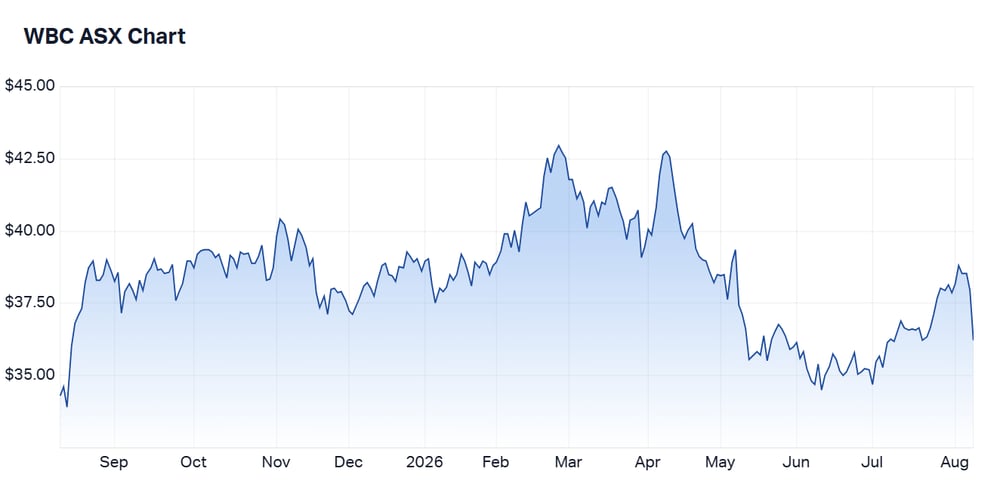
Westpac 1-year price chart (Source: Market Index)
3Q26 numbers at a glance
Pre-provision profit of $2.8bn (+1% on 1H26 quarterly average)
Statutory net profit of $1.8bn (+3% on 1H26 quarterly average)
Net operating income of $5.7bn (+1% on 1H26 quarterly average)
Net interest income of $5.0bn (+2% on 1H26 quarterly average)
Operating expenses of $2.9bn (+1% on 1H26 quarterly average)
Net interest margin (NIM) of 1.89% (flat on 1H26 quarterly average)
CET1 of 12.1% (vs 11.25% target)
Average monthly mortgage application volumes down 11% quarter-on-quarter, with the post-budget run rate down 20% on 2Q26
Lending up 2% (on 1H26, business +4%, Institutional +3%, housing +2%) and deposits up 2%
The result in focus
Westpac's result laid bare how severely the government's May budget and rate hikes hit mortgage applications, with owner-occupier volumes down 18% and investor applications down 26% post-budget. CFO Nathan Goonan suggested "the rate impact is probably equal or potentially a bigger impact than anything that happened in the budget."
That application slump points to a broader credit slowdown ahead. Westpac's economists now expect total housing credit growth to ease from 6.8% in FY26 to 4.7% in FY27, with the investor segment halving from 9.1% to 4.5% as the budget changes bite.
Westpac plans to grow its own mortgage book slower than the wider market in the fourth quarter, taking a cautious approach and leaning on its proprietary channel as competition sharpens. Management expects lending margin compression to continue, particularly in Australian mortgages, and warned the squeeze will be more pronounced at the full-year result.
The offset is business, where pipelines stay strong at the top end and credit growth is tracking near 8% in FY26 before easing above 6% in FY27. That leaves Westpac leaning harder on business and institutional customers to carry balance-sheet growth while the mortgage market stays dislocated.
Bad debts benign — for now
A provision is money a bank sets aside in advance for loans it thinks might sour, and Westpac quietly built up those defences this quarter. It lifted the overlay, the extra buffer management adds on top of its model's estimate when it wants to be cautious, to $2.0 billion above its base-case scenario, and made its downside scenario more severe.
The key thing for investors is that nothing has actually gone wrong yet. The impairment charge — which is what gets booked as an actual loss each quarter — held steady at a modest 10 bps, and stressed loans stayed low at 1.19%. So real losses aren't showing up yet.
What's changed is that Westpac is deliberately padding its reserves for what it sees coming: Goonan said the bank raised "a new overlay for discretionary spend," judging it prudent given the way consumers are adjusting how they live.
The bottom line
Westpac's mortgage application slump dragged the wider sector down with it, with the S&P/ASX 200 Financials index off 2.2% in morning trade. As the first of the big banks to report this season, Westpac’s update sets the tone for its peers. While these are only third-quarter figures, investors will be bracing for more of the same from Commonwealth Bank of Australia (CBA), National Australia Bank (NAB) and ANZ.
Westpac’s result shows how the budget and three cash rate hikes have combined to make would-be borrowers think twice about coming to market. We’ll see how the other big banks are coping soon, with Commonwealth Bank to hand down its full-year result on 12 August, ANZ will deliver a third-quarter update on 13 August, and NAB reports its third quarter on 17 August. You can keep tabs on the reporting dates and key earnings numbers for over 250 ASX stocks in our Reporting Season Calendar.