US stocks crash could be buying opportunity for ASX investors
US stocks now make up half of the stocks Aussies trade most – here's why, and how you can get your slice of the Wall St pie.


Source: Shutterstock
Mentioned
KEY POINTS
- For decades, lucrative fully franked dividends and familiarity kept Australian investors anchored at home, even though the ASX is only a sliver of the global equity universe.
- New data shows US companies now make up half of the most traded stocks by Australian investors, with US names attracting 55% of all net buying in a recent six-month period.
- We weigh up the pros and cons of investing offshore, look at how today’s Magnificent 7 fared after the dot-com crash, and for those unsure where to start, check out a major investment bank’s most heavily weighted US stock picks.
Falling knife.
Quality on sale.
The line between the two is often blurred.
But if you’re leaning towards the latter option, then this article is for you. And it seems, for tens of thousands of Aussie investors who have already embraced investing in US shares.
According to a new survey from online portfolio tracking platform Sharesight, US-listed companies now make up half of the 20 stocks Australians trade the most. With major US stock indices tumbling, it’s the perfect time to get one’s ducks in a row if a major buying opportunity presents itself.
Below, we unpack Sharesight's findings, weigh the pros and cons of investing offshore – and in the US specifically – and, for those keen to start but unsure what to buy, look at the US stocks carrying the heaviest weightings in Morgan Stanley's Global Leading Ideas Equity Portfolio.
What Sharesight found
Australian investors have long kept their equity dollars close to home. Dividend imputation, introduced in 1987, means fully franked dividends from ASX companies carry tax credits no offshore company can match, and the household names – the big banks, the miners, Telstra (TLS) – are businesses most investors feel they already understand.
But that's changing, and quickly. Sharesight compared trading in the six months to 9 October 2026 with the six months before. The number of US-listed stocks in the top 20 rose from 8 to 10, with NVIDIA (NVDA) now the most traded stock of all, ahead of local blue-chip stalwart CSL (CSL). SpaceX (SPCX) became the sixth most traded within four months of its June listing, ahead of Woodside Energy (WDS).
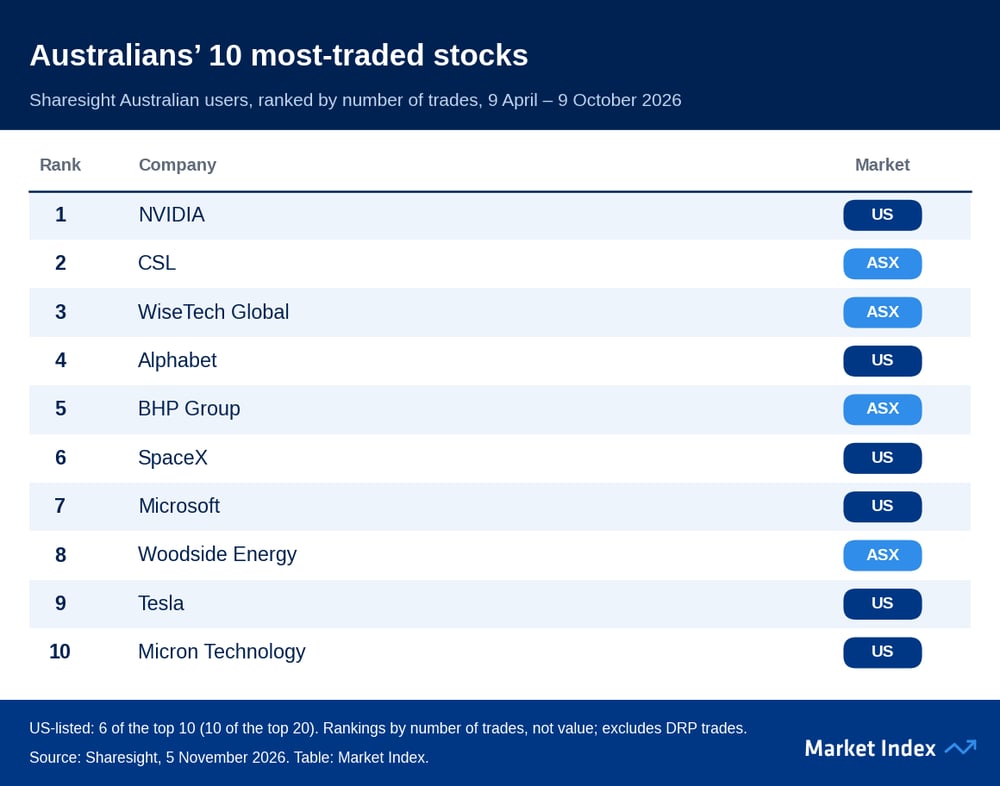
The 10 most-traded stocks among Australian Sharesight users, 9 April to 9 October 2026. Source: Sharesight. Table: Market Index.
Across the 25 most-traded ASX and US stocks, US names accounted for 47% of all trades, up from 40%, as trading in leading ASX stocks fell 25%. Investors were mostly buyers rather than sellers, with the data suggesting greater confidence in US offerings (66% of trades in leading US stocks versus 62% for leading ASX stocks). Indeed, US stocks attracted 55% of all net buying, up from 50%.
Local resources companies lost the most ground, with trades in WDS down 44% and BHP Group (BHP) down 23%, while National Australia Bank (NAB), Telstra (TLS), Fortescue (FMG) and Westpac (WBC) – all well-known dividend payers – were the only leading ASX stocks to draw more buy trades.
Sharesight CEO Douglas Morris said Australians can see the ASX 200 has barely moved this year while the S&P 500 has set record after record, and that the local market has few of the AI and technology companies driving US gains. Investors, he said, appear to be "leaning on the local market for dividends and looking to the US for growth".
The case for – and against – going offshore
The case for investing abroad starts with diversification. Spreading capital across different economies, currencies and sectors reduces reliance on any one market's fortunes, and it unlocks industries that are lacking or absent on the ASX – think semiconductors, cloud computing, global consumer brands and large-cap pharmaceuticals.
The trade-offs are real, however. Offshore returns are exposed to currency moves – a rising Australian dollar erodes offshore gains, while a falling one boosts them. Foreign companies don't pay franking credits, their dividends may be subject to foreign withholding tax*, and overnight trading hours mean news often breaks while Australian investors are asleep.
The US adds its own considerations. It's the world's deepest and most liquid market and home to most of the companies leading the AI build-out, but that depth comes with concentration, with a handful of mega-cap technology stocks driving much of its index performance. And let’s address the elephant in the room. What goes up often comes down – and right now it’s coming down with a thud.
But there’s another saying in markets: nothing goes up in a straight line. There will be wobbles along the way, but few would dispute AI is going to revolutionise how we live, work and play. Many will remember the internet boom of the late 1990s and early 2000s, and of course, the so-called dot-com crash. Not all budding internet companies survived, but those that did have paid off many times over for savvy and patient investors.
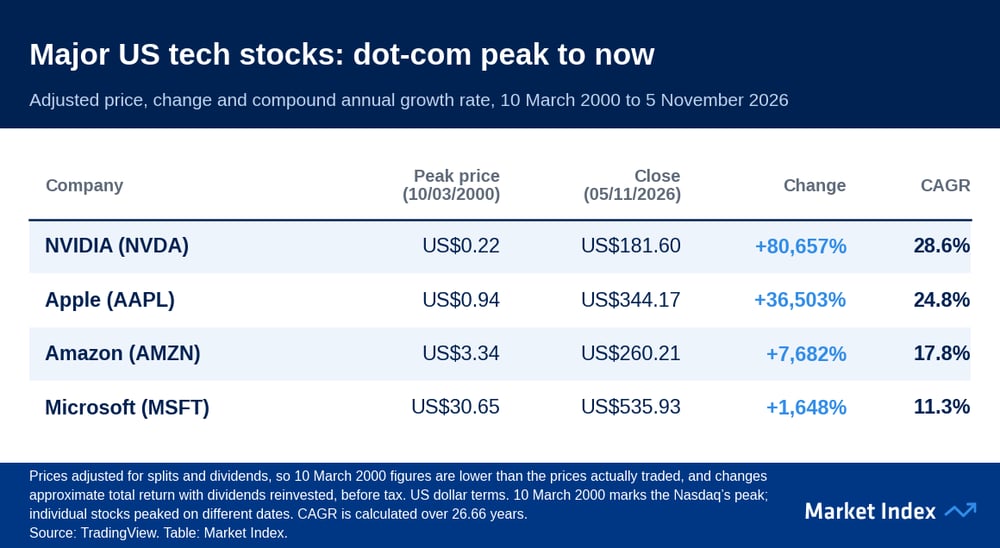
The four Magnificent 7 stocks listed at the dot-com peak, then versus now. Source: TradingView. Table: Market Index.
Don't know where to start? Follow Morgan Stanley's heaviest weightings
For those keen to start but unsure what US companies to buy, one approach is to look at what professional portfolio managers favour. Morgan Stanley Wealth Management's Global Leading Ideas Equity Portfolio is a hypothetical model portfolio of 43 international stocks, built primarily on Morgan Stanley Global Equity Research's high-conviction ideas.
Eight of its 10 largest holdings at 31 October were US-listed: Apple (AAPL), NVDA, Eli Lilly (LLY), Amazon (AMZN), Microsoft (MSFT), Coca-Cola (KO), Visa (V) and JPMorgan Chase (JPM) – a mix of AI-exposed technology leaders and steadier earners across health care, consumer staples and financials.
The portfolio has returned 19.35% p.a. since inception in May 2023, against 16.34% p.a. for its MSCI World ex Australia NR AUD benchmark, and 9.73% over the past 12 months against 4.29%. Those are total returns in Australian dollars, gross of fees and excluding franking credits, and individual stock weightings aren't disclosed.
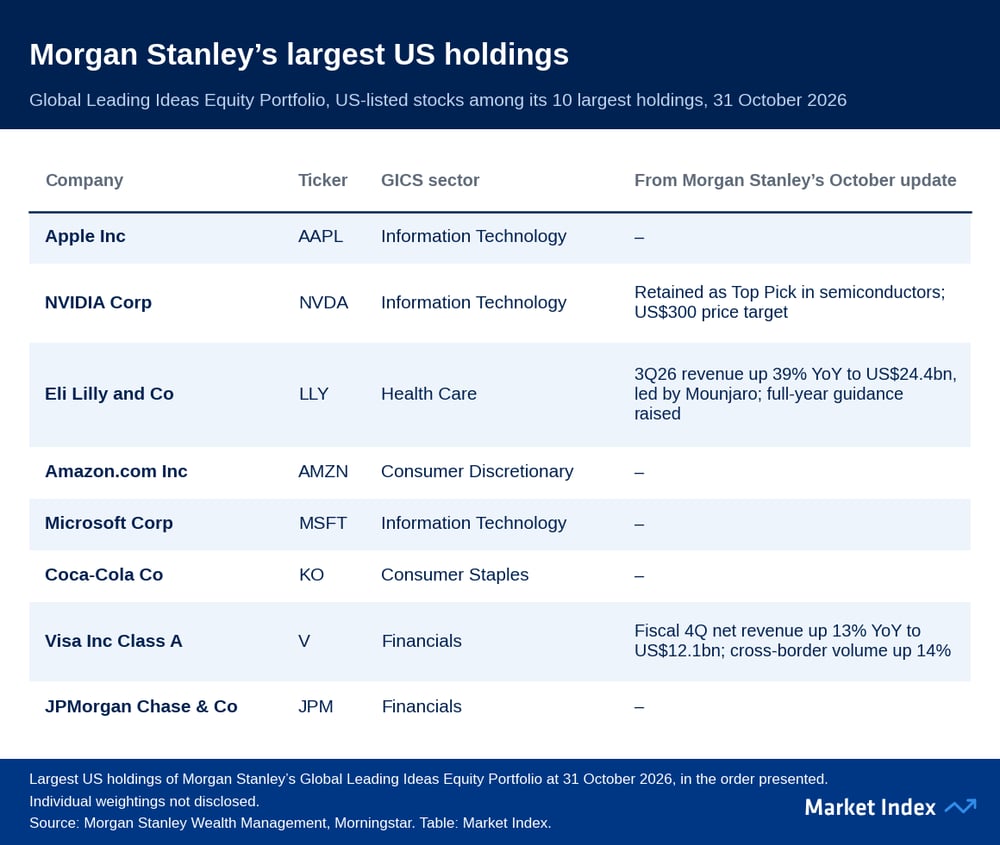
Largest US holdings of Morgan Stanley's Global Leading Ideas Equity Portfolio at 31 October 2026, in the order presented. Source: Morgan Stanley Wealth Management, Morningstar.
Widening one’s horizon
Aussie investors must face facts. Australia accounts for just 1.5% of global equities as measured by the MSCI ACWI IMI, which covers around 99% of the investible global equity market. The local market is also narrow, with financials and materials making up approximately two-thirds of the ASX 200’s market capitalisation.
We don’t have any major AI focused companies to speak of. That may change, of course, but right now, the only way for investors to gain exposure to potentially the biggest trade of our lifetimes is to look overseas. Even after the stumble of the last 24 hours, the US stock market offers a depth of opportunity in technology, consumer, biotech and other sectors that are scarce or non-existent here.
Further, with most of the major local stockbrokers offering investors the ability to trade US stocks just as easily as in BHP or CBA, it’s never been a better time to begin diversifying one’s portfolio – away from just banks, miners and CSL, that is!
Notes & References
*US dividends paid to Australian residents are generally subject to 15% withholding tax once a W-8BEN form is lodged, and US estate tax can apply to US-listed shares held directly by non-residents.
This article draws upon research from Morgan Stanley Wealth Management, Global Leading Ideas Equity Portfolio – Equity Model Portfolio Performance, at 31 October 2026; Sharesight, US stocks now make up half of Aussie investors' most-traded list, 5 November 2026; MSCI, A Complete Geographic Breakdown of the MSCI ACWI IMI, data as at 30 June 2026; MSCI, MSCI Australia Index (USD) factsheet, 31 August 2026.