Rio Tinto shares jump as dividend soars 43% to four year high on 1H26 beat
Reporting season is underway, and Rio Tinto has kicked things off — lifting its dividend on the back of strong cash flow.

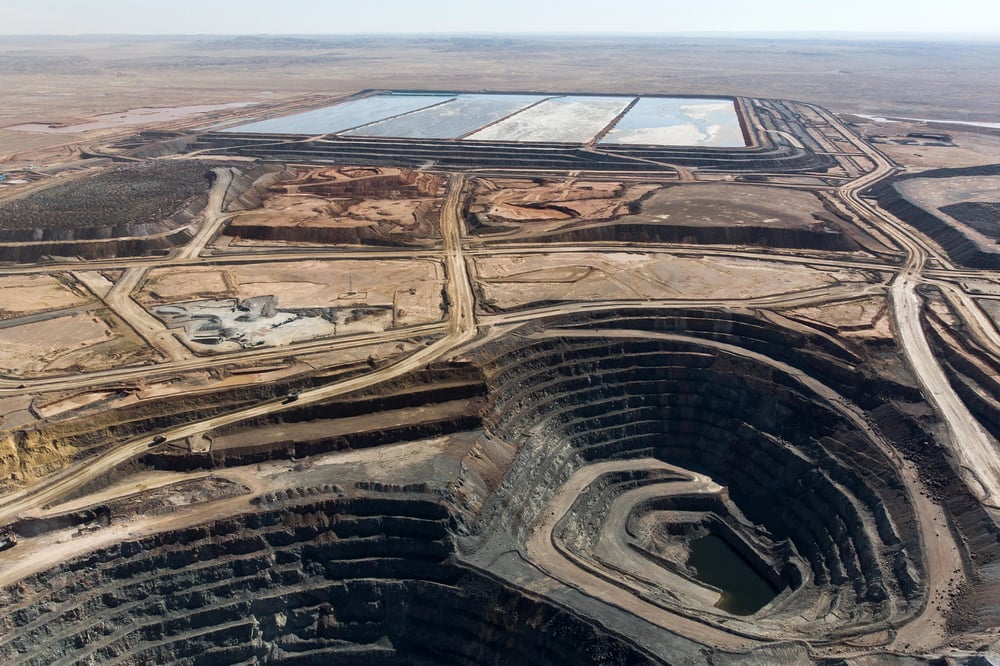
Source: Rio Tinto's Oyu Tolgoi (Source: Getty Images)
Mentioned
KEY POINTS
- The 2026 reporting season has arrived, and Rio Tinto is among the first out of the gate, posting its half-year results just two weeks after a positive quarterly update.
- A healthy balance sheet and strong free cash flow gave the miner room to lift its interim dividend, rewarding shareholders while continuing to invest in growth.
- Read on for a closer look at Rio Tinto's HY26 results and management's commentary.
Miners are printing cash in this elevated commodity price environment, and Rio Tinto’s (RIO) 1H26 showcased just that, with its interim dividend up 43% to US$2.11 per share, the highest in four years. The stock is up 4.5% to $166.81 at the time of writing, far outperforming the broader Material’s index gain of 1.3%.
Today’s outperformance was driven by a relatively clean beat across the board, with the interim dividend slightly ahead of US$2.09 per share expectations, along with better-than-expected cash flow and net debt. The full-year guidance was left unchanged, with the tax rate and copper cost outlook guided lower.
The production numbers for the first half will come as no surprise, given Rio Tinto reported these two weeks ago, as part of its June quarter/first half production report. Before we dig further into the HY26 numbers and management's commentary, it's worth a quick word on what separates a half-year result from the quarterly update Rio posted a fortnight ago.
Reporting season has officially started
Now that the 2026 reporting season has arrived, it is worth looking at the different kinds of results a company can put in front of the market. Mining companies have already posted their quarterly results this month, ahead of the half and full year results that are now arriving.
What’s the difference you ask?
Quarterlies: Quarterly reports are neither audited or reviewed. They show what happened operationally and to cash over the latest three months. On the ASX they are lodged mainly by resources companies and earlier-stage entities rather than the whole market, and they track cash flows and spending against plan rather than statutory profit.
Half-year and full-year: are a more in-depth look at the financials and they translate the quarterly activity into statutory earnings, assets, liabilities and shareholder equity. Both HY and FY are prepared under the Corporations Act, with the annual report audited and the half-year usually reviewed, giving readers the fuller picture of financial performance and position.
1H26 figures vs. estimates
Here are the key numbers for the first half of 2026 compared to analysts expectations:
Sales (segmental) of US$32.62B vs US$32.63B ests (in line)
Underlying EBITDA of US$14.83B vs US$14.79B ests (0.2% beat)
Underlying earnings of US$6.85B vs US$6.81B ests (0.6% beat)
Underlying EPS of 421.4 US cents (+42% year-on-year)
Dividends paid out of US$2.11 vs US$2.09 ests (1% beat)
Interim ordinary dividend of US$3.4B (+43% year-on-year), a 50% payout ratio
Net debt of US$14.06B vs US$15.25B ests (8% lower, i.e. stronger balance sheet)
Iron ore EBITDA of US$6.77B vs US$6.97B ests (3% miss)
Copper EBITDA of US$5.71B vs US$5.35B ests (7% beat)
Aluminium & Lithium EBITDA of US$3.31B vs US$3.35B ests (1% miss)
FY26 production guidance maintained
Rio Tinto held its full-year production and sales guidance unchanged across every commodity, with first-half output tracking within the ranges below.
Copper production of 800-870kt (H1: 442kt)
Total iron ore sales of 343-366Mt (H1: 164.5Mt)
Pilbara iron ore sales (100% basis) of 323-338Mt (H1: 157.7Mt)
Simandou iron ore sales (100% basis) of 5-10Mt (H1: 0.4Mt)
Bauxite production of 58-61Mt (H1: 28.5Mt)
Alumina production of 7.6-8.0Mt (H1: 4.0Mt)
Aluminium production of 3.25-3.45Mt (H1: 1.68Mt)
Lithium carbonate equivalent production of 61-64kt (H1: 27.3kt)
What management said:
Rio Tinto Chief Executive Simon Trott said: "We achieved a step-change in performance in the first half, which, alongside favourable commodity prices, delivered a 28% increase in underlying EBITDA and a 75% rise in free cash flow.”
"Our strong performance is underpinned by accelerating productivity across the business. We have already banked $870 million of productivity benefits and are on track to reach an annualised run-rate of $1.8 billion by year-end, with significantly more to come as our multi-year program continues to scale,” he added.
"Our strong cash flow and balance sheet allow us to declare a $3.4 billion interim ordinary dividend, up 43 per cent, as we continue to invest in high-returning growth," Trott said.
Rio’s 1H26 commodity commentary
Copper: Delivered a record first half, with underlying EBITDA up 84% to $5.7 billion year-on-year.
Rio said the direct cost of producing its copper fell below zero, because the gold and silver pulled from the same ore earned more than those production costs. Copper net unit costs was cut to 30-50 US cents a pound, from 65-75 US cents.
Iron ore: Underlying EBITDA broadly flat at $6.8 billion year-on-year, as the highest first-half Pilbara production since 2018 offset a weaker IOC contribution and resilient rather than rising prices.
Rio said prices held steady rather than climbing, so the story was about volume and quality, with the miner shipping more high-grade ore and less of its cheaper low-grade product. It also reported its first sales from the giant new Simandou mine in Guinea, a milestone the company noted even though the volumes are still small.
Aluminium: Underlying EBITDA up 31% to $3.1 billion year-on-year, driven by a tight market and higher LME prices and premiums that offset US tariffs, partly checked by weaker bauxite prices.
Rio pointed to a market short of metal, a shortage it said is pushing prices up, with its realised price climbing 39%. The company said US import tariffs cost the business several hundred million dollars, but that higher regional prices largely made up for it.
Latest analyst commentary
Analysts have yet to run the ruler over today's numbers. The most recent note, from UBS on 16 July, carried a Neutral rating and a 12-month target of A$177.00. The analysts framed the June quarter as robust, with iron ore and lithium production above consensus while copper and aluminium came in line, and pointed to volume growth from Simandou, Oyu Tolgoi and lithium as the key drivers ahead.
You can keep tabs on the reporting dates and key earnings numbers for over 250 ASX stocks in our Reporting Season Calendar.