ASX real estate stocks have been slammed by rate hikes, is it time to buy the dip?
ASX real estate stocks have been hit as brokers slash forecasts on rising interest rates — but are bargains emerging?


Source: Shutterstock
Mentioned
KEY POINTS
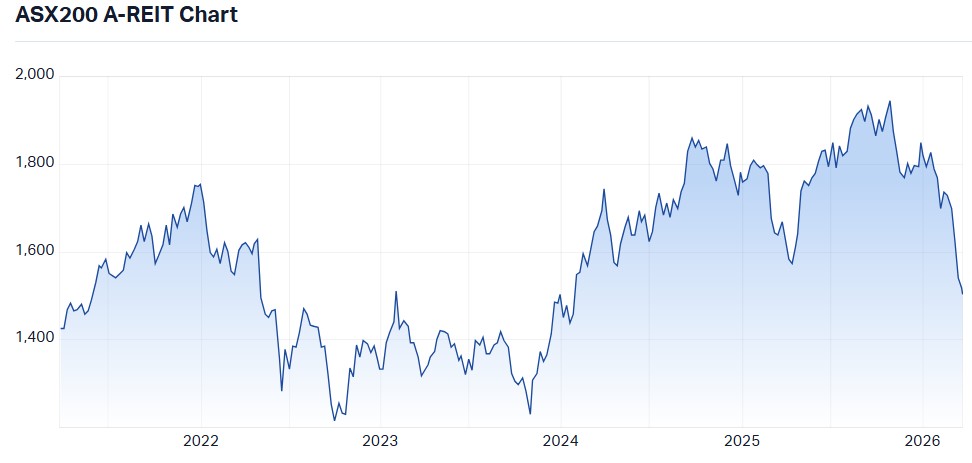
- Australian real estate stocks have shed 15% year-to-date, while the ASX200 is roughly flat, as rising bond yields, RBA rate hikes and the Middle East conflict combine to create the most challenging macro environment for the sector since 2022.
- Further pain for the sector may be on the way, as markets are pricing even more interest rate hikes ahead.
- This article breaks down what two of the world's leading investment banks are saying about the sell-off, where they see risks, and which ASX real estate stocks they think are worth owning right now.
Just as the real estate sector was finding its footing post pandemic, the ground has shifted again. The Middle East conflict has sent oil prices surging and inflation expectations with them. The problem for real estate stocks is this: its exactly the kind of external shock that forces central banks to act even when the domestic economy is already feeling the strain. Interest rates — both official and market — are rising, and that’s bad news for the sector.
The S&P/ASX 200 Real Estate Investment Trust Index (XPJ) has delivered a total return of -15% year-to-date against a one percent decline for the benchmark S&P/ASX 200 (XJO). The question now is whether the worst is already priced in — or whether this sell-off has further to run?
Two of the world's leading investment banks have just released detailed research reports on the ASX real estate investment trust “REITs” sector, and each as a nuanced view of where it’s headed next. This article will summarise what they're are saying about the recent REITs sell-off, where they see risks, and which REITs they think are worth owning right now.
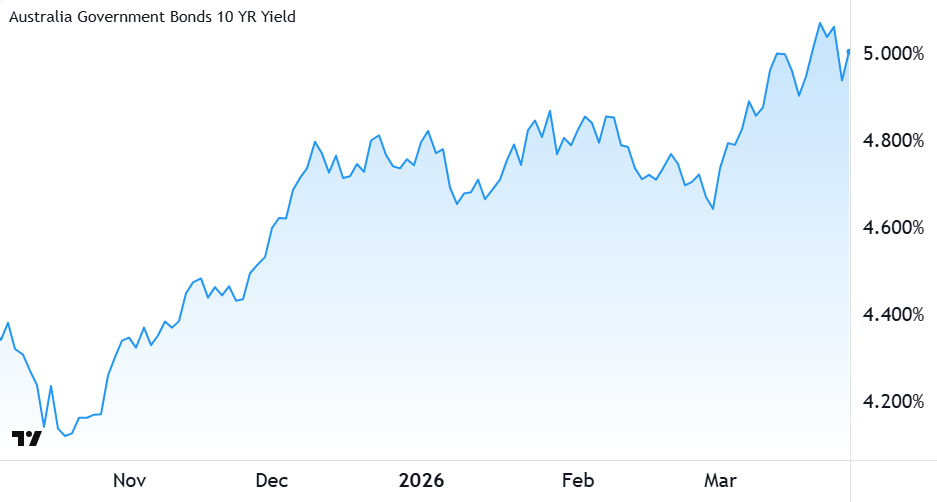
Australian 10-year Government Bond (Source: Trading View)
Why the ASX real estate sector is under pressure
To understand why rising interest rates hit property stocks so hard, let’s start with the alternatives. Arguably, REITs major competitor for investors' capital is the bond market, particularly benchmark government bonds.
REITs are often described as “bond proxies” because, like bonds, they're primarily owned for their income rather than capital growth. That makes them direct competitors in portfolios. If investors can earn more from “risk-free” government bonds, the additional return required for taking on REIT risks like debt servicing, vacancies, and property valuations — must increase.
Consider that the 10-year Australian government bond yield has risen from around 4.6% in January to over 5% earlier this week. The gap between risk-free bonds and the ASX REIT sector’s typical yield of around 5–6% has narrowed sharply, weakening the case for owning them.
As the gap between risk-free bond yields and REIT yields compresses, REIT prices must adjust to restore it. This repricing tends to hit REITs in two key ways:
Competition with risk free bonds — as bond yields rise, investors rotate out of REITs and into safer income assets.
Valuation pressure on REIT assets — higher bond yields lift the required return on property assets. Because rental income doesn’t adjust instantly, the only way for yields to rise is for property values to fall.
Australian 10-Year Government Bond yield 26 March 2026
What the big brokers say about ASX REITs
Before the Middle East crisis sharpened the interest rate outlook, the earnings picture for REITs was holding up better than their share prices implied. In a recent research note on the sector, Macquarie found that December 2025 half results beat consensus by 1.8% on average, with every Australian REIT reaffirming or lifting FY26 guidance.
The results moved Macquarie's FY26 earnings forecasts up by just 0.2% on average, however, because the broker conceded that "A solid reporting season could not offset the change in rate outlook".
In a separate note on the sector, rival investment bank UBS downgraded its FY27/28 earnings per share (EPS) estimates by 3% to 4% on average across the 23 ASX-listed REITs it covers. Price targets were cut 7% on average from previous estimates — though even after those cuts, revised valuations still implied 14% upside to 17 March closing prices, or 9% excluding Goodman Group (GMG).
The revisions reflected four key changes:
A peak cash rate assumption lifted to 4.6% by August 2026 from a prior 4.1%.
A revised long-term neutral cash rate of 4.1%.
A risk-free rate increased 50 basis points to 4.50%.
Near-term inflation forecasts lifted in line with UBS Economics' latest projections.
The sector's three-year EPS compound annual growth rate (“EPS CAGR”), the rate at which earnings are expected to grow annually, now sits at 4.1%, down from 5.3% at the start of 2026. That's a meaningful step-down in expectations in less than three months. Despite the pressure, UBS argues the ASX REIT sector looks broadly undervalued, trading at 15 times earnings and a 9% discount to the underlying value of their assets (ex-GMG).
On sector balance sheets, UBS is cautiously reassuring. Even if official interest rates where to rise a further 0.75% beyond current assumptions, sector interest coverage — the buffer between earnings and the interest bill — holds at 3.0 times in FY27 and 2.9 times in FY28. In other words, for every dollar of interest owed, the sector is still generating roughly three dollars of earnings to cover it — that's considered a healthy buffer.
Where the brokers see value in ASX REITs now
Arguably, the major problem for ASX REITs is that the gap between their yield and the yield on benchmark Australian government bonds has narrowed to the point where the risk premium has all but disappeared. UBS argues that if rental income growth comes in stronger than expected, it could restore that gap and put a floor under valuations.
UBS’s most preferred ASX REITs:
Vicinity Centres (VCX)
Charter Hall Group (CHC)
Goodman Group (GMG)
Arena REIT (ARF)
Region Group (RGN)
Centuria Industrial REIT (CIP)
Macquarie's preferences skew toward quality and growth at a reasonable price ("GARP"). Among large caps, the broker favours GMG, Mirvac (MGR) and Charter Hall (CHC) — names it sees as best placed to compound earnings through the volatility. Among smaller names, Macquarie noted that Qualitas (QAL) and Arena REIT (ARF) stand out, with implied total returns over one year of 47% and 26% respectively.
Macquarie's most preferred ASX REITs:
Goodman Group (GMG)
Charter Hall Group (CHC)
Mirvac Group (MGR)
Qualitas (QAL)
Arena REIT (ARF)
Dexus Industria REIT (DXI)
It’s worth noting that GMG and CHC appear on both UBS and Macquarie’s preferred lists — the closest thing to a consensus buy in the current environment.
The value is there — if earnings growth holds up
If inflation pressures ease, the RBA may yet avoid the further hikes markets are currently pricing. But right now, borrowing costs are indeed rising, and the energy shock that triggered this latest leg of the sell-off in REITs shows no sign of resolving.
The brokers are not running for the exits. They are making very careful distinctions between the REITs that can weather coming storm and those that cannot. For investors with exposure to ASX-listed real estate through direct holdings, managed funds, or superannuation, understanding which side of that line your portfolio sits on is what ultimately matters.