ASX lithium crash: PLS, LTR, MIN face third bear market in a decade
The ASX lithium faithful are staring down their third bear market in under a decade. We unpack the latest developments and price forecasts.

Source: ChatGPT
Mentioned
KEY POINTS
- In just 11 months, the price many ASX lithium producers earned for their production increased over 400%, but it has since halved since the May peak – it’s the commodity price cycle on fast-forward!
- Rumours about CATL battery production cuts sparked a 12% one-day plunge on 12 October, but the chart shows the trend turned months earlier on doubts over storage demand, Beijing policy changes, and a growing supply response.
- With demand still forecast to grow strongly, we investigate the latest supply swing factors, why the GFEX futures market matters more than lithium bulls admit, and where two major research houses see the market balance and prices heading.
Lithium investors have seen this film before. The 2016–18 boom ended in a bust that ran into 2020, and the 2021–22 boom gave way to a withering two-year bear market that only bottomed in mid-2025. Now the 2025–26 recovery has handed back more than half its gains in five months.
The benchmark lithium carbonate contract on China's Guangzhou Futures Exchange (GFEX) closed at RMB94,180/t yesterday, 55% below its 13 May high of RMB210,580/t. Australian spot spodumene concentrate (SC6) is at US$1,540/t, down 48% from its US$2,945/t peak. Talk of battery production cuts at CATL, the world's biggest battery maker, triggered the latest leg down – but it didn't start the latest downtrend.
In this article, I work through lithium’s demand and supply factors, the growing influence of GFEX, and the latest broker forecasts. The common thread: in lithium, price is the best guide to the fundamentals.
Demand: the trend turned long before CATL
Unverified chatter this month was the spark, but the market had been losing faith in the 2026 demand story for months.
The chatter trigger: GFEX carbonate fell 11.8% to RMB104,740/t on 12 October on market chatter CATL had cut its October production plan by about 10%, with similar cuts reported along the supply chain.
Chatter evolved into data that mattered: A week later, Citi, citing consultancy ZE Consulting, said that the top five battery makers’ October production schedule rose just 1% on September, against roughly 7% expected. Next, CATL’s shares fell 12% on 21 October after a weaker-than-expected Q3 result, and carbonate fell 5.4% the same day. CATL didn’t confirm an official production cut, spinning that 2027 demand “may be less pessimistic than the market expects”.
Storage assumptions under question: Battery energy storage systems (BESS) have been the engine of 2026 demand upgrades – and very likely a major driving force behind the latter part of the 2025-26 lithium price rally. Beijing's anti-involution campaign reached BESS in mid-May, when Beijing quietly froze approvals for new battery capacity – a freeze that only became public in September. Separately, but also important, China’s 6% export VAT rebate on storage batteries is set to expire at year end. The experts are divided on near term impacts of BESS-related market factors, with Macquarie noting concern is building that cell makers cut production further in November and December, while Canaccord has lifted its 2026 demand forecast 14% to 1.8Mt lithium carbonate equivalent (LCE) primarily on BESS.
China sets the price: One thing is for sure, China is the dominant producer and consumer of lithium, with Canaccord putting China’s share of the global lithium-ion battery market at about 80%. If Beijing's aim is to stop a race to the bottom in storage batteries, anyone who pencilled in BESS as the engine of a bottom-left-top-right demand chart to 2035 must think again.
EVs are a mixed bag: Macquarie's macro strategy team says global EV sales rose 3% in the first nine months of 2026, with US and Chinese sales down 30% and 13% respectively, while Europe rose 30% and the rest of the world 80%. It expects full-year growth of about 5% – the slowest in a decade.
The EU hybrid cap is more headline than risk: The EU has agreed with Beijing to roughly halve imports of Chinese hybrid vehicles under a four-year quota, with the cap expected to apply from next year. To put this into perspective, Canaccord estimates EU plug-in hybrid sales account for less than 2% of total lithium demand over 2026–35.
Demand isn't the problem: Canaccord forecasts demand growth of 29% in 2026 and 16% in 2027, with demand more than doubling to 3.9Mt LCE by 2035.
Supply: the swing factor
Lithium bulls often forget demand is only half the price equation – supply has typically decided where the cycle turns.
Supply responds to price: Lithium's last two busts were supply stories – waves of new tonnes arriving in markets priced for scarcity. The August 2025 to May 2026 rally has triggered the same response: in Australia, Mineral Resources’ (MIN) Bald Hill and Core Lithium’s (CXO) Finniss are coming back online, while MIN and Ganfeng have approved an expansion of their 50:50 Mt Marion joint venture. In China, CATL secured a safety permit for its Jianxiawo lepidolite mine in late June – though local authorities said in August it had yet to resume operations.
The supply wave is big: Canaccord now forecasts mine supply growth of about 1.35Mt LCE to 2030, up 80% on 2026, led by local expansions, Chinese and African hard rock, and brines.
But it's at risk: Canaccord considers its own supply forecasts optimistic, noting Jianxiawo's environmental approval was revoked in September, Zimbabwe (about 10% of modelled mined supply) moves to ban concentrate exports from January 2027 under company-specific quotas, and the fact that new lithium projects have run about four years late on average. If only 70% of forecast Chinese supply arrives, the 2030 deficit almost doubles to about 326kt LCE, Canaccord says.
The cost curve is the next line of defence: Macquarie flagged GFEX approaching the upper end of its cost curve near RMB105,000/t, and sees the next support at about RMB80,000/t, where a cluster of higher-cost producers making up about 10% of global supply would come under increasing pressure.
GFEX: sideshow or price-setter?
Many lithium bulls dismiss GFEX as a speculators’ sideshow. The exchange has spent the year trying to tame its lithium carbonate contract. It has raised margins, widened daily price limits and capped daily new positions for non-hedging accounts, most recently at 800 lots per contract from 22 September. It also opened the contract to overseas traders mid-year.
Despite the curbs, open interest on the benchmark January 2027 contract rose from 412,703 lots on 30 September to 429,039 lots on 12 October as the price fell. One interpretation is that new short sellers were driving the decline, rather than it being a simple flush-out of longs. Canaccord acknowledges high volatility in GFEX lithium contracts from speculative trading but notes the exchange’s prices have become increasingly relevant for equity investors, despite only a small share of contracts ending in physical delivery.
The broker also gives an example of how easily the contract is moved by headlines that don’t shift a tonne of physical supply or demand. Reports on Jianxiawo’s restart have repeatedly swung the price, and when the consultancy SMM widened its inventory survey “visible” inventories jumped from about 75kt to 175kt LCE. Futures sold off, even though it’s doubtful much of the material can be used in batteries* – the contract fell 8.5% in the two sessions that followed.
Speculators may exaggerate the moves, but they trade alongside producers and battery makers hedging their physical exposure. GFEX futures have become a useful measure of market sentiment – and that sentiment seems to correlate strongly with the prices of ASX lithium producers. Consider that the correlation coefficient between the benchmark GFEX lithium carbonate contract and daily PLS Group (PLS) closing prices over the last 18 months is 0.95 (a coefficient of 1.0 indicates a perfect positive correlation).
Market balance and price forecasts
If futures are pricing next year rather than today, the question is what next year looks like. Macquarie’s data shows lithium carbonate inventories kept falling through September regardless of the SMM survey change, and it argues futures are pricing uncertainty about 2027 demand rather than today’s tight physical market.
Canaccord sees a softer near-term price cycle but has left its long-term view intact. Its 2026 deficit forecast is largely unchanged, but it expects smaller deficits in 2027–29 as higher prices draw out more supply, before meaningful deficits of 3–6% return from 2030 to 2035. It forecasts spodumene (SC6) at US$2,000/t in the December quarter and US$1,820/t in 2027, with a long-term price of US$1,800/t. Its China battery-grade carbonate forecasts are US$19,450/t and US$19,000/t, with a long-term price of US$23,500/t.
To put Canaccord’s forecasts into perspective, at US$ 1,540/t, SC6 is currently 15.5% below the 2027 spodumene forecast and 14.5% below the long-term price. GFEX carbonate at RMB94,180/t converts to about US$14,230/t, about 25.1% below the 2027 carbonate forecast.
ASX lithium stocks under pressure
The table below shows how the major ASX lithium stocks have tracked the lithium price over the past one, three and 12 months. Only takeover target Global Lithium Resources (GL1) is showing a gain since the May commodity price peak, with only it, CXO, MIN and PLS still holding onto 12-month gains.
ASX Lithium Company | Last Price | 1-month Chg % | 3-month Chg % | 1-year Chg % |
|---|---|---|---|---|
Core Lithium (CXO) | $0.210 | -50% | -18% | +68% |
Elevra Lithium (ELV) | $3.75 | -41% | -53% | -13% |
Global Lithium (GL1) | $0.94 | -8% | +88% | +100% |
IGO (IGO) | $5.15 | -26% | -24% | -2% |
Liontown (LTR) | $0.690 | -34% | -44% | -36% |
Mineral Resources (MIN) | $44.25 | -19% | -19% | +5% |
PLS Group (PLS) | $2.85 | -32% | -33% | +1% |
Vulcan Energy (VUL) | $1.095 | -50% | -59% | -80% |
Wildcat Resources (WC8) | $0.215 | -33% | -39% | -4% |
ASX lithium stocks performance over the past one, three and 12 months. Source: Norgate Data as at close 22 October.
Conclusion: (as always) watch the price
In lithium, the price is the best real-time read on the fundamentals – and right now it says the market expects more supply in 2027 than it can absorb. Bulls need a supply undershoot for lithium to mount a sustained recovery. If one doesn't arrive, the current price regime may become entrenched.
If you’ve been reading my reports on this market (and any other market) for any length of time, you know my view: price tells the story best. The bull market came into question as early as June, just weeks after the May peak, and by September, a new bear market had begun. Present lithium price trends leave me with a very cautious view of the lithium market and of ASX-listed lithium stocks.
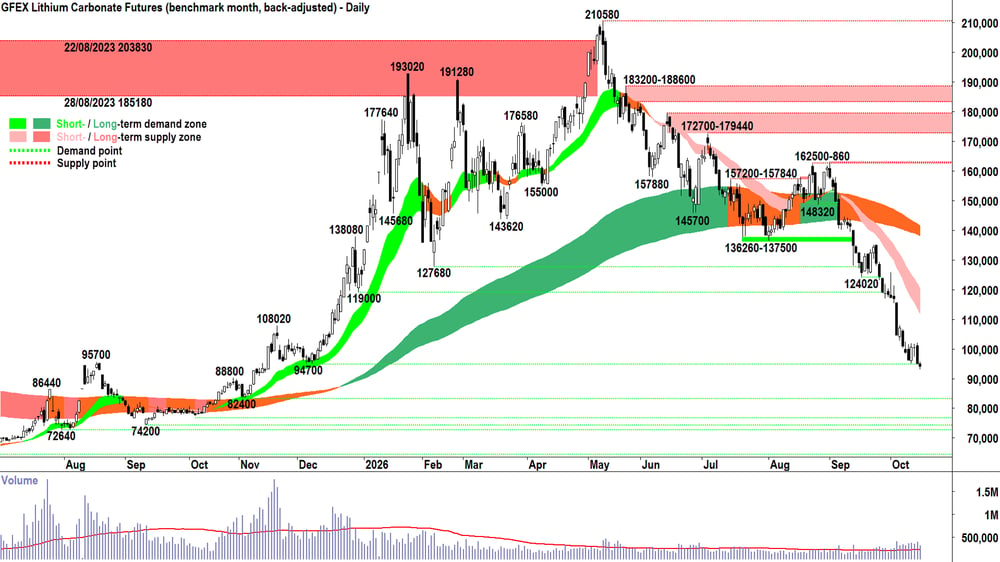
Lithium Carbonate Futures (Benchmark month, back-adjusted) GFEX. Source: SMM and author's own data
📺 WATCH: ChartWatch calls the top in lithium prices (June 3, 2026)
📺 WATCH: ChartWatch calls start of a new bear market in lithium prices (September 10, 2026)
Most lithium stocks have been constituents of my ChartWatch ASX Scans Downtrends lists for over a month now as per the table below. You can check my technical analysis updates on the entire ASX each day here.
ASX Lithium Company | 1st 📉 Appearance Date | 1st 📉 Appearance Price | Chg % since 1st 📉 Appearance |
|---|---|---|---|
Core Lithium (CXO) | 19/10/2026 | $0.20 | +5% |
Elevra Lithium (ELV) | 16/07/2026 | $8.82 | -57% |
Global Lithium (GL1) | has not appeared | n/a | n/a |
IGO (IGO) | 14/09/2026 | $7.32 | -30% |
Liontown (LTR) | 26/06/2026 | $1.66 | -58% |
Mineral Resources (MIN) | 14/09/2026 | $56.76 | -22% |
PLS Group (PLS) | 14/09/2026 | $4.41 | -35% |
Vulcan Energy (VUL) | 20/05/2026 | $3.36 | -67% |
Wildcat Resources (WC8) | 15/09/2026 | $0.335 | -36% |
ChartWatch ASX Scans vs ASX lithium stocks. A Downtrends 📉 list appearance implies a higher probability the price of the stock in question will fall than rise. Source: Market Index
If you’re not a fan of technical analysis, then these are the key pressure points to watch going forward:
Jianxiawo: Canaccord considers the potential restart of CATL's Jianxiawo operations – about 110ktpa LCE, or 6% of its estimated 2026 market falling to 4% in 2027 – a key driver of volatility. Yichun's environmental authority reopened public comment on the mine's environmental impact assessment from 8 to 20 October.
The October storage battery order book: Macquarie says this is the key data point to watch, with the 6% export VAT rebate on storage batteries due to expire at year end.
Zimbabwe: The concentrate export ban takes effect from January 2027. Quota detail will determine how much supply actually leaves the country.
Key levels: Macquarie's next cost-curve support at about RMB80,000/t, then the June 2025 low of RMB64,320/t.
* SMM widened its inventory survey to include non-conventional sources such as bauxite residue and aluminium smelter slag.
References: Broker research from Canaccord Genuity’s lithium supply-demand update and Macquarie Research’s lithium market update, together with Macquarie Macro Strategy’s Global EV Update (not a Macquarie Research product). Citi’s battery production schedule estimates (citing ZE Consulting), CATL’s response to market concerns, GFEX rule changes and open interest, and Jianxiawo permit and environmental assessment details are drawn from Chinese financial media reporting, with the Yifeng County ecology bureau’s August statement on Jianxiawo reported by Gasgoo. GFEX benchmark lithium carbonate futures contract and Australian spot spodumene concentrate assessments from SMM.