ASX 200 September rebalance: Joining the ASX 200 used to be good news, since 2022 it hasn't been
Five companies join the ASX 200 this month, the evidence that being added is good for a share price has weakened since 2022.

Source: Chat GPT
Mentioned
KEY POINTS
- Five companies join the S&P/ASX 200 on 21 September and five leave, triggering an estimated $668 million of forced buying and selling by index funds, according to Morgan Stanley
- Research found additions returned 4.5% on average into implementation since 2007, beating the market by 5.0%, but that pattern inverted from March 2022.
- Last quarter's five additions all fell after implementation, by 28.8% on average against a market down 0.4%.
The S&P/ASX 200 rebalances every quarter, and the interesting part isn't who's in and out. It's the forced buying and selling that lands around rebalance day, when index funds and market participants transact, regardless of price.
For the September quarter, five companies left the index and five higher-ranked ones took their place.
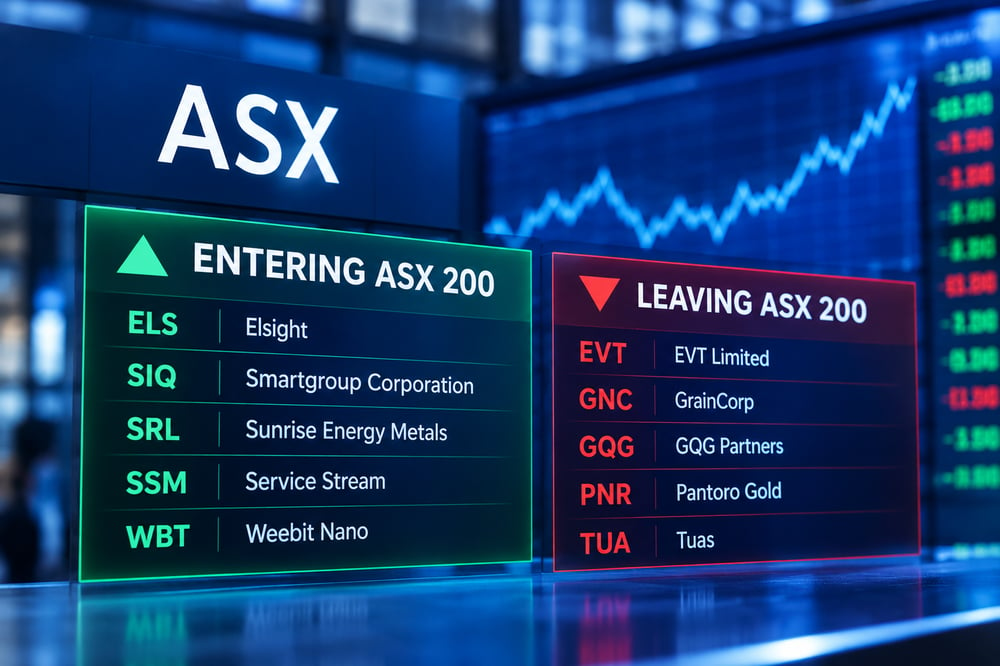
Additions: Elsight (ELS), Smartgroup Corporation (SIQ), Sunrise Energy Metals (SRL), Service Stream (SSM), Weebit Nano (WBT)
Removals: EVT Limited (EVT), GrainCorp (GNC), GQG Partners (GQG), Pantoro Gold (PNR), Tuas (TUA)
Index funds tracking the ASX 200 have to hold what the index holds, so an addition gets bought and a deletion gets sold, price be damned. Most of that flow lands in a single closing auction on the effective date, which is why volume on rebalance day can run several times the norm.
Active managers and arbitrageurs position ahead of the announcement, so a chunk of the move is already in the stock by the time S&P confirms it. What follows is often a partial unwind once the index funds have finished buying. This article examines research which collates historic price moves, looks at how last quarter's additions and removals fared, and unpicks the eligibility criteria for making it onto Australia's benchmark S&P/ASX 200.
S&P/ASX eligibility criteria
Firstly, it may be obvious, but to become eligible to be tracked by an S&P/ASX index, a company must have already been accepted to list on the ASX. The ASX runs the exchange and sets the rules companies must follow to list and stay listed, while S&P Dow Jones Indices sorts those listed companies by size and tradability so investors can see how they compare to the rest of the market.
The key criteria to join an S&P/ASX index are:
Size is measured as float-adjusted market capitalisation, which is the share price multiplied by shares on issue, multiplied by the proportion of those shares actually available to investors. That last proportion is the investable weight factor (IWF), and a company needs at least 15% of its shares freely tradable to be eligible at all. The figure is averaged over three months, so a single strong or weak month moves a company's rank very little.
Liquidity is measured against the rest of the market, with a company's median daily value traded divided by its average float-adjusted market capitalisation and then compared with the same figure market-wide. For the ASX 200 the result has to be at least 50%. Fail it and the company drops out of the size rankings altogether, however large it is.
Every eligible company is then ranked by float-adjusted market capitalisation, and buffers decide who moves. A company outside the index must rank 179 or higher to be added, and a company inside it is not removed until it ranks 221 or lower. The 40-place gap between the two thresholds means a company can slip out of the top 200 and stay in the index, which keeps turnover down and spares index funds the cost of trading a stock in and out each quarter.
Deletion usually is what it looks like. But rank is relative, so a company can hold its ground and still be outgrown, and because index weight is float-adjusted, a reclassified stake or demerger can push a name out while the business carries on unchanged.
The knock on effect: index fund reset
An index fund exists to match the index it tracks, so when the constituents change, the fund has no choice but to buy those five arrivals, and sell the five departures. The trading is done on the last day the old index applies, which will be at the close on Friday 18 September this time round.
Ahead of the September announcement, Morgan Stanley strategist Antony Conte estimated the rebalance would generate around $2.5 billion of gross trading across the S&P/ASX indices, with the ASX 200 additions and removals accounting for roughly $668 million. That estimate was based on his forecast of six changes each way rather than the five S&P confirmed.
How share prices move around a rebalance
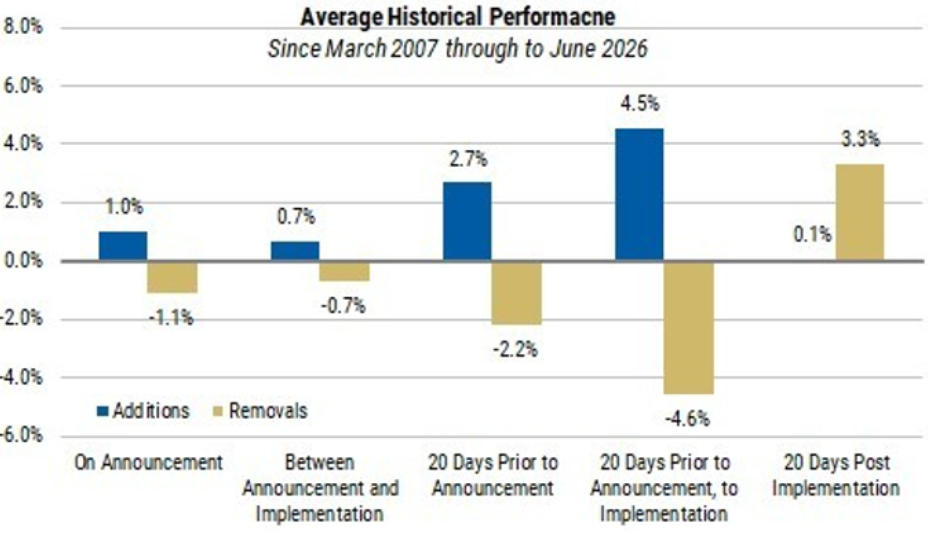
Looking at every ASX 200 rebalance from March 2007 to June 2026, Conte found the additions returned 4.5% on average from 20 days before the announcement to implementation, against an ASX 200 that fell 0.4%. The removals fell 4.6% over the same window.
He also found that buying the additions and shorting the removals in the same time period returned 9.1% and worked in 72% of the 72 rebalances measured.
Source: Morgan Stanley
However, the additions flatlined in the 20 days after implementation, returning an average of just 0.1% against the ASX 200 that was up 1.2%. Interestingly, the removed companies bounced 3.3% in the same window.
Conte also broke the 19 years into three periods, which points to a turning point in 2022.
Additions climbed steadily through the announcement window between March 2007 and December 2019
Again through 2020 and 2021
From March 2022 the pattern inverts, with additions tracking the market into the announcement and falling below it afterwards, while removals end up ahead
Taken as a whole, the evidence suggests buying companies added to the S&P/ASX 200 ahead of implementation would garner returns, but since 2022 that has turned on its head.
June quarterly share price movements
The windows below are for the June 2026 rebalance, which was announced on 5 June and implemented at the close on 19 June, and run 20 sessions either side of that date.
The June quarter largely followed the post-2022 pattern. The additions tracked the ASX 200 into the announcement and fell well below it after implementation, as Conte's post-2022 period found. The removals were the exception, beating the market between announcement and implementation but finishing behind it afterwards, where Conte's analysis has them ending up ahead.
Additions | 8 May – 4 Jun | 5 Jun – 19 Jun | 19 Jun – 17 Jul |
|---|---|---|---|
Elevra Lithium (ELV) | -14.4% | 7.4% | -29.4% |
Electro Optic Systems (EOS) | 20.8% | -2.8% | -34.1% |
FireFly Metals (FFM) | 8.1% | -4.5% | -12.4% |
Kingsgate Consolidated (KCN) | -23.6% | 11.8% | -30% |
Minerals 260 (MI6) | 7.5% | 20% | -38.2% |
Average | -0.3% | 6.4% | -28.8% |
ASX 200 (XJO) | -0.7% | 2.4% | -0.4% |
Removals | 8 May – 4 Jun | 5 Jun – 19 Jun | 19 Jun – 17 Jul |
|---|---|---|---|
Guzman y Gomez (GYG) | 2.5% | 0.8% | 13.9% |
IDP Education (IEL) | -27.2% | 28.3% | -14.1% |
SiteMinder (SDR) | 23.1% | 5.2% | -14.6% |
Temple & Webster (TPW) | -19.9% | 21.7% | -9% |
WEB Travel Group (WEB) | -12.4% | 26.5% | -18.9% |
Average | -6.1% | 16.5% | -8.5% |
ASX 200 (XJO) | -0.7% | 2.4% | -0.4% |
Four of the five additions were resources companies and the fifth was a defence electronics maker. Metals and mining stocks fell 9.8% over the same period, which accounts for part of the decline but not all of it.
Conclusion
The pre-2022 research reads logically enough: a company grows, joins a bigger index, and the share price keeps rising. Since 2022 that has reversed, with removals outperforming both the market and the additions.
The additions' fall after implementation is harder to dismiss, holding across all five stocks and running well beyond the mining sector's decline over the same period. What holds is that the pattern before 2022 no longer describes what happens now, and that an addition to the index is not on its own a reason to buy.