ASX 200 Live Today - Wednesday, 18th March
The S&P/ASX 200 is set to edge higher after a relatively uneventful overnight session. Here are today's top stories.

Today’s ASX 200 Updates
Welcome to our live ASX coverage for Wednesday, March 18. Expect a high volume of posts pre-market and more periodic updates throughout the day. We'll be wrapping the blog up around 2:00 pm AEST. Let us know how we can make it even better.
ASX 200 higher as Tech, Utilities and Real Estate stocks bounce
[2:20 pm] ASX 200 showing some signs of strength, up 0.32% despite trading around breakeven earlier on. Quite a few rate-sensitive sectors are bouncing from lows, including:
Tech (XIJ) up 1.98% after falling 9.6% in the last six sessions
Utilities (XUJ) on a four day winning streak, but experienced a ~5.2% pullback between 20-Feb and 12-Mar. This is despite its largest constituents (ORG and AGL) reporting stronger-than-expected 1H26 earnings in February
Real Estate (XRE) up 1.1%, on track to close higher for a second straight session. Before that, the sector has been trending sharply lower, down 17% since 23-Dec-25
The Aussie 10-year yield slipped after the RBA hike, down ~5 bps to 4.90% and oil prices are trading lower on Wednesday, with Brent down 1.6% to US$101.7 a barrel. We continue to see this dynamic of higher yields and oil prices driving stocks down (and vice versa), though the index as a whole, has been relatively resilient.
Some of the data we noted earlier this morning further reinforce this resilience, including:
The economic impact of the oil shock may be more muted than historical episodes. At US$100 a barrel, oil represents just 1.4% of OPEX (similar to 1997 when oil was $20), a US$900 per household drag equating to 4% of disposable income, well below the 6% seen during Russia-Ukraine and 11% during the Arab Spring.
Positioning dynamics are providing a technical cushion. Goldman Sachs noted systematic funds have sold around US$80bn in global equities over the past month, with asset managers offloading a record US$36.2bn of S&P 500 in the week ending 10 March.
Short exposure in macro products is now at its highest since September 2022, suggesting room for a squeeze
As well as the very strong February ASX reporting season and still-elevated commodity prices. That's all for today. Let's see if markets can continue to stabilise.
China aluminium glut flashes warning sign
[1:31 pm] Record-high aluminium prices triggered by the Iran conflict are suppressing Chinese fabricator demand and driving inventory accumulation, setting up a wave of exports that could cap further price gains.
Shanghai Metal Market data shows primary aluminium stockpiles have surpassed 1.3 million tons, the highest since 2020, as Chinese fabricators slow purchases to hand-to-mouth levels in response to elevated prices.
London aluminium prices have gained 28% over the past 12 months but Shanghai prices are up only 20%, widening the export arbitrage window and incentivising China to redirect surplus metal offshore.
China's exports of unwrought aluminium and products had already surged 13% in the first two months of 2026 before the latest price spike, with further export acceleration likely given the shortfall in Middle Eastern supplies following Iran-related shutdowns.
Semi-finished product inventories sit around 600,000 tons, approximately 75% of last year's levels, indicating the demand weakness is rippling through the domestic supply chain beyond just primary metal.
The aluminium demand softness is a potential leading indicator for China's broader industrial economy, which rebounded in the first two months of the year but now faces headwinds from higher energy costs and Middle East conflict disruptions.
Source: Bloomberg
Travel stocks higher on positive demand outlook
[12:38 pm] Travel stocks trading higher following a positive read through from US peers such as Delta and American Airlines, both of which upgraded their revenue guidance due to increased demand as the Iran conflict increases fears around higher jet fuel prices. Delta closed up 6%, while American Airlines closed up 3% overnight.
Ticker | Company | % Chg | Price |
|---|---|---|---|
WEB | Web Travel Group | 6.60% | $2.83 |
AIZ | Air New Zealand | 2.78% | $0.37 |
FLT | Flight Centre Travel Group | 2.48% | $11.76 |
QAN | Qantas Airways | 2.09% | $8.78 |
HLO | Helloworld Travel | 0.34% | $1.47 |
CTD | Corporate Travel Management | -0.06% | $16.07 |
AIA | Auckland International Airport | -0.43% | $6.87 |
By Stephanie Gardner
Uranium stocks broadly higher
[12:27 pm] Uranium stocks are broadly higher, although uranium prices continue to sit around US$88 per pound, having traded in a narrow range since its pullback from January highs. The Energy Index is also trading broadly higher today, up 1.07%.
Ticker | Company | % Chg | Price |
|---|---|---|---|
AEE | Aura Energy | 8.33% | $0.13 |
DEV | Devex Resources | 8.11% | $0.20 |
PDN | Paladin Energy | 2.89% | $11.58 |
BOE | Boss Energy | 2.81% | $1.65 |
NXG | Nexgen Energy | 2.59% | $17.04 |
PEN | Peninsula Energy | 2.59% | $0.60 |
EL8 | Elevate Uranium | 2.41% | $0.30 |
BMN | Bannerman Energy | 2.20% | $3.72 |
LOT | Lotus Resources | 1.71% | $1.49 |
DYL | Deep Yellow | 0.58% | $1.73 |
AGE | Alligator Energy | 0.00% | $0.04 |
T92 | Terra Critical Minerals | -3.19% | $0.09 |
By Stephanie Gardner
Energy stocks broadly higher
[12:12 pm] The Energy Index is up 1.07% today, trading at the highest level since April 2024.
Ticker | Company | % Chg | Price |
|---|---|---|---|
NHC | New Hope Corporation | 6.85% | $5.30 |
VEA | Viva Energy Group | 3.20% | $2.10 |
BPT | Beach Energy | 3.07% | $1.24 |
PDN | Paladin Energy | 2.84% | $11.57 |
NXG | Nexgen Energy | 2.53% | $17.03 |
ALD | Ampol | 2.40% | $31.53 |
DYL | Deep Yellow | 1.28% | $1.74 |
STO | Santos | 0.97% | $7.79 |
WDS | Woodside Energy Group | 0.73% | $31.65 |
WHC | Whitehaven Coal | 0.40% | $8.73 |
YAL | Yancoal Australia | -0.73% | $7.52 |
By Stephanie Gardner
Top ASX 200 gainers and losers
[12:06 pm] Here are today's top gainers and losers on the S&P/ASX 200.
Ticker | Company | % Chg | Price |
|---|---|---|---|
SGM | Sims | 10.10% | $20.72 |
TLX | Telix Pharmaceuticals | 8.03% | $12.64 |
NHC | New Hope Corporation | 6.05% | $5.26 |
EOS | Electro Optic Systems | 5.51% | $9.39 |
DRO | Droneshield | 4.48% | $4.20 |
VNT | Ventia Services Group | 3.29% | $5.65 |
PMV | Premier Investments | 3.26% | $12.67 |
MSB | Mesoblast | 2.97% | $2.08 |
BPT | Beach Energy | 2.90% | $1.24 |
ASB | Austal | 2.84% | $4.90 |
Ticker | Company | % Chg | Price |
|---|---|---|---|
IPX | Iperionx | -5.65% | $4.01 |
AUB | Aub Group | -3.11% | $23.09 |
RMS | Ramelius Resources | -3.06% | $3.97 |
GMD | Genesis Minerals | -2.98% | $6.03 |
WGX | Westgold Resources | -2.96% | $6.06 |
PRU | Perseus Mining | -2.59% | $5.09 |
PME | Pro Medicus | -2.58% | $124.81 |
CMM | Capricorn Metals | -2.13% | $11.48 |
PLS | Pls Group | -2.03% | $4.58 |
ANZ | Anz Group | -2.00% | $36.78 |
By Stephanie Gardner
ASX 200 breadth check
[11:44 am] The ASX 200 is down around 6.3% from its 2 March record high but how are things under the hood? Not so well.
87% of the ASX 200 are more than 10% off their highs, 58% are more than 20% off, and 11% are more than 50% off
Tech is the most beaten-up sector, where every single member is >10% off, and over half are >50% off their highs
Energy is holding up best, with only half of members >10% off and none >50% off
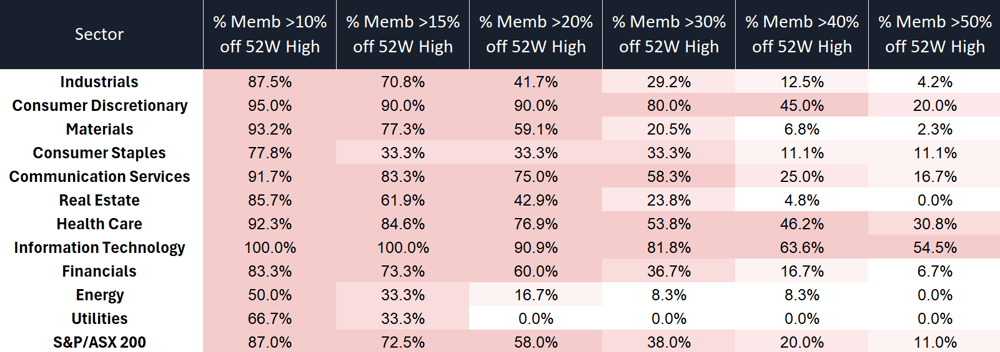
Source: Author's own calculations
Japan's February exports slow sharply but beat expectations
[11:25 am] Japan's export growth decelerated markedly from January's multi-year high, with weakness to China and the US being offset by strong gains to Hong Kong, Europe and Southeast Asia.
Exports rose 4.2% year on year in February, well below January's 16.8% surge but ahead of the 1.6% Reuters consensus estimate, suggesting underlying demand holds up despite deteriorating conditions with key partners.
Shipments to mainland China fell 10.9% and exports to the US dropped 8%, with further weakness to the US likely after Washington launched Section 301 investigations that could lead to tariff reimposition following the Supreme Court's striking down of Trump's reciprocal tariffs in February.
Southeast Asian nations collectively surpassed mainland China to become Japan's second-largest export destination in February, with shipments to the bloc up 5.1%, while Hong Kong exports spiked 32.3% and Western Europe rose 17.5%.
Imports climbed 10.2%, slightly below the 11.5% consensus estimate and a sharp reversal from January's 2.6% decline, pointing to firming domestic demand or energy import costs driven by the Iran conflict.
As narrow as it gets
[11:18 am] The ASX 200 is currently flat and trading within an extremely tight range, with session highs of 0.20% and lows of -0.14%. If the market continues to trade sideways, this will mark the narrowest trading session since 7 August, 2025.
Analysts' take on New Hope
[11:15 am] New Hope shares dipped 6.4% on Tuesday after reporting a mixed 1H26 result, where EBITDA met expectations while net profits missed due to higher tax and other items. The 10 cps interim dividend was higher than expected, while management's decision to reaffirm the full-year guidance was seen as encouraging, given prior issues at Bengalla. Here's what analysts are thinking:
Bell Potter upgraded to Hold from Sell, raised target from $4.10 to $4.50. A dividend surprise and strong balance sheet offset a below-the-line cost miss, with energy security concerns brightening the coal price outlook despite limited near-term growth.
Goldman Sachs maintained Sell, raised target from $3.10 to $3.50. Management appeared confident following operational resets and guidance was seen as achievable on stronger H2 delivery, though buyback inactivity and a cautious medium-term coal outlook kept the stance negative.
Morgans maintained Hold, left target unchanged at $5.00. A non-recurring tax effect distorted an otherwise weak headline result, but core asset quality held firm and rising coal prices supported a constructive outlook as Bengalla and New Acland are expected to improve.
ASX 200 edges higher
[10:30 am] A fairly uneventful open, with the ASX 200 currently up 0.07%. Breadth is relatively positive, with 140 constituents (70%) higher, though index gains are capped given weakness from major banks (ANZ down 1.7%).
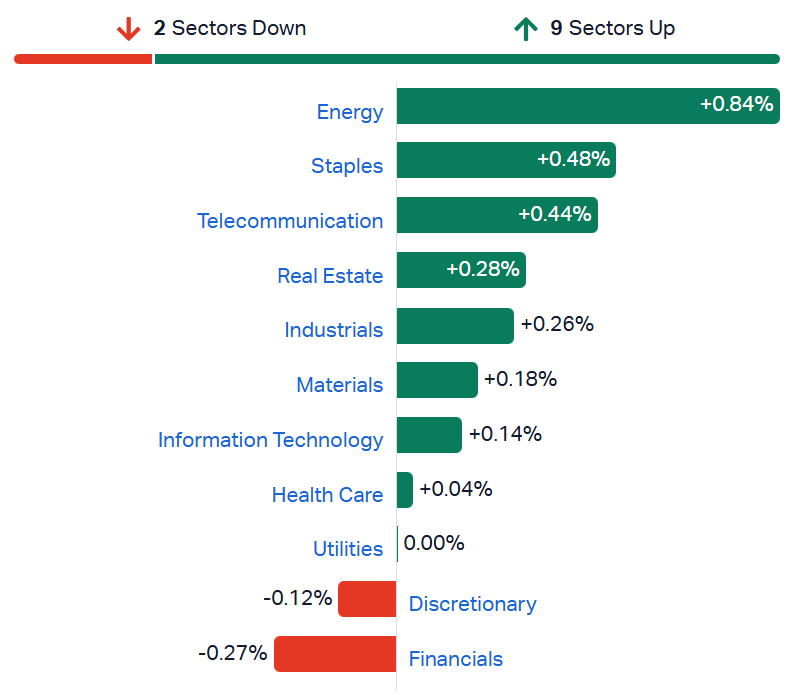
ASX 200 sectors (Source: Market Index)
Sims opens sharply higher
[10:16 am] A very, very volatile open for Sims after the company provided FY26 EBIT guidance of $350-400 million, well-above consensus expectations of $305.5 million.
The stock surged 16.8% at the open ($21.99), but gains quickly faded to just 7.1% ($20.17) within the first few minutes of trade, suggesting some over-eager orders may have inflated the match/open price. It has since recovered to sit up 9.1% at $20.55.
Macquarie's take on New Hope
[9:52 am] Macquarie upgraded New Hope to Neutral after the company's 1H26 result on Tuesday. "The market backdrop for New Hope has improved due to increased demand for seaborne thermal coal, substituting natural gas on Qatar's LNG outage. We upgrade to Neutral on a positive short term earnings backdrop, noting New Hope's thermal leverage offsets higher diesel costs," the analysts said in a note this morning.
The key takeaways include:
The interim dividend of 10 cps paid approximately 150% of underlying earnings, with the analysts suggesting this likely incorporates expected strong second half FY26 cash flows following the recovery in thermal coal pricing post the outbreak of the Israel/US-Iran conflict.
At spot prices, FY26 EPS is forecast at 25 cps, providing capacity to pay a further 10 cps final dividend and maintain a full year payout ratio of around 80%.
Diesel represents around 20% of New Hope's cost base, presenting a key risk if supplies tighten. Though management does not see a near-term threat but has engaged industry bodies to put preventive measures in place.
Woodside confirms Liz Westcott as permanent CEO
[9:33 am] Woodside has ended its CEO search by appointing its Acting CEO to the role permanently, providing leadership continuity following Meg O'Neill's departure in December 2025.
Westcott has served as Acting CEO since December 2025 and joined Woodside in 2023, initially leading Australian Operations before being appointed EVP and Chief Operating Officer Australia, overseeing the Scarborough Energy Project and Bass Strait operator transition.
She brings over 30 years of energy industry experience, including a 25-year career at ExxonMobil across Australia, the UK and Italy, and most recently served as COO at EnergyAustralia.
Company page: Woodside Energy (WDS)
A closer look at Sims
[9:26 am] Such a large FY26 guidance beat (previous post) is rather intriguing – let's take a closer look at a few recent events and data points.
1H26 result: Sims reported a stronger-than-expected 1H26 EBIT result, though statutory profit was weighed by tax and one offs. The stock dipped 4.0% on results day (17-Feb), likely due to i) shares had run ~49% since the Aug-25 result and ii) the lack of a formal second half guidance.
1H26 EBIT: Sims reported 1H26 underlying EBIT of $121.1m. Today's FY26 guidance of $350-400m (let's use the midpoint of $375m) implies a 2H26 EBIT of $254m.
UBS ests: After the 1H26 result, UBS said it expects 2H26 underlying EBIT of $177m (which is above consensus expectations of $143). Despite being more bullish than the average analyst, today's implied 2H26 EBIT guidance is still running 43% above UBS estimates.
Sims lifts FY26 earnings guidance on non-ferrous and memory chip strength
[9:19 am] Sims has issued a positive trading update driven by strong non-ferrous metals and DDR4 memory chip pricing, with guidance comfortably ahead of market expectations.
Underlying EBIT guidance of $350-400m is well above consensus of $305.5m, representing a 23% beat at the midpoint.
Sims Lifecycle Services is expected to deliver underlying EBIT of $165-185m for FY26, reflecting continued strength in DDR4 secondary market pricing and sustained hyperscaler activity
The Metal business is being supported by strong non-ferrous prices, improved US domestic ferrous prices and higher aluminium prices driving a further uplift in Zorba prices, partially offsetting ongoing elevated Chinese steel exports
A materially improved second half is expected for both the North American and South American and Recycling segments, with a strong third quarter anticipated.
The operational impact of the Middle East conflict remains relatively limited outside of shipping and fuel costs
Company page: Sims Limited (SGM)
BHP CEO Mike Henry steps down
[9:15 am] BHP CEO Mike Henry is stepping down after six and a half years in the role. The company's Americas President Brandon Craig has been named incoming CEO, effective 1 July.
Company page: BHP Group (BHP)
Markets show resilience despite oil shock as positioning and fundamentals provide support
[9:09 am] All things considered, global equity markets are holding up relatively well, with analysts citing factors like improving geopolitical dynamics, positioning tailwinds and solid corporate newsflow buoying valuations.
Potential off-ramps are emerging, with Iran allowing select vessels to transit the Strait of Hormuz, the US permitting Iranian tankers through, and the IEA flagging possible further reserve releases, easing some of the acute supply disruption fears
The economic impact of the oil shock may be more muted than historical episodes. At US$100 a barrel, oil represents just 1.4% of OPEX (similar to 1997 when oil was $20), a US$900 per household drag equating to 4% of disposable income, well below the 6% seen during Russia-Ukraine and 11% during the Arab Spring.
Positioning dynamics are providing a technical cushion. Goldman Sachs noted systematic funds have sold around US$80bn in global equities over the past month, with asset managers offloading a record US$36.2bn of S&P 500 in the week ending 10 March.
Short exposure in macro products is now at its highest since September 2022, suggesting room for a squeeze
Corporate newsflow has been positive with Nvidia GTC takeaways highlighting US$1 trillion-plus in data centre orders through 2027, Meta rallying on reports of a potential 20% workforce reduction, and Delta, American and JetBlue all raising first-quarter revenue guidance
Private credit faces rising default risk as AI disruption hits software lenders
[9:07 am] Morgan Stanley warns direct lending default rates could approach Covid-era peaks, driven by AI-related deterioration in software sector credit fundamentals.
Morgan Stanley expects direct lending default rates to reach 8%, approaching Covid peak levels, with AI disruption seen as a key catalyst as the technology erodes demand for software services and pressures borrowers' ability to service debt.
Software exposure among direct lenders is estimated at 26% based on business development company holdings and 19% based on private credit CLOs, making it the single largest source of concentration risk.
Software loans carry the highest leverage and lowest interest coverage ratios across major sectors, with 11% of the maturity wall due by end of 2027 and a further 20% maturing in 2028, creating a front-loaded refinancing risk.
Investor concern has already triggered a spike in redemptions from private market and alternative asset managers; Blue Owl Capital, which sold $1.4 billion of loan assets in February, is down 41% year to date, while Blackstone is down nearly 31%.
Morgan Stanley does not view the risks as systemic, noting corporate balance sheets remain broadly healthy and leverage in private credit funds and BDCs is lower than during prior episodes of stress such as the global financial crisis.
Nvidia GTC 2026: $1 trillion backlog and inference push take centre stage
[9:04 am] Jensen Huang used the annual GTC keynote to outline a dramatically expanded demand outlook and unveil new hardware that positions Nvidia at the centre of the next wave of AI infrastructure spending.
Huang expects US$1 trillion in Blackwell and Vera Rubin purchase orders through 2027, doubling the US$500 billion figure first disclosed last October, though the street noted the figure excludes Groq, Rubin CPX and standalone Vera, meaning the true backlog is likely larger.
Vera Rubin, expected to ship later this year, will deliver 10 times more performance per watt than Grace Blackwell
Nvidia unveiled the Groq 3 LPX rack, manufactured by Samsung and shipping in the second half of 2026, which when paired with Vera Rubin delivers up to 35 times higher inference throughput per megawatt and up to 10 times more revenue opportunity for trillion-parameter models.
Huang declared the inference inflection point has arrived, with token generation exploding as AI shifts from chatbots to agentic applications, and introduced NemoClaw as an enterprise-ready reference stack built around the fast-growing OpenClaw open-source agent framework.
Fed set to hold rates as Middle East conflict clouds the outlook
[9:00 am] The March FOMC meeting is expected to deliver no change to rates, but updated projections and Powell's press conference will be closely watched for how the Fed frames the impact of the Middle East war. The rate decision takes place tomorrow at 5:00 am AEDT.
The Fed is widely expected to hold rates at 3.5-3.75%, though two to three dovish dissents are anticipated, with Miran and Waller having already dissented for a 25bp cut in January and Bowman potentially joining them this time
Fed statement expected to acknowledge Middle East conflict for the first time, flagging heightened uncertainty alongside near-term upside risks to inflation and downside risks to economic activity
The updated Summary of Economic Projections is likely to show upward revisions to headline and core PCE inflation for 2026, driven primarily by higher oil prices, while growth revisions are expected to be modest and two-sided, with AI cited as a slight tailwind and oil as a slight headwind
The 2026 median dot is expected to hold at 3.375%, implying one rate cut for the year, a view now closely aligned with market pricing of around 25bp of cuts, down sharply from 60 bp priced just a month ago. The 2027 and 2028 dots are also expected to be unchanged at 3.125%
US airlines lift revenue guidance as strong demand offsets fuel cost surge
[8:57 am] Despite absorbing roughly $400m fuel cost hits, major US carriers are upgrading their first-quarter revenue outlooks as robust travel demand more than compensates.
Delta now expects first-quarter revenue to grow at a high-single-digit percentage, up from prior guidance of as much as 7%, with bookings up 25% year-on-year and eight of the top 10 sales days in company history recorded this quarter
American Airlines lifted its total revenue growth outlook to more than 10%, compared with prior guidance of 7% to 10%, citing stronger-than-expected demand
JetBlue raised operating revenue guidance to 5% to 7% growth, up from a prior range of flat to 4%, as demand strengthened across premium and core cabin segments
Both Delta and American flagged approximately $400m hits to first-quarter expenses from higher jet fuel costs, though strong revenue momentum is absorbing the impact
Perhaps this is an encouraging look through for a local name like Qantas, which has seen its year-to-date returns flip from a 10% gain in early February to -16% as of Tuesday close.
Source: CNBC
US diesel tops $5 a gallon
[8:55 am] Fuel prices are surging well beyond crude oil gains, with Persian Gulf refinery disruptions hitting diesel, jet fuel and heating oil simultaneously and threatening to ripple through the broader global economy.
The US national average retail diesel price hit $5.044 a gallon on Monday, up more than a third since the conflict began and the highest level since December 2022, with heating oil also crossing the $5 mark.
The rally has been more acute in refined products than in crude itself, as Persian Gulf refineries are major global suppliers, exposing consumers across the US, Asia and Europe to outsized price shocks.
In Europe and Asia, jet fuel has surged above US$200 a barrel and fuel oil is trading near $140 a barrel, levels that are compressing margins across shipping, aviation and logistics.
Source: Bloomberg
BofA fund manager survey: Investor sentiment falls to six-month low
[8:53 am] BofA's latest Global Fund Manager Survey signals a sharp bearish turn, with geopolitical risk and private credit concerns rattling investor confidence.
Sentiment indicator fell 2.6 points to 5.6, a six-month low, though still well above the Liberation Day trough of 1.8.
Bull & Bear indicator also slipped 0.2 to 8.5, extending its decline after triggering a contrarian sell signal in December
Cash levels rose 0.2 points to 3.5%, the biggest monthly jump since March 2020, reflecting a meaningful rotation toward defensiveness
Investors were 34% net overweight commodities, the most since April 2022, net 53% were also overweight emerging market equities, the highest since February 2021
Global growth optimism collapsed, with net 7% expecting a stronger global economy, down sharply from 39% in February.
Inflation expectations surged, with net 45% anticipating higher global CPI over the next 12 months, up from just 9% last month
Rate cut expectations also fell sharply, with only 17% expecting lower short-term rates ahead, down from 46% a month ago and the lowest reading since February 2023
Private equity and private credit remained the most-cited source of systemic credit risk for the eighth consecutive month, with concern jumping to 63%.
Geopolitical conflict overtook AI bubble as the top tail risk
Iran war squeezes US farmers as input costs surge
[8:51 am] Soaring fertiliser and fuel costs are hitting American farmers at the worst possible time, with planting season weeks away and margins already under pressure from tariffs and weak export markets.
Spot urea prices have climbed 28% in just two weeks, reaching the highest level since the Ukraine War, with around a third of global fertiliser shipments passing through the Strait of Hormuz according to the UN.
Diesel fuel is up 33% since hostilities began, compounding the cost burden on farmers who rely heavily on fuel for tractors, combines and other equipment.
Many farmers did not pre-book fertiliser this year due to the "tight economic environment," leaving them exposed to spot price spikes with planting season imminent.
Farmers face a difficult trade-off: shifting from corn to soybeans reduces fertiliser needs by around two thirds, but the US is already expected to plant more soybeans than corn this year, and China remains an unreliable buyer following recent trade tensions.
Source: Bloomberg
Middle East conflict escalates with key Iranian figures killed
[8:50 am] Israel's assassination of senior Iranian leaders and continued attacks on Gulf energy infrastructure are deepening the conflict and pushing oil prices higher.
Israel confirmed it has killed Ali Larijani, head of Iran's Supreme National Security Council and one of the regime's most powerful figures, along with Gholamreza Soleimani, head of the Basij paramilitary unit, representing a significant escalation in the targeting of senior Iranian leadership.
US intelligence assesses Iran's regime will likely survive the conflict but emerge weakened and more hard-line, suggesting a prolonged period of instability rather than a swift resolution.
Brent crude is back above US$100 as the Strait of Hormuz remains largely frozen
Iran has struck new Gulf targets including the UAE's Shah gas field and the Fujairah port, while a tanker anchored off the UAE coast was also hit.
Good morning!
[8:37 am] ASX 200 futures are up 12 pts (+0.13%) as of 8:30 am AEDT.
The overnight session in a nutshell:
Major US benchmarks mostly higher but off best levels, S&P 500 struggled to hold onto session highs but still managed to record its first back-to-back gain since 25-Feb
Nvidia CEO Jensen Huang says orders for Blackwell and Vera Rubin chips are on track to hit US$1tn through 2027 (double the US$500bn projected last year)
Bank of America's monthly fund manager survey observed a sharp spike in cash levels, jumping 0.2 points to 3.5% (largest rise since March 2020)
Iran set a massive natural gas field in the UAE ablaze, which likely offsets ongoing talks of further IEA reserve releases and certain vessels passing the Strait of Hormuz