ASX 200 Live Today - Tuesday, 14th April
The S&P/ASX 200 is set to rally as markets continue to price in de-escalation. Here are today's top stories.

Today’s ASX 200 Updates
Welcome to our live ASX coverage for Tuesday, April 14. Expect a high volume of posts pre-market and more periodic updates throughout the day. We'll be wrapping the blog up around 2:00 pm AEST. Let us know how we can make it even better.
ASX 200 gives back early gains as banks slip
[1:57 pm] ASX 200 currently up 0.32%, down from session highs of 1.07%.
Most of this intraday weakness reflects a sharp reversal for banks, with the Financials Index (-0.86%) trading lower, despite gaining ~0.4% in early trade
Tech (+4.59%) was a little dicey at the open, but has managed to trend back towards session highs. The Index is still down 5.7% in the last four sessions, so it is hard to argue that this is anything but a relief rally (for now)
Materials (+1.82%) edged higher intraday. This follows a strong overnight session where copper rallied 2.3% to above US$6/lb, aluminium hit a fresh four-year high and iron ore continues to sit around the US$105 level.
BHP (+3.0%) is trading at the highest since 4 March
PLS Group (+2.1%) trading at Nov-22 highs
Uranium stocks mostly up 6-7%, back to ~1 month highs
Sandfire (+2.6%) is off session highs of 5.3%
Overall, markets continue to chug higher in a relatively volatile fashion. As Morgan Stanley's Mike Wilson noted yesterday: The final phase of a correction is rarely straightforward and may require another re-test, particularly if rates or bond volatility climb again. That said, markets are doing what they typically do: Pricing in the future well ahead of the headlines. He believes much of the geopolitical risk, private credit concerns, and AI disruption has already been priced in, and encourages investors to think the same way.
To wrap up today's blog, here are a few things I'm watching:
Westpac issued the first look-throughs for Q2, which flagged some softness in earnings due to geopolitical uncertainty and interest rate volatility. Its Treasury and Markets NIM contributed 7 bps in Q2 vs. 15 bps in Q1. This is driving some broad weakness in banks today. Could we see such weakness persist?
Lithium prices are incredibly strong at the moment and ~12% away from late-Jan highs. The bellwether PLS Group is already trading back at 2022 levels and within 2% of all-time highs (thanks to massive production growth and operational excellence). A few lithium names are starting to look interesting (PMET Resources, Delta Lithium, even MinRes).
Uranium stocks have also moved in a V-shaped fashion, with Paladin Energy up 32% since 23 March. Uranium prices have been relatively steady in the past two months, trading around the US$85/kg level
Energy stocks have seen heightened volatility, though the underlying pricing environment, across Brent crude, refiners, natural gas, and coal, remains constructive for earnings.
Westpac tumbles as Q2 update misses expectations
[1:09 pm] Westpac is trading 3.6% lower after its Q2 trading update this morning flagged:
Weaker earnings due to Treasury and Markets volatility
Higher-than-expected impairment charge on geopolitical uncertainties
Core NIM stable (ex-timing impact of interest rate hikes)
Impairment charge of 10 bps was greater than the 7 bps ests
Westpac had rallied ~41% in the last twelve months prior to today's trading update. A softer-than-expected update like this has stoked concerns on valuation and earnings quality, and likely why peers like ANZ and NAB are also down ~1%.
Ticker | Company | % Chg | Price | 1 Yr % Chg |
|---|---|---|---|---|
MQG | Macquarie Group | 3.92% | $232.51 | 32.5% |
BEN | Bendigo & Adelaide Bank | 0.18% | $11.33 | 9.7% |
CBA | Commonwealth Bank | 0.03% | $183.25 | 17.9% |
BOQ | Bank Of Queensland | -0.27% | $7.40 | 13.5% |
NAB | National Australia Bank | -1.05% | $44.48 | 33.2% |
ANZ | ANZ Group | -1.34% | $38.32 | 40.9% |
WBC | Westpac | -3.62% | $41.05 | 35.9% |
4DMedical tumbles post ASX 200 inclusion
[1:02 pm] The below table observes the S&P/ASX 200 stocks with the largest declines from today's open.
On Monday (post-market), S&P Dow Jones announced the removal of Insignia Financial (subject to final court approval) from the S&P/ASX 200 effective prior to the open of trading on Monday, 20 April.
4DMedical is set to replace Insignia, with the news likely driving the stock 7.3% higher this morning. It's now down 4.1%.
Ticker | Company | % Chg from open |
|---|---|---|
4DX | 4DMedical | -10.70% |
TAH | Tabcorp | -4.37% |
WBC | Westpac | -3.55% |
ASK | Abacus Storage King | -3.43% |
ZIP | Zip Co | -3.37% |
LOV | Lovisa | -3.32% |
GQG | GQG Partners | -3.09% |
TLX | Telix Pharmaceuticals | -2.95% |
RWC | Reliance Worldwide | -2.85% |
TUA | Tuas | -2.80% |
What's catching a bid today?
[1:02 pm] The below table observes the S&P/ASX 200 stocks with the largest gains from today's open. Northern Star opened 3.8% lower, but has rallied its way back towards breakeven. The same goes for names like Yancoal, Whitehaven, Ora Banda and Alkane – all of which have clawed back early losses.
Ticker | Company | % Chg from open | Price |
|---|---|---|---|
NST | Northern Star Resources | 3.94% | $23.99 |
EOS | Electro Optic Systems | 3.89% | $9.89 |
DYL | Deep Yellow | 3.87% | $1.93 |
MCY | Mercury | 3.60% | $5.47 |
YAL | Yancoal Australia | 2.78% | $7.21 |
WHC | Whitehaven Coal | 2.56% | $8.41 |
PDN | Paladin Energy | 2.44% | $13.22 |
OBM | Ora Banda Mining | 2.43% | $1.27 |
ALK | Alkane Resources | 2.34% | $1.84 |
NIC | Nickel Industries | 2.32% | $0.97 |
Cuscal acquires NZ payments provider Paymark for $27m
[12:15 pm] Shares in Cuscal was halted this morning, pending a potential capital raising and acquisition announcement.
The company has announced the bolt-on acquisition of Paymark, New Zealand's leading payments infrastructure provider, funded via a fully underwritten placement, with the deal expected to be immediately EPS accretive in FY27.
Cuscal is acquiring 100% of Paymark from Worldline for $27m in cash, representing ~5x FY27 Paymark NPAT
The acquisition is expected to be mid-single digit EPS accretive in FY27 and deliver mid-teens ROIC in FY27
Funding comprises a fully underwritten $30m institutional placement at $4.00/sh (a 5% discount to last close of $4.21) and a non-underwritten $3m SPP
Paymark is undertaking a ~$21m Switch technology upgrade program running from FY26 to FY30, expected to be fully self-funded from Paymark's own cash generation and requiring no additional capital from Cuscal
Cuscal intends to operate Paymark as a standalone business with existing management retained, minimising integration risk and allowing Cuscal to remain focused on the Indue integration and its risk uplift program
Post-acquisition CET1 ratio expected at ~18-19%, within Cuscal's target range, with FY26 guidance reaffirmed
Overall, sounds like a decent acquisition, purchasing Paymark at a 5x NPAT multiple while raising $30 million (represents ~3.9% of existing shares on issue) for mid-single digit EPS accretion in FY27.
Back in August 2025, Cuscal announced the acquisition of Indue for $75 million. A much larger acquisition but anticipated to generate EPS accretion of over 25% by FY29, acquisition price represents a 25.3x/3.7x PE on a pre-and-post run rate synergy basis. The stock rallied 24% on the day of the announcement.
Company page: Cuscal (CCL)
Australian consumer sentiment crashes, biggest monthly drop since COVID
[11:35 am] A very ugly print for April, with the Westpac-Melbourne Institute Consumer Sentiment Index posting its sharpest monthly decline since the onset of the pandemic, with surging fuel prices and a 25bp rate rise delivering a severe combined blow to household confidence.
The index fell 12.5% to 80.1 in April from 91.6 in March, the largest monthly drop since the COVID pandemic onset, with 90 of the roughly 100 sub-groups tracked recording declines
Average pump prices hit $2.40/litre in the first week of April, up 37 cents from the March survey and 77 cents from early February, the biggest rise in the survey's history and comparable in percentage terms to the 50% annual rise during the 1979 oil crisis, even after the government's temporary halving of fuel excise took effect on April 1
The 'family finances vs a year ago' sub-index plunged 16.7% to 66.8, an extremely weak read approaching the lows seen during the 2022-24 inflation fight, while the 'time to buy a major item' sub-index fell 15% to 83.3
Unemployment expectations have deteriorated sharply, with the Unemployment Expectations Index jumping 9.7% to 147.8, the worst reading since August 2020, with construction (+22% to 152) and hospitality (+19% to 149) the most affected sectors
Mortgage rate expectations have returned to cycle highs, with over 80% of consumers expecting variable rates to rise over the next 12 months and 40% expecting an increase of more than 1 percentage point
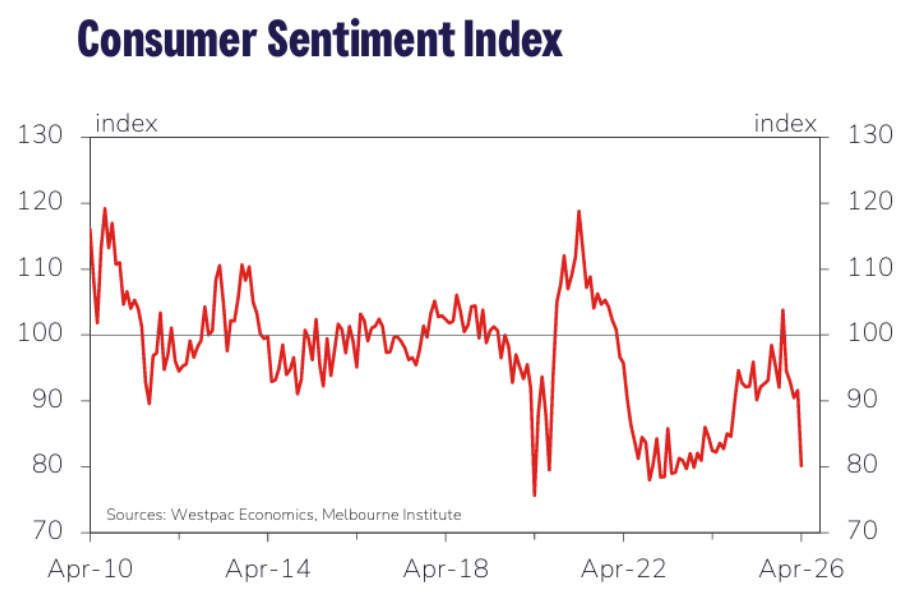
Source: Westpac
Lynas hits 15-year highs
[11:26 am] Lynas is up another 2.7% today and trading at levels not seen since the first rare earths bubble in 2011.
Recent company and sector newsflow has been incredibly bullish, including:
13-Apr: China Northern Rare Earth and Baotou Steel set Q2 rare earth concentrate prices at 38,804 yuan ($5,678) per metric ton, up ~45% from Q1 and the largest quarterly jump since China reformed its rare earth pricing mechanism in 2023
16-Mar: Lynas and US Department of War signed a binding letter of intent for the supply of light and heavy rare earth oxide, including an NdPr floor price of US$110/kg
10-Mar: Lynas and Japan Australia Rare Earths (JARE) updated their long-standing arrangement to include an offtake of 5,000tpa of NdPr at a floor price of US$110/kg as well as 50% of all future heavy rare earth production
To add some perspective, Lynas produced 6,558 tonnes of NdPr in FY25, while NdPr prices have experienced a strong recovery, trading at US$111.5/kg in late February.
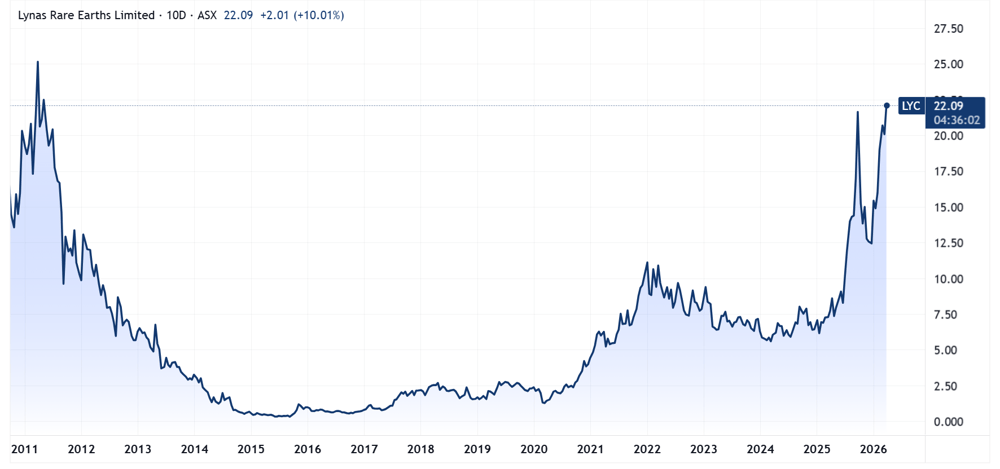
Lynas price chart (Source: TradingView)
Analysts' take on A2 Milk
[11:17 am] A2 Milk issued what amounted to a clear earnings downgrade for FY26 on Monday, driven by a combination of low inventory entering H2, tighter customs/testing processes following peer recalls, and elevated freight costs linked to Middle East disruption, all of which constrained product availability rather than reflecting any demand deterioration. The key numbers from yesterday's update include:
Revenue growth guidance cut to low-to-mid double-digit % vs. prior mid double-digit guidance
EBITDA margin lowered to 14.0-14.5% (previously 15.5%-16.0%), with additional one-off supply chain costs partially offset by savings initiatives
NPAT now expected to be similar to or down on FY25 (previously guided up), with cash conversion dropping to approximately 50% (previously 80%)
The stock finished the session down 13%, closing at the lowest since 15 August 2025. Key analysts takeaways include:
Morgans upgraded to Accumulate, lowered target to $8.70 (from $9.50).
Demand held firm through the disruption, market share gains continued, and the medium-term growth outlook remained constructive, the downgrade was seen as a timing and cost issue rather than a structural one.
Citi downgraded to Neutral, lowered target to $8.40 (from $10.55). A more cautious read on recovery risk, with concerns that lost shoppers may not return quickly and that valuation now leaves little margin for error.
Morgan Stanley maintained Overweight, lowered target to $9.90 (from $10.40). Low inventory amplified the supply shortfall, but Pokeno's progress reduces future supply risk and marketing support should help protect demand, though the core demand backdrop remained encouraging.
Tech stocks bounce
[11:04 am] Tech stocks are trading broadly higher thanks to a strong overnight lead, where the Nasdaq rallied 1.23% and the iShares Expanded Tech-Software ETF bounced 5.4%.
That said, tech stocks are struggling to hold on to gains, with the S&P/ASX 200 Tech Index currently up 2.8%, down from session highs of 5.3%.
Ticker | Company | % Chg | Price | 1 Yr % Chg |
|---|---|---|---|---|
WTC | Wisetech | 4.12% | $38.69 | -54.5% |
NXL | Nuix | 3.89% | $1.12 | -52.7% |
XRO | Xero | 3.32% | $72.76 | -53.2% |
NXT | NextDC | 2.75% | $12.91 | 17.0% |
CAT | Catapult Sports | 2.67% | $3.08 | -8.1% |
360 | Life360 | 2.23% | $18.31 | -1.8% |
WBT | Weebit Nano | 1.87% | $3.81 | 128.8% |
TNE | Technology One | 1.76% | $27.71 | -0.7% |
PPS | Praemium | 1.46% | $0.70 | 1.5% |
HSN | Hansen Technologies | 1.43% | $4.62 | -11.1% |
SDR | Siteminder | 1.37% | $2.96 | -18.2% |
MP1 | Megaport | 1.31% | $6.95 | -30.5% |
DTL | Data#3 | 1.20% | $6.73 | -9.4% |
PME | Pro Medicus | 0.60% | $133.17 | -34.7% |
DDR | Dicker Data | 0.58% | $8.67 | 7.0% |
OCL | Objective Corporation | 0.55% | $10.96 | -25.9% |
IRE | Iress | 0.44% | $6.86 | -10.1% |
BVS | Bravura Solutions | 0.26% | $1.96 | -6.9% |
MAQ | Macquarie Technology Group | 0.24% | $66.24 | 12.6% |
CDA | Codan | 0.18% | $33.83 | 133.0% |
AD8 | Audinate Group | 0.00% | $2.32 | -62.0% |
DGT | Digico Infrastructure REIT | -0.28% | $1.81 | -30.6% |
Chinese lithium futures open higher
[11:00 am] Chinese lithium futures just opened, currently up 2.7% to 166,200 yuan a tonne. This follows a 6.5% rally on Monday.
Local lithium names are trading broadly higher, with the bellwether PLS Group trading at the highest since November 2022.
Ticker | Company | % Chg | Price |
|---|---|---|---|
LTR | Liontown | 3.31% | $1.94 |
IGO | IGO | 2.31% | $8.40 |
PLS | PLS Group | 2.15% | $5.46 |
VUL | Vulcan Energy | 1.63% | $3.75 |
MIN | Mineral Resources | 0.89% | $58.07 |
Top ASX 200 gainers
[10:33 am] Leaderboard topped with select cyclicals and growth-oriented names like defence (EOS, ASB), uranium (DYL, NXG) and tech (WTC, XRO, XYZ).
Ticker | Company | % Chg | Price |
|---|---|---|---|
EOS | Electro Optic Systems | 9.86% | $9.92 |
DYL | Deep Yellow | 7.74% | $1.91 |
CSC | Capstone Copper Corp | 6.43% | $12.67 |
WTC | Wisetech Global | 6.38% | $39.53 |
L1G | L1 Group | 4.91% | $1.11 |
XRO | Xero | 4.88% | $73.86 |
ASB | Austal | 4.66% | $4.72 |
NXG | Nexgen Energy | 4.63% | $16.63 |
ORA | Orora | 4.46% | $1.45 |
XYZ | Block | 4.35% | $90.51 |
Top ASX 200 losers
[10:33 am] Cleanaway trading slightly lower after issuing a small FY26 guidance downgrade, gold stocks also broadly lower, Westpac shares ease after a mixed 1H26 trading update.
Ticker | Company | % Chg | Price |
|---|---|---|---|
CWY | Cleanaway Waste Management | -3.43% | $2.25 |
YAL | Yancoal Australia | -2.19% | $7.14 |
A2M | A2 Milk Company | -1.99% | $7.88 |
WBC | Westpac | -1.85% | $41.80 |
DBI | Dalrymple Bay Infrastructure | -1.69% | $5.22 |
RMS | Ramelius Resources | -1.69% | $3.78 |
SEK | Seek | -1.57% | $14.45 |
NST | Northern Star Resources | -1.42% | $23.66 |
TLX | Telix Pharmaceuticals | -1.33% | $15.56 |
GMD | Genesis Minerals | -1.31% | $6.42 |
ASX 200 higher, within 2% of all-time highs
[10:29 am] ASX 200 currently up 0.72%, already off session highs of 1.07%. Another classic opposite day, where growth, select cyclicals and rate-sensitive pockets of the market like Tech (+3.8%), Real Estate (+1.6%) and Materials (+1.4%) are outperforming, while Energy (-0.4%), Staples (-0.2%) and Telcos (-0.1%) slip. Breadth is very strong today, with 163 constituents (81%) trading higher. The ASX 200 has now rallied 7.8% from the 23 March low and 2.3% away from its 2 March record high.
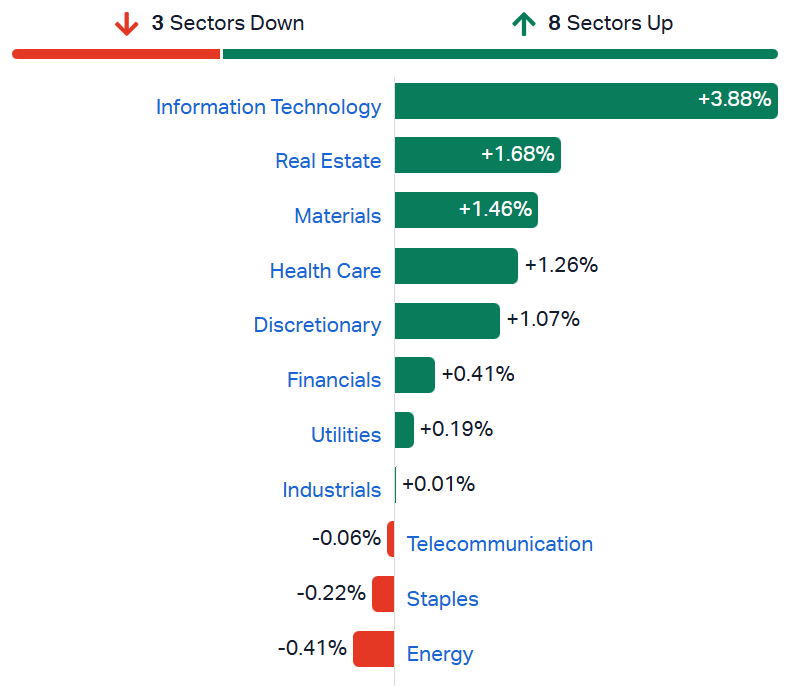
ASX 200 sectors (Source: Market Index)
Quick question for readers
[10:26 am] We’re looking to better understand the investors who read the Market Index Live Blog each day. To do that, we’ll be running a quick daily poll – just one simple question – to learn more about how you invest, trade, and navigate the markets.
It’ll take a few seconds to answer, and over time it helps us shape the content and coverage that matters most to you.
RBA's Hauser flags stagflation risk, energy shock complicates policy path
[9:55 am] RBA Deputy Governor Andrew Hauser has warned of a difficult macro backdrop, with the combination of elevated inflation and weakening economic activity raising the risk of a stagflation-style scenario.
Hauser described the RBA's "nightmare" outcome as inflation rising while economic activity weakens, a scenario that would leave the central bank with limited room to respond to either problem
The Middle East energy shock flagged as a significant income shock for Australians, eroding household purchasing power and lifting business input costs, with the scale of the activity slowdown still uncertain
Underlying inflation remains too high per Hauser, with supply constraints limiting the economy's capacity to absorb external shocks and raising the risk that price pressures prove more persistent than expected
A key focus for the RBA is preventing any de-anchoring of medium-term inflation expectations, with second-round effects, where higher energy costs feed into wages and broader pricing behaviour, flagged as a material risk
Lithium stocks set to extend gains
[9:46 am] Chinese lithium carbonate futures rallied 6.5% on Monday to 166,500 yuan a tonne, but still ~12% off recent multi-year highs of 189,440 yuan. Major US-listed lithium names like Albemarle and Lithium Americas rallied 6.7% and 7.6% respectively overnight.
Aluminium hits fresh four-year high
[9:44 am] Aluminium prices gained 3.3% overnight to US$3,612 a tonne, trading at the highest level since March 2022.
Nasdaq-listed Century Aluminium gained 1.4%, closing at the highest since 2008, while NYSE-listed Alcoa shares edged 0.3% higher.
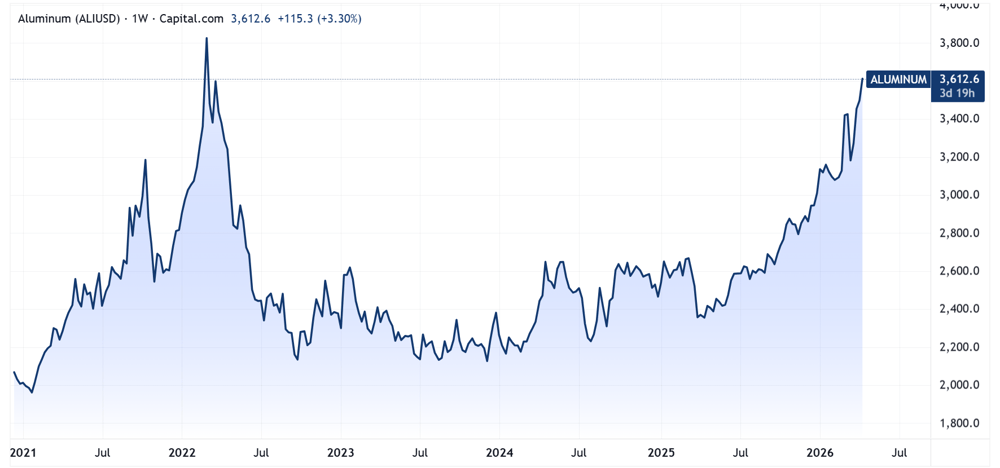
Aluminium price chart (Source: TradingView)
Macquarie flags ~$315m pre-tax headwind for Qantas
[9:37 am] Prior to today's trading update from Qantas, Macquarie flagged the crack spread (price difference between oil and refined products) as the more material earnings risk relative to crude oil exposure.
Qantas is implied ~86% hedged over 2H26 on crude oil, adding ~A$65m to pre-tax costs
The larger risk is the crack spread, which Qantas is entirely unhedged against. This has surged from US$16.97/bbl pre-conflict to a post-conflict average of US$81.38/bbl, with the half-to-date average already at US$30.34/bbl, well ahead of Macquarie's prior assumption of US$21/bbl
Macquarie has lifted its base case crack spread assumption to US$36/bbl, assuming another 2-3 months of elevated spreads, adding ~$250m to pre-tax costs
Combined, Macquarie estimates total incremental pre-tax fuel cost headwinds of ~$315m for Qantas in 2H26
Qantas flags major fuel cost blowout
[9:30 am] Qantas says jet fuel costs for 2H26 have roughly doubled from prior expectations, partially offset by stronger-than-expected unit revenue on both domestic and international routes.
Jet refining margins have surged from US$20 per barrel in February to a peak of ~US$120, with estimated 2H26 fuel costs now $3.1-3.3bn, despite the Group being ~90% hedged on crude oil exposure in 2H26
Group International RASK growth for 2H26 upgraded to 4-6%, double prior guidance, with domestic RASK now expected at ~5% for 2H26 and ~6% for Q4, reflecting fare increases and strong demand on rerouted European itineraries
Domestic capacity in Q4 2026 has been cut by ~5 percentage points, with capacity redeployed from the US and domestic network to increase services to Paris and Rome to meet strong European demand
The $150m on-market buyback has not commenced given current uncertainty, though the $300m interim dividend (19.8 cents per share) will proceed as planned on 15 April
FY26 capital expenditure will be at or below $4.1bn, the bottom end of prior guidance, with net debt expected at or above the middle of the target range at 30 June 2026
The Group has deferred any FY27 outlook commentary to a later date, citing ongoing volatility in fuel prices and global economic conditions
Company page: Qantas (QAN)
Universal Store CEO Alice Barbery to retire
[9:22 am] The Universal Store has announced a planned CEO transition, with long-serving MD and CEO Alice Barbery stepping down at the end of October and handing the reins to an internal successor with two decades of company experience.
Barbery will retire on 31 October 2026 after her tenure as MD and CEO, with George Do appointed as successor effective 1 November 2026
Do joined the company in 2005 and most recently serving as Universal Store and Perfect Stranger CEO since 1 March 2025
Barbery will transition to the board as a Non-Executive Director from 1 February 2027, and has committed to consulting support
Barbery currently holds 1.849 million shares
Company page: Universal Store (UNI)
Westpac H1 trading update: Core NIM stable but provisions trending higher
[9:20 am] Westpac has flagged solid underlying operating momentum in 1H26, though rising credit provisions and a softer Treasury and Markets NIM contribution reflect the impact of geopolitical uncertainty and the Middle East energy shock.
Lending and deposit growth of 4% and 3% respectively
Core NIM stable in the second quarter excluding the timing impact of rate rises
Treasury and Markets NIM contribution stepped down to 7 bps in Q2 from 15 bps in Q1, driven by interest rate volatility associated with the Middle East conflict
Credit provisions have been increased, with a new portfolio overlay added for energy-intensive sectors, resulting in the RWA ratio rising to ~129 bps and a credit impairment charge of 10 bps of average gross loans
First half result to include a $75m notable item (post-tax) related to transaction costs for the sale of the RAMS mortgage portfolio to a Pepper Money, KKR and PIMCO consortium
CET1 capital ratio strengthened in Q2 and asset quality metrics improved
Company page: Westpac (WBC)
Cleanaway cuts FY26 EBIT guidance on war-driven fuel cost and Middle East headwinds
[9:17 am] Cleanaway has trimmed its full-year earnings outlook due to the impact of the Iran war on fuel costs and Middle East contract activity, though management is framing the hit as largely a timing issue rather than structural margin deterioration.
FY26 EBIT guidance cut to $460-480m vs. prior guidance of $480-500m and ests of $489.5m (4% miss at midpoint)
The ~$20m EBIT impact reflects higher direct fuel costs, increased supplier and third-party logistics costs, and reduced activity in the Contract Resources business in the Middle East
Management stressed the impact is "largely timing differences in cost recovery rather than structural margin pressure," with most contracted prices set to reflect recent fuel increases by 1 July 2026 and remaining adjustments flowing through in FY27
Cleanaway has not experienced any fuel supply issues to date, with a long-term strategic partnership with a major fuel supplier providing reliable access to competitively priced fuel through the period of elevated volatility
Starting to see a few Iran-related downgrades pop up over the last couple of days. On Monday, A2 downgraded its FY26 guidance reflecting a combination of freight disruptions from the Middle East conflict, low inventory from its manufacturer, extended customs clearance and new testing requirements.
Cleanaway shares rallied 7.5% on the day of its 1H26 result on 26 February, where numbers were broadly ahead of market expectations, including:
Underlying NPAT up 17.8% to $109.7m vs. $103.0m ests (6% beat)
Interim dividend of 3.35 cps vs. Morgans ests of 3.0 cps (11.6% beat)
FY26 underlying EBIT guidance upgraded to $480-500m vs. $479.6m ests (2.2% beat at the midpoint)
The stock has given back all of its results-driven gains, and down ~9% since March.
Company page: Cleanaway Waste Management (CWY)
Santos denies CEO departure speculation
[9:11 am] A Santos spokesperson has "categorically" denied reports of CEO Gallagher's departure, branding the talk as "false," though The Australian cites persistent market chatter and sources pointing to potential replacement candidates.
This is not the first time the speculation has surfaced, with a similar story reported by The Australian in early April 2025, at which point Gallagher addressed it directly at the AGM stating "despite rumors to the contrary, I am not planning to go anywhere soon".
4DMedical joins the S&P/ASX 200
[9:08 am] Insignia Financial will be removed from the S&P/ASX 200, subject to final court approval where the company will be acquired by Daintree. Insignia will be replaced by 4D Medical in the ASX 200, effective prior to the open of trading on Monday, 20 April.
Source: S&P Dow Jones
Rare earth stocks in focus
[9:05 am] Local rare earth names like Lynas and Iluka could get a kick after major Chinese producers announced a sharp increase in second quarter product prices.
China Northern Rare Earth and Baotou Steel set Q2 concentrate prices at 38,804 yuan ($5,678) per metric ton, up ~45% from Q1 and the largest quarterly jump since China reformed its rare earth pricing mechanism in 2023
Baotou Steel Union shares rose as much as 8.5%, China Northern Rare Earth gained up to 3.1% and China Rare Earth Resources and Technology added 2.5% on the back of the pricing announcements
The hike follows Beijing tightening export controls and introducing licensing regimes over the past year, which have progressively disrupted global rare earth supply chains
Australia and US commit up to $600m to back Tronox rare earths refinery
[9:01 am] The US and Australian governments have issued coordinated financing support for two critical minerals projects in Western Australia, marking one of the most concrete commitments under their bilateral critical minerals partnership.
Export Finance Australia and the US Export-Import Bank each issued letters of support of up to $424m (A$424m) for Tronox Holdings' rare earths refinery project, which spans Western Australia and the US and would produce mixed rare earth carbonate containing both light and heavy rare earth elements used in defence, manufacturing and clean energy
The same agencies also issued letters of support of up to A$500m each for Ardea Resources' Kalgoorlie Nickel Project, which holds Australia's largest nickel-cobalt resource
Combined potential financing across both projects totals up to A$1.85bn, representing one of the most substantial concrete commitments to emerge from the Australia-US critical minerals partnership to date
Source: Bloomberg
Goldman Sachs Q1 2026: Record equities offset by fixed income miss and rising credit provisions
[8:59 am] Goldman Sachs is one of the first major US names to report, delivering its second-highest quarterly revenue on record, driven by an all-time high in equities trading.
Revenue up 14% to $17.23bn vs. $16.97bn ests (2% beat)
EPS up 24% to $17.55 vs. $16.49 ests (6% beat)
Equities revenue up 27% to $5.33bn vs. $4.90bn ests (9% beat)
The highest quarterly equities revenue ever recorded by any bank, surpassing Goldman's own prior record of $4.31bn set in Q4 2025 by over $1bn
Investment banking fees up 48% to $2.84bn
FICC revenue down 10% to $4.01bn vs. $4.87bn ests (18% miss), with weakness in rates, mortgages and credit, though Solomon pushed back on the narrative, calling it "the 10th-best FICC quarter ever"
Provision for credit losses up 9% to $315m vs. $150m ests (110% miss), the largest increase since 2020, prompting analyst questions about what Goldman sees developing in wholesale credit markets
Solomon flagged that a prolonged conflict resolution "will be a headwind… particularly inflation trends… and how commodity prices translate into consumer demand," while noting the M&A backlog "did not move very significantly"
Shares fell 1.8%, bouncing off session lows of -4.6%
Analysts see earnings acceleration as key buffer against macro headwinds
[8:55 am] A broad range of strategists are pointing to accelerating earnings growth as the primary reason to look through near-term volatility, with several flagging improving valuations and a likely market bottom.
Morgan Stanley highlights that the median S&P 500 company is growing EPS at a double-digit pace, the fastest since 2021, with earnings growth actually accelerating despite the oil shock, and notes the S&P 500 forward P/E is now 18% below its October peak, creating a more attractive setup
Jefferies pushes back on fears that consensus estimates are too high, noting the 12-week moving average of the earnings revision ratio remains above 1 (more upgrades than downgrades), and that 2026 EPS estimates have actually risen ~3% since end of February
Deutsche Bank sees Q1 earnings growth accelerating into the mid-teens, a level only matched three times in the past two decades (twice post-GFC and once following the 2018 corporate tax cuts), with the high bar supported by a strong macro backdrop, cyclical growth, a weaker dollar and AI spending tailwinds
RBC Capital Markets believes the S&P 500 has likely put in its bottom after a 9.1% drawdown from the January high, citing limited recession risk, signs of Middle East de-escalation and improved valuations as key supports
Trump begins Hormuz blockade, Iran eyes more talks
[8:50 am] The US has moved to cut off Iranian ports from the Strait of Hormuz, marking a significant escalation even as both sides leave the door open for another round of negotiations before the April 22 ceasefire expiry.
The blockade targets vessels transiting to and from Iranian ports and coastal areas, with CENTCOM confirming neutral ships not calling at Iran will not be impeded, though they may be searched for contraband
Despite the escalation, fresh talks are being discussed, with Trump telling reporters Iran had reached out Monday morning with "the right people, the appropriate people" signalling a desire to negotiate
Iran responded with a stark warning, saying security of regional ports is "either for everyone or for no one" and threatening to target all Persian Gulf ports if its own shipping hubs are threatened, raising the risk of a broader conflict on the high seas
Source: Bloomberg
Gulf Arab oil output collapses as Iran war disrupts Hormuz exports
[8:46 am] OPEC's March production data reveals a severe supply shock across Gulf Arab states, with output plunging across the board as the Iran war halts tanker traffic through the Strait of Hormuz.
Overall OPEC production fell 27% month-on-month from 28.7 million bpd to 20.8 million bpd in March, with the steepest declines in Iraq (-61% to 1.6 million bpd), Kuwait (-53%) and the UAE (-44%)
Saudi Arabia, OPEC's largest producer, saw output drop 23% from 10.1 million bpd to 7.8 million bpd, with the kingdom relying on its East-West pipeline to reroute exports, though a recent Iranian attack has cut that pipeline's capacity by 700,000 bpd
Kuwait Petroleum Corp's CEO noted that while some production can be restored "within a few days," the "full production will come within three or four months," flagging a prolonged supply gap even in a ceasefire scenario
Iran's own production declined only modestly (-5% to 3.06 million bpd) as it continued exporting through the strait during the conflict, though a US naval blockade of Iranian ports commenced Monday following failed peace talks
JPMorgan warns of imminent oil flow shock as Hormuz closure bites
[8:45 am] JPMorgan is flagging a supply inflection point as pre-closure oil barrels are nearly exhausted from the global supply chain. Though the investment bank is still urging investors to use any geopolitical weakness as a buying opportunity.
The last tanker to clear the Strait of Hormuz on February 28 is expected to reach its destination around April 20, marking the point at which pre-closure barrels are fully exhausted, making reopening "the market's most time-sensitive priority" according to JPMorgan
Large-scale refinery run cuts outside the Middle East have not materialised, with Asian refiners reducing throughput by only ~2 mbd due to crude shortages, led by China (~1 mbd), Japan (0.4 mbd) and the remainder across Singapore, Malaysia and India
JPMorgan estimates ~13 mbd of missing Persian Gulf supply has so far been bridged by aggressive inventory draws and involuntary demand destruction, as "fuel availability becomes increasingly difficult to secure", a dynamic that becomes unsustainable post-April 20
Despite the supply shock risk, JPMorgan remains constructive on equities over a 3-6-12 month horizon, noting it "looked to buy into the market fall after the initial phase of knee jerk derisking and position squaring became advanced"
The investment bank acknowledges geopolitical fat tails and the potential for renewed weakness on escalation, but warns that "the risk of getting whipsawed increases significantly" for those who succumb to bearish views at current levels
Largest short covering day in years
[8:41 am] Last week saw the biggest short covering of US-listed ETFs in over a decade, according to Goldman Sachs. Hedge funds are winding down their macro hedges, as they begin to look beyond the Iran conflict.
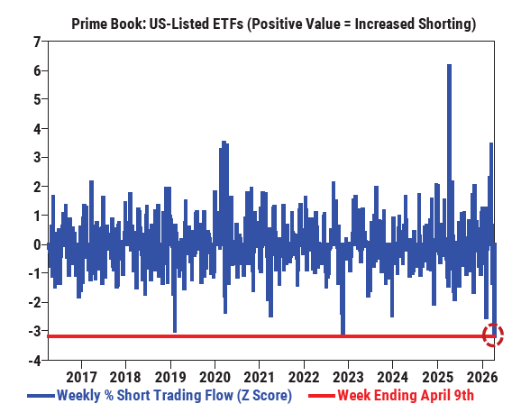
Source: Goldman Sachs
Analysts see positioning and seasonality as potential upside catalysts
[8:39 am] Some food for thought as markets continue to climb.
BofA estimates systematic positioning could generate $42bn in purchases in a flat market and $54bn in an up market, compared to only $23bn in selling in a down market, suggesting an asymmetric setup skewed to the upside
Goldman Sachs notes CTAs have sold ~$115bn in global equities over the past month and are expected to cover ~$120bn over the next month in a flat tape, a potential mechanical tailwind for markets
Aggregate positioning remains in just the 27th percentile since 2010 per Deutsche Bank, meaning markets are still broadly underweight despite a modest increase last week, leaving room for further re-engagement
Positive April seasonality is a tailwind, with Citadel pointing to historical capital rotation toward Q2 earnings and a potential reacceleration in IPO activity as supporting factors
Goldman Sachs' trading desk flagged client fear of missing a right-tail rally, which has contributed to sharper single-session rips than dips, reinforcing the downside-dampening dynamic
Jefferies notes that while the equity risk premium of ~3% sits in just the 25th percentile since 1997, it has historically preceded forward 120-day S&P 500 gains of 8.5% and 240-day gains of over 16%, suggesting current levels remain attractive despite the uncertain backdrop
Morgan Stanley says S&P 500 correction is in its final phase
[8:37 am] Morgan Stanley argues the true extent of the US equity pullback is being masked by resilient earnings, with broader market internals already showing significant damage.
S&P 500 earnings multiples have de-rated 18% from their October peak, and more than half of Russell 3000 stocks are down at least 20%, suggesting the correction is far deeper beneath the surface than the headline index implies
Wall Street analysts still expect 12% earnings growth for S&P 500 companies in Q1 2026, with reporting season now underway and Goldman Sachs kicking it off with a second consecutive record quarter from its equities trading desk
Morgan Stanley favours cyclicals including financials, industrials and consumer discretionary, as well as quality AI cloud providers where valuations and sentiment have reset to more attractive levels
Goldman Sachs strategists see opportunity in secular growth stocks but urge selectivity, while Morgan Stanley says investors should be prepared to add risk even as the Middle East conflict keeps energy supply and monetary policy paths uncertain
Morgan Stanley warns the final phase of a correction is rarely smooth and flags a potential re-test of lows, particularly if rates or bond market volatility move higher again
Source: Bloomberg
JPMorgan and Morgan Stanley see buying opportunity in geopolitical dip
[8:35 am] Major Wall Street brokerages are turning constructive on equities, pointing to resilient earnings growth and improving valuations as reasons to buy the Iran war-driven weakness.
S&P 500 Q1 2026 earnings growth estimates have actually risen since the war began, moving from 12.7% to 13.9% as of April 10, suggesting corporate fundamentals remain largely insulated from the conflict
JPMorgan characterises geopolitical dips as buying opportunities, maintaining that further escalation is unlikely to persist indefinitely, though the bank still favours international equities over the US
Morgan Stanley views the selloff as a correction rather than the start of a prolonged downturn, favouring cyclical sectors including financials, industrials and consumer discretionary, as well as AI hyperscalers
Mag-7 valuation premium has compressed sharply, which JPMorgan flags as a notable re-rating opportunity
Source: Reuters
S&P 500 back at pre-war levels
[8:33 am] A very strong overnight session, with the S&P 500 climbing 1.02% to close at 6,816 points, the highest since 26 February. The index has now rallied 8.5% since the 30 March low and flat year-to-date.
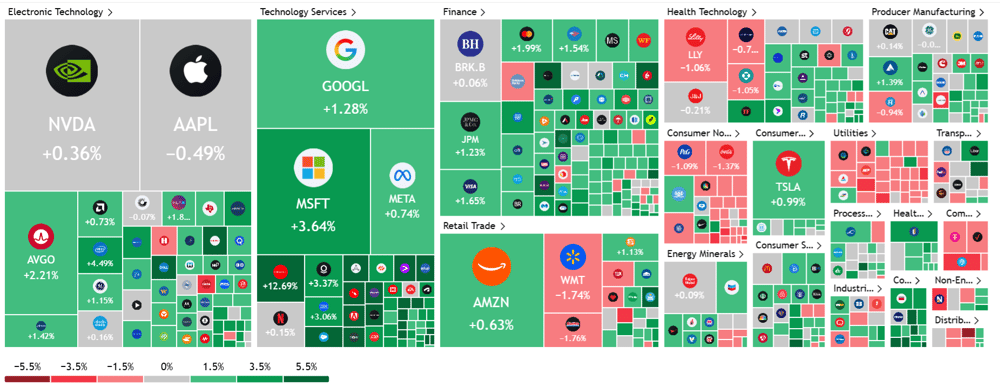
S&P 500 heatmap (Source: TradingView)
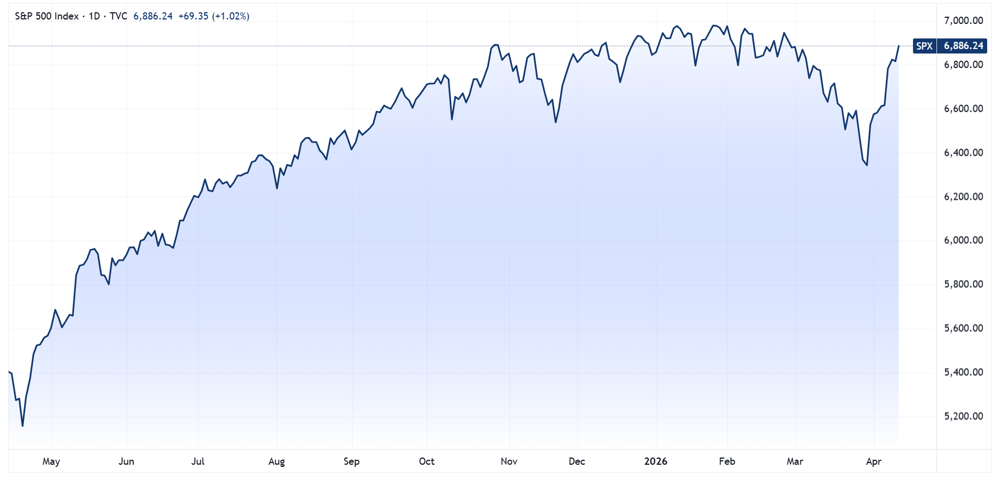
S&P 500 chart (Source: TradingView)
Good morning!
[8:24 am] ASX 200 futures are up 119 pts (+1.33%) as of 8:30 am AEDT.
The overnight session in a nutshell:
Major US benchmarks reversed early weakness to close higher, with the S&P 500 now trading at pre-war levels and up 0.20% year-to-date
Markets buoyed by news that Iran had contacted the Trump administration to "work out a deal"
Brent settled 3.9% higher to US$98 a barrel, down from session highs of 10.2%
Rare earths and lithium stocks surged on various catalysts (China's largest producers hiked prices, Aus-US financing announcement and soaring Chinese lithium carbonate futures)
Software stocks recorded a ~5% bounce overnight but still down 2% in the last two sessions