Albo and Trump just had a convo about rare earths and critical minerals – here’s what you need to know
A US$8.5 billion alliance just redrew the global rare-earths map – and Australia’s critical-minerals miners are front and centre.

Source: ChatGPT, Market Index
Mentioned
KEY POINTS
- Prime Minister Anthony Albanese and US President Donald Trump have just signed a landmark US–Australia critical-minerals pact – the biggest push yet to break China’s dominance in rare-earths supply.
- The US$8.5 billion pipeline of priority projects and government equity stakes in Australian mines put new momentum behind local processing and refining of rare earths and other critical minerals.
- From Lynas (LYC) to Arafura (ARU), a new wave of ASX-listed critical-minerals stocks could ride this geopolitical tailwind – if they can deliver on scale and timing. We investigate 8 potential winners from today’s developments.
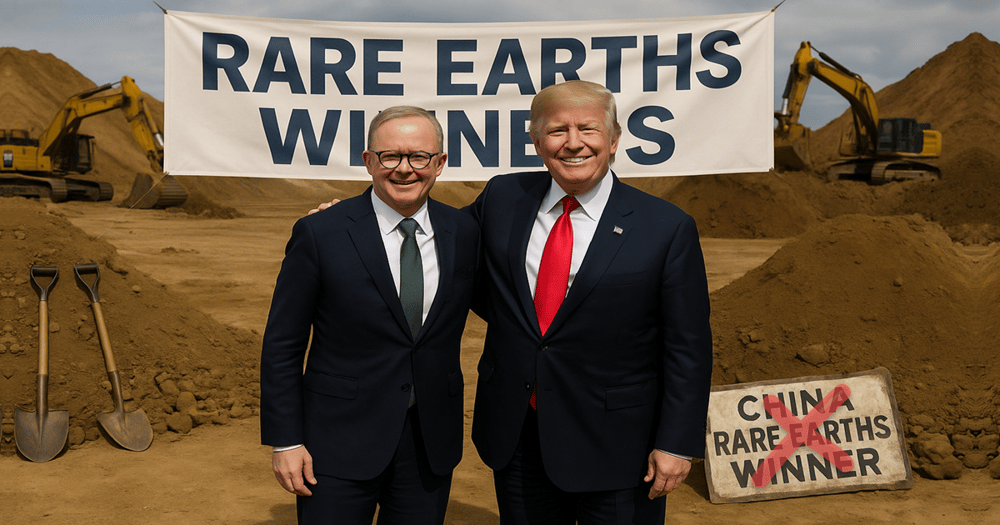
Prime Minister Anthony Albanese finally got his one-on-one sit down with US President Donald Trump – the long-awaited bilateral meeting on defence and rare earths and critical minerals supply, held in the early hours of this morning at the White House.
The result was a historic signing – the United States-Australia Framework for Securing of Supply in the Mining and Processing of Critical Minerals and Rare Earths (the “Framework”). Framed as a “new chapter” in the two countries’ alliance, it promises to accelerate an US$8.5 billion pipeline of priority projects across both sides of the Pacific over the next six months.
The deets…
The deal locks Australia into Washington’s broader push to diversify its supply chains for metals essential to defence, clean energy, and semiconductor manufacturing. At its heart, it’s about resource security and technological sovereignty – ensuring that key inputs for advanced manufacturing can be sourced from allies rather than geopolitical rivals.
Two cornerstone projects were named on day one. The Alcoa-Sojitz Gallium Recovery Project in Wagerup, Western Australia, will receive up to US$200 million in concessional equity from the Australian government, alongside a US investment and offtake rights for both nations. When operational, it could supply roughly 10 percent of global gallium – a metal crucial for radar, defence electronics, and chip production. Japan is also a partner, having already covered 50 percent of the project costs.
The second is the Arafura Nolans Project in the Northern Territory – one of Australia’s most advanced rare-earth developments – which secured US$100 million in fresh equity funding. Once online, it is expected to produce around 5 percent of global rare-earth oxides, underpinning permanent magnets used in electric vehicles and wind turbines.
A strategic pivot with global implications
Behind the photo-ops lies a coordinated industrial strategy. The Framework establishes a US-Australia Critical Minerals Supply Security Response Group, led by the U.S. Secretary of Energy and Australia’s Minister for Resources. Its mandate: identify mineral vulnerabilities and fast-track investment in mining, separation, and refining capacity. The aim is resilience – insulating both economies from China’s overwhelming dominance in rare-earth processing, which currently exceeds 80 percent of global supply.
The Prime Minister summed it up neatly: “Australia is home to much of the periodic table of critical minerals and rare earth metals that are vital for defence and other advanced technologies. We’re going to make more things together.”
For investors, this signals policy certainty – a rare commodity in itself! Government involvement, concessional financing, and guaranteed offtake rights create clearer revenue visibility for companies that might otherwise struggle to raise capital. The joint US-Aus governments’ marketing department is touting the Framework as industrial policy designed to crowd-in private investment, not crowd it out.
What it means for investors
For beginner investors eyeing this sector, “critical minerals” might sound abstract, but the logic is simple: these are the metals that make modern technology possible. They include rare earths (like neodymium and praseodymium, used in high-strength magnets), as well as cobalt, lithium, nickel, and gallium – all essential for batteries, renewable energy, and advanced electronics. Consider:
1. Tailwinds that are hard to ignore
Global demand for critical minerals is being driven by the energy transition and defence modernisation. Nations are scrambling to secure access to these resources to meet net-zero goals and maintain technological independence. Australia’s geology offers the supply; now, through this deal, it also gains policy and capital to build the mid-stream processing capacity that it has long been missing.
2. Investment is shifting from extraction to processing
Historically, Australia has dug stuff up and shipped it to China. The new model is “mine-to-metal” – refining and value-adding onshore. That shift means companies positioned in refining, separation, and processing stand to benefit most. Think of it as moving up the value chain – and capturing more of each tonne’s worth.
3. But there are still risks
These projects are capital-intensive and often pre-revenue. Prices for rare earths and specialty metals can be opaque and volatile. Geopolitical tailwinds can reverse quickly, and policy promises can lag implementation. Diversification, patience, and attention to the funding of, and meeting of key project milestones on time and on budget are likely to be critical for anyone investing in this theme.
4. (Some of) The likely winners
Established players such as Lynas Rare Earths (LYC) and Iluka Resources (ILU) already have proven production and processing footprints. They are ready to take advantage of any increase in mineral prices now – but similarly, are at greater risk than those at earlier stages of development if prices should fall.
Developers like Arafura Rare Earths (ARU), Cobalt Blue Holdings (COB), Australian Strategic Materials (ASM), and Hastings Technology Metals (HAS) are moving towards commercialisation with varying degrees of government backing in place.
Explorers such as WA1 Resources (WA1) and Chalice Mining (CHN) sit further up the risk curve, where discoveries and feasibility studies can still move share prices sharply.
These are just some of the players in the space, there are too many to mention in one article, but we have a far more comprehensive list here: Market Index Rare Earth Page.
Alliance economics
This framework isn’t just about minerals – it’s a re-wiring of economic alliances. By formalising shared control over critical supply chains, Washington and Canberra are effectively creating an “allied metals bloc.” Investors can view it as a bet on industrial decoupling: the West building redundancy against Chinese dominance in the clean-energy and defence supply chain that will help shape the next century.
For the US, it’s a hedge against vulnerability. For Australia, it’s an invitation to climb up the value ladder – from “dig it up and ship it out” to the manufacturer of indispensable materials. For investors, it’s an emerging structural theme backed by both market and policy forces.
The bottom line? The Albo–The Donald meeting at the White House this morning wasn’t just diplomacy – it was a green light for the local rare earths and critical minerals industry to forge ahead. The money, and the momentum appear to be coming together.
Sampling of ASX Critical-Minerals Stocks
(Not an exhaustive list! Just a representative sample of major and emerging players across a few super-interesting minerals.)
Lynas Rare Earths (ASX: LYC) – Market Cap $19.8 billion
%20chart.png)
Operates the world’s largest rare earths processing facility outside China, with mining at Mt Weld in WA and refining in Malaysia and Kalgoorlie.
Partnered with the US Department of Defense to build a heavy rare-earth separation plant in Texas.
Proven producer with established offtake and downstream clients.
A key beneficiary of Western diversification away from China.
Iluka Resources (ASX: ILU) – Market Cap $3.3 billion
%20chart.png)
Mineral-sands producer pivoting into rare-earths processing through its Eneabba refinery in WA – Australia’s first integrated “mine-to-oxide” facility.
Receives federal financing support through the Critical Minerals Facility.
Eneabba Stage 3 refinery to process both Iluka and third-party concentrates.
Cash-flow from zircon/titanium operations provides funding stability.
Arafura Rare Earths (ASX: ARU) – Market Cap $1.5 billion
%20chart.png)
Developer of the Nolans Project in the NT, targeting neodymium-praseodymium (NdPr) oxides for EV and turbine magnets.
Secured US$100m equity from the Australian government under the new Framework.
Multiple offtake MoUs with Hyundai, GE Renewable Energy, and Siemens Gamesa.
Fully permitted with construction finance progressing.
WA1 Resources (ASX: WA1) – Market Cap $1.6 billion
%20chart.png)
Emerging explorer behind the West Arunta Project in WA, which uncovered one of Australia’s most promising niobium-rare-earth systems.
Major discovery at the Luni prospect – potentially world-class niobium resource.
Niobium is a critical mineral used in high-strength alloys and superconductors.
Chalice Mining (ASX: CHN) – Market Cap $867 million
%20chart.png)
Developer of the Julimar Project in WA – a polymetallic discovery hosting nickel, copper, cobalt, and platinum-group elements.
Advanced feasibility and permitting underway; potential downstream synergies.
Partner discussions ongoing for financing and offtake options.
Australian Strategic Materials (ASX: ASM) – Market Cap $350 million
%20chart.png)
The company describes its Dubbo Project in NSW as one of the few “shovel-ready” rare-earths / critical-minerals projects, containing light and heavy rare earths, plus zirconium, niobium and hafnium.
The project has an advanced approvals pathway and clear positioning for downstream processing in Australia (not just mining).
Hastings Technology Metals (ASX: HAS) – Market Cap $195 million
%20chart.png)
Advancing the Yangibana Project in WA toward production of NdPr concentrate.
Supported by Northern Australia Infrastructure Facility (NAIF) and German export-credit agencies.
Construction funding and engineering contracts in place.
Cobalt Blue Holdings (ASX: COB) – Market Cap $112 million
%20chart.png)
Battery-metals developer with projects in NSW and WA focused on cobalt-sulphate production.
Broken Hill Cobalt Project advancing pilot operations.
Proposed Kwinana Refinery aims to supply EV battery-grade feedstock.
Positioned to benefit from growing cobalt demand in EVs and defence tech.