Woodside and Santos dividends set to jump as UBS bets on higher-for-longer oil
UBS expects oil and gas prices to remain elevated as a result of the protracted US-Iran conflict, lifting dividends for Woodside and Santos


Source: iStock
Mentioned
KEY POINTS
- UBS has lifted its near to mid-term oil and LNG forecasts as the US-Iran conflict drags on, tipping Brent to average US$100 a barrel in the December quarter.
- The upgrades lift UBS’s earnings forecasts by 26% in 2026 and 32% in 2027 for Woodside, and by 27% in both years for Santos. Dividend forecasts for 2026 are up 49% for Woodside and 87% for Santos on 2025 levels.
- Santos remains UBS’s top Australian energy pick, while Woodside stays Neutral
UBS has raised its near to mid-term oil and LNG price forecasts, saying the US-Iran conflict has “progressively deteriorated into a prolonged war of attrition” following the collapse of the ceasefire earlier this year. The conflict has caused start-stop oil and gas flows out of the Gulf and drawn down global inventories putting upward pressure on prices, according to the broker.
While oil flows out of the Gulf recovered to around 14 million barrels a day (Mbpd) in September, ongoing Iranian attacks and disruptions in the Red Sea add to the near-term risk premium, according to UBS analysts Tom Allen and Vignesh Nair. The analysts expect the rebuilding of depleted inventories to support oil prices through 2027.
The broker lifted its December quarter Brent forecast to US$100 a barrel from US$80, and its 2027 forecast to US$80 from US$75. As a result, UBS has lifted its earnings forecasts for Woodside (WDS) by 26% for 2026 and 32% for 2027, and for Santos (STO) by 27% in both years, alongside higher dividend forecasts.
This article unpacks why UBS raised its oil and LNG price forecasts and how a higher-for-longer oil price flows through to Woodside and Santos earnings and dividends.
Higher-for-longer oil prices
UBS can’t see a clear path back to normal over the next three months and now expects Brent to average US$92 a barrel across 2026, while keeping its long-term forecast of US$75 a barrel from 2028 unchanged.
Global inventories have fallen from 8.3 billion barrels in January to about 7.6 billion, and UBS expects them to drop to 7.3 billion by December. The broker said stockpiles at that level have historically gone hand in hand with rising prices. US strategic reserves, the emergency supply the government holds for crises, are also at ~40% of capacity, their lowest level since the early 1980s.
Where oil goes from here depends on how the conflict plays out. UBS puts the range at US$75 to US$135 a barrel over the next two years and warned further strikes on energy infrastructure could push prices above US$120.
That said, UBS doesn’t expect a large sustained rally, pointing to rising supply from producers outside OPEC, emergency stock releases, weaker demand and alternative shipping routes as factors keeping a lid on prices over the medium term.
Tighter-for-longer LNG market
UBS expects the LNG market to stay tight for longer than oil, noting that gas from the Gulf can’t be rerouted by pipeline the way some crude can and that gas facilities take longer to restart. The broker raised its December quarter forecast for JKM, the benchmark Asian LNG price, to US$26 per million British thermal units (mmBtu) from US$22, and its 2027 forecast to US$16/mmBtu from US$14.50.
Europe is heading into winter with gas storage about 15% below the seasonal average while it phases out Russian LNG, and UBS expects buyers to compete for cargoes over the next six months. The broker said this competition adds upside risk to winter gas prices and expects JKM to trade between US$17 and US$30/mmBtu for the rest of 2026.
Woodside: Bigger dividends and higher price target
UBS has kept its Neutral rating on Woodside and lifted its price target to $31.10 from $30.20. The new target sits ~3% below the stock’s $31.96 close on 12 October.
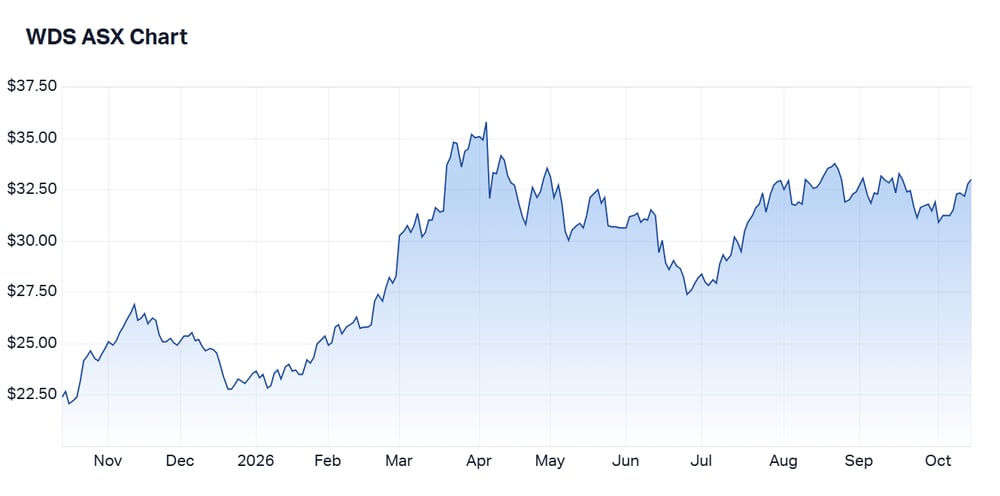
WDS 12-month price chart
Woodside has several big projects on the go, with its first-half FY26 result showing Scarborough 98% complete and on track for first LNG in the December quarter, Trion 64% complete and targeting first oil in 2028, and Louisiana LNG 28% complete and targeting 2029.
The first half was a tough one, with production down 13% to 86.5 million barrels of oil equivalent after Pluto LNG paused in March due to Tropical Cyclone Narelle. Gearing rose to 20.6%, just above Woodside’s 10% to 20% target range, which the company put down to new lease liabilities, hedge settlements and the timing of receivables.
UBS expects Woodside’s underlying profit to jump almost 50% to US$3.96 billion in 2026, from US$2.68 billion in 2025.
Free cash flow is coming off a low base after Woodside spent more than it brought in during 2025, and UBS expects FCF to climb steadily as capital expenditure fall from US$6.2 billion in 2026 to US$1.2 billion in 2030.
FY25a | FY26e | FY27e | FY28e | FY29e | |
|---|---|---|---|---|---|
FCF | -US$719m | US$1,109m | US$2,774m | US$2,912m | US$4,738m |
FCF yield | -1.8% | 2.6% | 6.5% | 6.5% | 10.3% |
DPS | US$1.12 | US$1.67 | US$1.53 | US$1.13 | US$1.11 |
Dividend yield | 5.3% | 7.5% | 6.9% | 4.8% | 4.6% |
Source: UBS
Santos: Shifts from building to earning
UBS has retained its Buy rating on Santos, its most preferred Australian energy stock, and lifted its price target to $9.50 from $8.30, about 9% above the stock’s $8.68 close on 12 October.
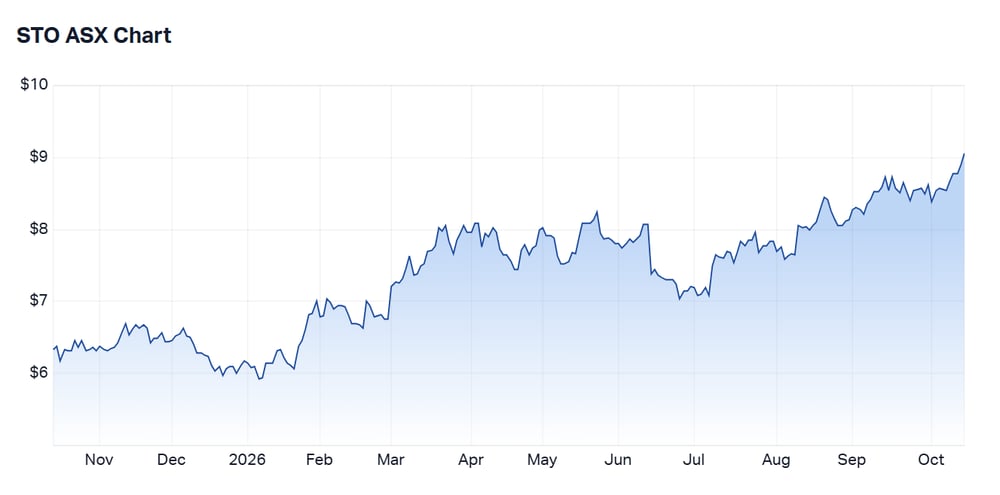
STO 12-month price chart
The broker said in its October 12 note Santos has the strongest near-term production growth in its coverage as Pikka and Barossa ramp up, and expects the company to confirm Pikka has reached its full rate of 80,000 barrels a day at its September quarter update on 22 October.
UBS also pointed to its separate deep dive on the Beetaloo Basin, which it said could become Australia’s largest-ever gas discovery if proven commercial. That could be confirmed within six to nine months. Beetaloo is valued at 55 cents a share, or $1.79 billion, in its sum-of-the-parts valuation on a 50% risked basis, and up to $1.10 a share un-risked.
UBS expects Santos’s underlying profit to more than double to US$2.01 billion in 2026, while free cash flow is forecast to almost triple to US$1.86 billion in 2026 before climbing further through 2029.
FY25a | FY26e | FY27e | FY28e | FY29e | |
|---|---|---|---|---|---|
FCF | US$635m | US$1,858m | US$2,526m | US$2,749m | US$3,668m |
FCF yield | 2.2% | 6.6% | 8.9% | 9.7% | 12.9% |
DPS | US$0.237 | US$0.444 | US$0.485 | US$0.487 | US$0.427 |
Dividend yield | 4% | 7.3% | 7.9% | 8.0% | 7.0% |
Source: UBS. FCF excludes projects yet to reach a final investment decision.