Two ASX real estate buys UBS still likes after the Bathla blow-up
The Bathla collapse has hit ASX-listed managers with private credit exposure, but UBS still sees value in two names across the sector.


Source: iStock
Mentioned
KEY POINTS
- Three RBA rate hikes, a 10-year yield at 5.40% and Budget changes to negative gearing have pushed the S&P/ASX Real Estate index down 19% year to date, to its lowest since December 2023.
- Bathla's collapse with $3.2 billion in liabilities has hit managers with private credit exposure, with UBS coverage in the group down 28.9% on average this year.
- UBS rates Centuria Capital and HMC Capital as Buys, and this article covers the case for each and what needs to happen for the shares to re-rate.
Australia's real estate sector has had plenty to contend with this year already. Three RBA rate hikes lifted the cash rate to 4.35% by May, with another possible before year's end, and the federal Budget scrapped the capital gains tax discount and ended negative gearing for established properties, exempting new builds.
In the past month, the Australian 10-year yield has taken another leg up, surging from 5.0% to 5.40%, the highest since April 2011. Higher bond yields tend to weigh on real estate stocks, lifting borrowing costs and making their dividend yields less attractive relative to risk-free government bonds.
Now to compound matters, the sector has been rocked by the collapse of Bathla, a Sydney-based residential property developer that fell into voluntary administration on 25 August with $3.2 billion in liabilities. Of that, $3.08 billion was owed to private credit firms, according to the administrators' report.
These headwinds have pushed the S&P/ASX Real Estate index down around 19% year to date and trading at the lowest since December 2023, with extra pressure on companies exposed to the Bathla fallout. This article will look at how private credit exposed stocks are suffering because of Bathla and UBS’s two value plays amid the blow-up.
Private credit exposed ASX real estate stocks
The Bathla collapse has exposed how reliant private credit is on residential development lending, and fund managers with private credit exposure have underperformed as a result, UBS said.
Stocks under UBS's coverage are down an average of 28.9% year to date, against a 3.4% gain for the ASX 200, with earnings multiples de-rating 36% to an average forward P/E of 11.1x.
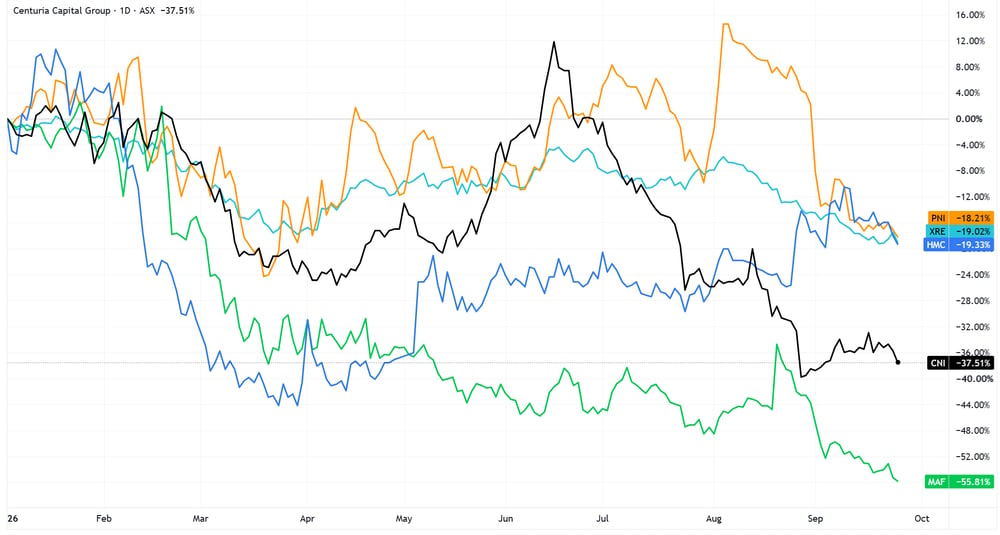
YTD price chart for Centuria Capital (black), Pinnacle Investment Management (orange), HMC Capital (dark blue), MA Financial Group (green), S&P/ASX Real Estate index (light blue)
Although the group is down an average of 28.9% year to date, the split isn't even. CNI and MAF have fallen far harder than that average, while HMC and PNI are broadly tracking the wider real estate index.
Amid all the factors working against the real estate sector, UBS sees value in two names: Centuria Capital and HMC Capital.
Centuria Capital: A big discount to NAV
Centuria Capital (CNI) is an ASX-listed real estate funds manager with $22.2 billion in assets under management and a market capitalisation of $1.23 billion, with shares down 37% year to date.
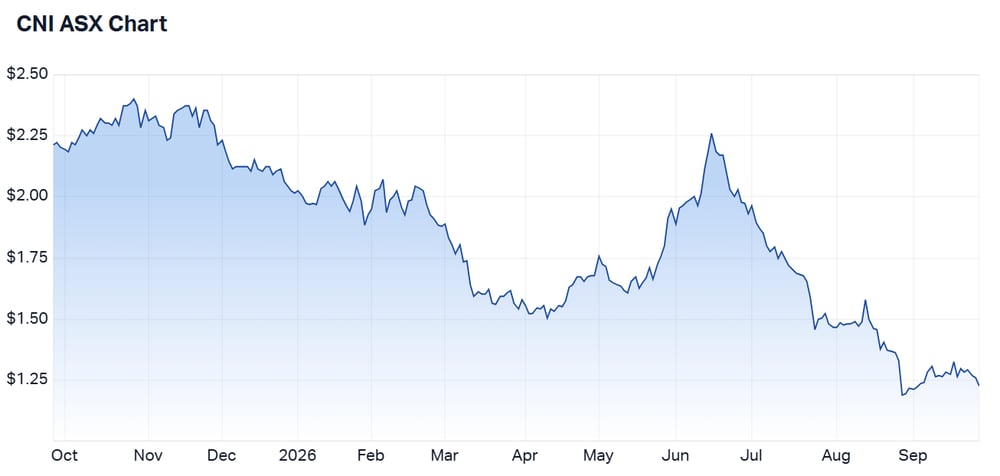
CNI 1-year price chart (Source: Market Index)
"Due to concerns with Bass' Bathla exposure, CNI is now trading -27% below NAV with no value in the security price for either the ResetData or private credit businesses," UBS said. At $1.29, the stock trades 5% below UBS's conservative valuation of the core business of $1.36 a share.
Centuria bought 50% of private credit manager Bass Credit for $24 million in April 2021 and now owns it outright.Bass carries $278 million of exposure to Bathla across six loan facilities, and SQM Research downgraded Bass funds to non-investment grade in July over governance concerns and the elevated Bathla exposure. Centuria froze redemptions on its two pooled Bass funds in August and aims to reopen them within two to six months.
The largest piece of that exposure, $196 million, is tied to the Sanctuary Quarter project in Rouse Hill, which CNI announced on 22 September had received its occupation certificate, clearing the way to settle pre-sold units once titles are issued. Bass management believes its Bathla exposure could be quickly cut by around $100 million through Rouse Hill pre-sales and land sales, with the remainder depending on whether it sells stock or on-sells loans.
Centuria Capital Group acquired a 50% stake in ResetData in August 2024 for up to $21 million. In FY26, ResetData reported an operating loss of $10.9 million as it continued to build out capacity. UBS values the business at 15 cents a share and sees contract wins as another catalyst if credit concerns are addressed.
UBS argues the market is ascribing zero value to Bass Credit and ResetData, for understandable reasons, while the stock trades on a forward P/E of 9.9x, roughly 30% below its five-year average. The broker's Buy rating and $1.80 target rest on how far the valuation has fallen against these anchor points, though it concedes "a clear path forward on Bathla will be necessary to drive a re-rate."
HMC Capital: Undemanding valuation vs. FY27 guidance
HMC Capital (HMC) is an ASX-listed alternative asset manager with $16.9 billion in assets under management and a market capitalisation of $1.25 billion, with shares down 23% year to date.
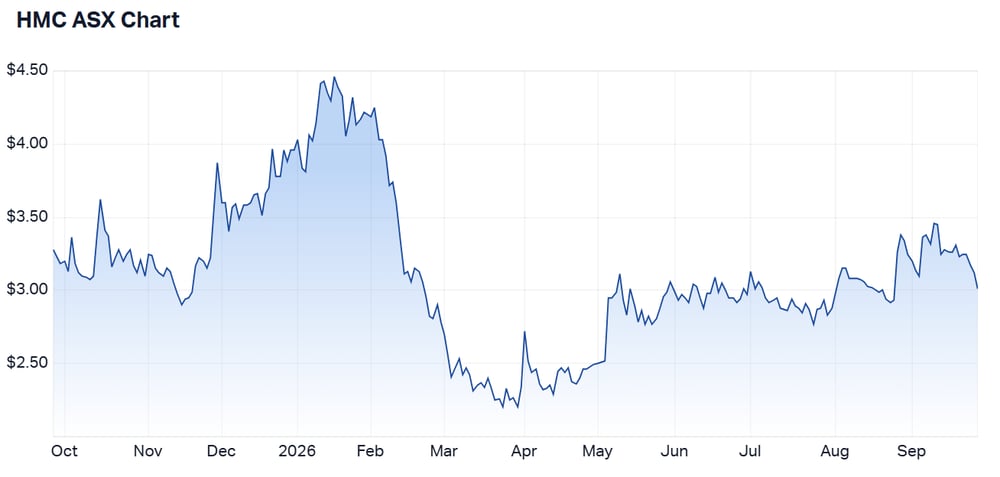
HMC 1-year price chart (Source: Market Index)
"HMC's private credit platform has transitioned into an institutional grade business and has avoided embroilment in Bathla issues," UBS said. HMC bought private credit manager Payton Capital for $127.5 million in May 2024 and has since grown the platform's assets under management from $1.5 billion to $2.3 billion, although private credit EBIT fell 28% to $13.3 million in FY26 as origination pulled back.
In June, HMC raised $1.35 billion in institutional capital for the platform, shifting away from its previous base of wholesale and high-net-worth investors, and it now has $1 billion of institutional capital ready to deploy. HMC has no exposure to Bathla loans and has flagged an attractive opportunity in the second half of 2026 as competitors deal with challenged loans and redemption pressure.
HMC shares have risen 26% since 25 March, and the stock still trades on less than 10x FY27 forecast earnings while the company guides to underlying EPS growth of 16% in FY27. UBS estimates HMC's net tangible assets at $2.22 a share once its listed co-investments are marked to market, compared with $2.95 reported at 30 June. Backing that out implies the market is valuing HMC's funds management business at just 3.8x earnings.
UBS rates HMC a Buy with a $3.80 price target and describes the valuation as "highly undemanding." The broker expects HMC to expand its share of the $224 billion private credit market, citing its well-credentialled team and track record, which includes zero principal losses in its first mortgage core fund.
The bottom line: UBS's two picks sit on opposite sides of the Bathla fallout with Centuria's re-rate depends on Bass working through its $278 million of Bathla exposure. While HMC, with no Bathla exposure and $1 billion to deploy, is positioned to take share from rivals tied up with challenged loans and redemption pressure.