TPG returns to profit in FY25 after 30% ex-dividend reset: Is it a buy now?
FY25 beat on NPAT and dividend, but guidance keeps investors cautious as shares stay under pressure.

Mentioned
KEY POINTS
- Shares fell again on Friday after the FY25 despite an in-line EBITDA outcome and beats on NPAT and dividend, attention shifted to FY26 guidance
- TPG is down about 30% since November after trading ex-entitlement to the $1.61 per share distribution
- This article breaks down what drove the post-result weakness, summarises the key broker takeaways, and sets out what to watch next
TPG Telecom (TPG) had a volatile session last Friday, swinging from an early gain to a loss. The reversal came despite the telco delivering a relatively in-line FY25 result and its strongest mobile subscriber growth since 2022.
Shares opened the session 1.7% higher at $4.08 on result day but finished 2.7% lower as investors looked past an in-line FY25 EBITDA print and focused on the outlook and mix shifts inside the mobile base.
“FY25 was a year of transformation, positioning us strongly for FY26,” said TPG CEO and Managing Director Iñaki Berroeta.
Key numbers:
Revenue $5.04bn vs. $5.00bn ests (1% beat)
Service revenue $4.18bn (up 2.2%)
EBITDA $1.66bn vs. $1.64bn ests (in line)
NPAT $60m ex-items vs. $43.4m ests (38% beat)
Full-year dividend 18 cps vs. 17 cps ests (5.8% beat)
FY26 EBITDA guidance $1.665-1.735bn vs. $1.71bn ests (1% miss at midpoint)
Capex guidance ~$750m; FY27 capex toward the higher end of $550-650m
So why did TPG fall 2.72% on result day? Let’s unpack why investors sold the stock despite FY25 being broadly in line on EBITDA with beats on NPAT and dividend.
Why did TPG fall so sharply in November?
TPG’s $1.61 per share payout was funded by its July 2025 sale of its fibre network assets and EGW fixed operations to Vocus at an enterprise value of $5.25 billion. The sale generated about $4.7 billion of net cash proceeds for the company.
TPG says it used $3 billion to fund the $1.61 per share cash distribution, comprising a $1.52 per share capital reduction plus a 9 cent unfranked special dividend.
The company’s 31 October 2025 tax update created some uncertainty because it flagged an ATO class ruling on the tax treatment of its $1.52 per share capital return. The update also warned there was “no guarantee” until the final ruling was issued.
It’s worth noting that TPG shares have traded effectively flat since November, when adjusted for the special dividend.
Why did TPG fall despite returning to profit in FY25?
UBS described TPG’s FY25 as an “overall relatively in-line result”, saying revenue was “slightly ahead of cons mainly driven by hardware revs.”
The broker then zeroed in on mix and unit economics, flagging a “continuing shift in TPG’s Consumer base from Postpaid to Prepaid.”
They also noted “postpaid subs were flat” and that FY25 Postpaid ARPU was slightly softer, suggesting either “some continued trading down or dilution.”
On the outlook, UBS pointed to FY26 EBITDA guidance of $1,665m-$1,735m, with the “midpoint relatively in line with consensus”, and capex “approximately $750m.”
TPG also guided that capex is “expected to decrease to c. $650m in FY27” and then trend within the $550m-$650m range.
UBS retained a Neutral rating and a $3.80, 12-month price target.
Where to from here
While guidance was framed as broadly steady, the midpoint came in slightly below consensus, and UBS reiterated a Neutral view with a $3.80 price target versus the prior close of $4.05.
For investors, the debate is whether subscriber momentum can offset a potential dilution in revenue quality as the base tilts toward lower-ARPU prepaid and MVNO customers, while fixed broadband remains under pressure.
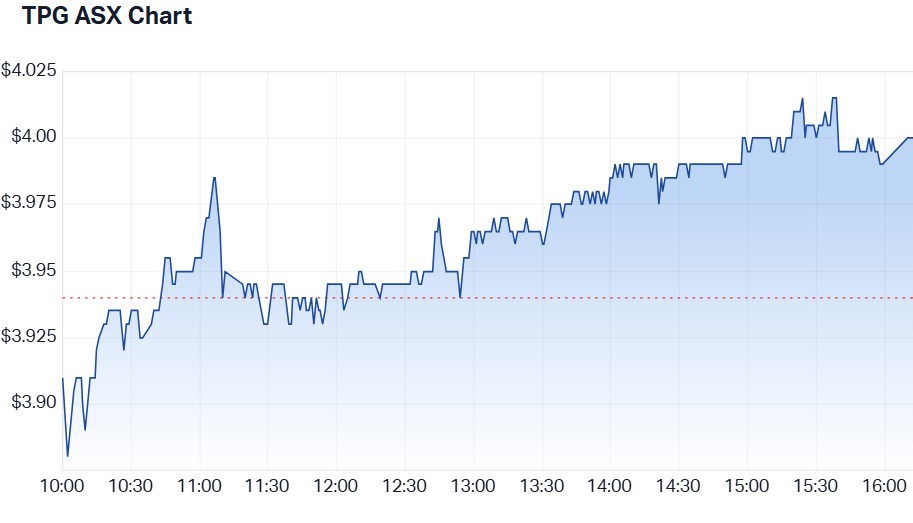
TPG gained 1.52% to close at $4.00 today.