REA Group FY26: Profit up 15%, dividends beat, but listings growth stalls
REA flexes pricing power with a clean FY26 beat, but a softer FY27 and no volume recovery keep the bulls in check.


Source: Shutterstock
Mentioned
KEY POINTS
- REA’s FY26 results came out slightly ahead across the board, with core NPAT up 15% to $650.5m and National Buy listings flat.
- The final dividend jumped 25% to $1.73 fully franked, capping full-year payouts of $2.97, even as REA braces for a softer FY27.
- With FY27 listings guided flat to down, growth rests on price: an 8% Premiere+ hike is doing the heavy lifting to keep Residential Buy yield in double digits.
REA Group’s (REA) FY26 result had something for both bulls and bears, a slight beat on profit, pricing and dividends, but flagged a softer FY27 as the business leans on rising prices rather than volume growth.
The property site you all know and love flexed its pricing power at a time where new listing volumes have tumbled amid rising interest rates, tax reforms and falling property prices.
CEO Cameron McIntyre pointed to REA's audience as the buffer, saying "more Australians trusted realestate.com.au for their property needs than ever before in FY26, with a record 12.7 million average monthly visitors."
Shares have whipsawed in early trade, fluctuating between highs of 5% and lows of breakeven.
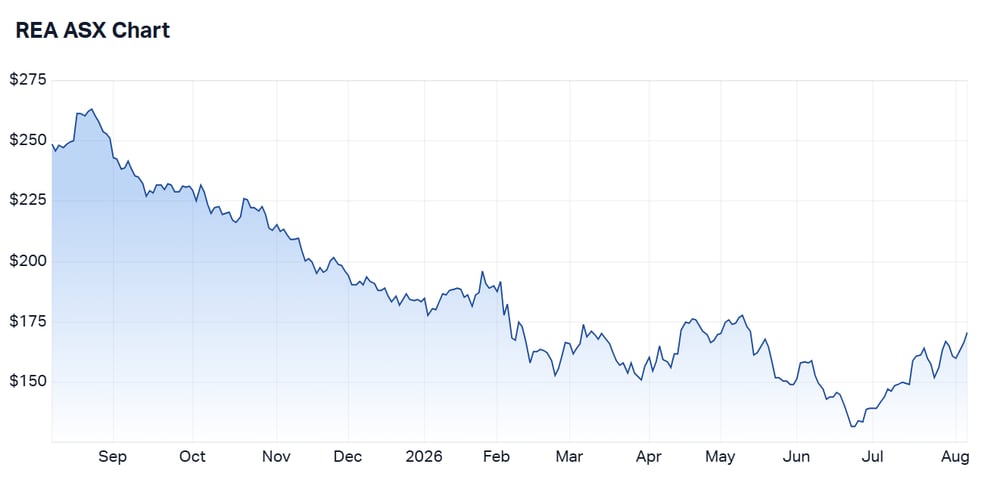
REA 12-month price chart (Source: Market Index)
FY26 at a glance
Here are the key numbers for FY26 compared to analysts expectations:
Revenue up 7% to $1,793m vs $1,790m ests (in line)
Core EBITDA (ex-associates) up 12% to $1,088m vs $1,060m ests (2.6% beat)
Core NPAT up 15% to $650.5m vs $637.3m ests (2.1% beat)
Core EPS up 15% to $4.93 vs $4.85 ests (1.6% beat)
Full-year dividends of 297c vs Macquarie 295c / Morgans 281.4c ests (beat both)
REA beat its listings guidance with yield landing on target.
National Buy listings flat (0%) vs guided 1% to 3% decline (beat)
Residential Buy yield growth of 13% vs ~13% guided (in line)
FY27 guidance
REA guided to a softer listings backdrop with yield again the main driver.
New national Buy listings flat to down low single-digits
(July listings -2% year-on-year, Melbourne and Sydney combined -16%, Brisbane, Perth and Adelaide +13%)
Residential Buy yield growth low double-digit controllable
(ex geographic mix), driven by an 8% Premiere+ price rise and growth in add-ons
Operating costs (excluding acquisitions) to rise mid single-digits for both Australia and the group, on a continuing basis that excludes India
Operating costs (including acquisitions) to rise mid to high single-digits in FY27
REA's softer FY27 guidance on listings and buy yield growth was widely expected. Morgans said in a recent note that property demand has dropped since the May budget tax changes, pointing to a 16% fall in June-quarter capital city sales, clearance rates near 50% and rising stock as turnover slows. With listings under pressure, REA is leaning on an 8% Premiere+ price rise to keep yield growth in double digits.
McIntyre argues the downturn plays to REA's strengths, betting that a weaker market pushes sellers towards the biggest audience. "Softening levels of buyer demand will see customers and vendors continue to turn to REA as they seek to differentiate their properties with our products and ensure their properties reach the largest and most engaged audience of Australian property seekers."
Beyond the listings backdrop, investors came into the results looking for REA to back up its AI commentary, contain costs and update on the India sale, and it largely delivered. AI tools are rolled out but without a disclosed revenue number, costs were held flat to lift the Australian margin to 66%, and Housing.com is being sold to Aurum PropTech with a 24.9% stake retained.
McIntyre struck an upbeat note on what comes next. "The business is well positioned for future growth with a strong foundation and balance sheet, growing audience and engagement, and an exciting product pipeline accelerated and supported by new AI applications."
The bottom line
REA delivered a clean beat on earnings, yield and dividends, and its FY26 listings held flat against guidance for a decline, a better-than-feared outcome. Yet the share price reaction was fairly volatile, with the stock continuing to bounce between breakeven and session highs of 5%.
REA is currently trading around 25x forward earnings, close to the low end of the past decade. While an argument can be made that it’s cheap, by historical standards, the lack of volume recovery and dependence on pricing will likely keep optimism at bay.
Attention now turns to FY27, where listings are guided flat to down low single-digits, and the weakness is concentrated in Sydney and Melbourne, REA's highest-value markets. Whether that is enough to reignite growth is the open question, and the October Investor Day is the next test of whether REA's audience and AI edge can justify a valuation that still assumes a return to form.
You can keep tabs on the reporting dates and key earnings numbers for over 250 ASX stocks in our Reporting Season Calendar.