REA Group earnings preview: Down 30% in a year and cheapest in a decade
A 30% fall has left REA at its cheapest earnings multiple in over a decade. The catch is nobody knows where listings bottom.


Source: iStock
Mentioned
KEY POINTS
- REA trades near 25x forward earnings against a range of low 20x to 55x, its cheapest in over a decade aside from the pandemic.
- The latest 3Q26 result (8 May) was slightly ahead of market expectations, with revenue up 11% to $398 million and EBITDA up 16% to $220 million, largely supported by lower costs and pricing power.
- June-quarter capital city sales fell 16% and clearance rates sit near 50%. Soft demand feeds into listings with a lag, making FY27 volume guidance the number to watch.
REA Group (REA) has been gutted in the past 12 months, down 30% to levels not seen since December 2023.
The indiscriminate SaaSapocalypse kicked off the sell-off late last year, and the recent downturn in the Australian housing market compounded it from there.
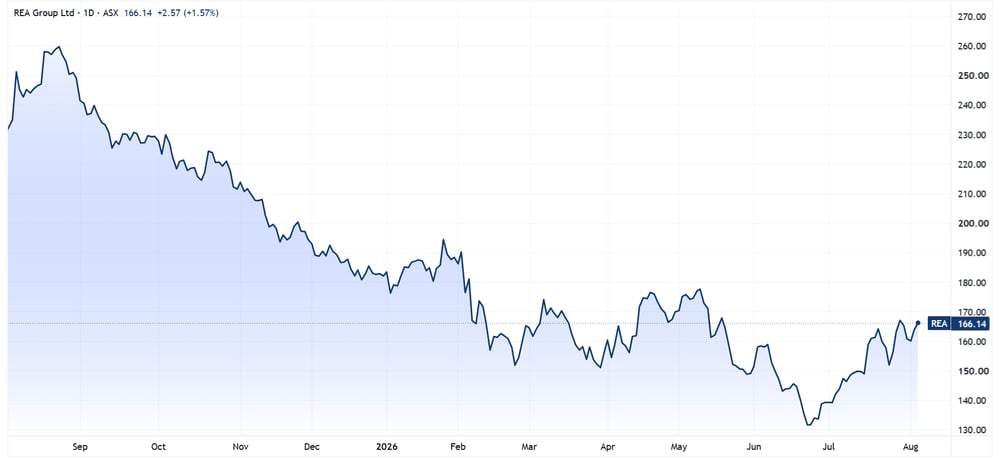
REA Group 12-month price chart (Source: TradingView)
The latest commentary from Cotality paints a downbeat outlook for the all-important listing volumes.
“We have observed a deterioration in the flow of new listings across the country in recent weeks, led by Sydney, as potential vendors assess a weak market and choose to wait until conditions improve. However, this trend has lagged the decline in demand, as evidenced by total listings numbers that have continued to track higher.”
"Nationally, total home listings sat 1.1% below the five-year average over the four weeks ending 26 July, up from 25.9% below average in mid-January. Among the combined capitals, advertised supply is now 5.7% above average."
Since the February result
REA shares have traded relatively flat since the 1H26 result on 6 February. The only market-sensitive announcement to have dropped since the half-year result was the 3Q26 update on 8 May, which reported:
Revenue up 11% to $398m
National Buy listing volumes up 1%
EBITDA up 16% to $220m
FY26 outlook commentary was fairly consistent, with buy yield guidance tightened to 13% (from 12-14%) and costs guided to slightly lower year-on-year
FY26 national residential Buy listing volumes unchanged at a 1-3% decline
The stock rose 1.3% ($176.89) on the day, with the 3Q26 result slightly ahead of market expectations on the back of yield expansion and cost management.
Macquarie (8 May) retained a Neutral rating and trimmed its target price to $190 (from $200) after the update, noting, "REA is quickly incorporating AI products and is carefully managing costs, considering the backdrop, but on the flip side, there looks to be modest caution on FY27 revenue drivers (i.e., buy-yield and volumes)." The latest Macquarie note (20 July) kept the Neutral rating, though the target price dipped further to $165.
"The Australian housing market is challenged with reform impacts, which we see negatively impacting listing volumes, house prices and possibly buy-yield," noted the analysts.
FY26 results: Key metrics
Here's what Macquarie and Morgans expect REA to deliver for FY26.
Macquarie | Morgans | |
|---|---|---|
Revenue ($m) | 1,804 | 1,785.5 |
EBITDA ($m) | 1,064 | 1,075 |
EBITDA margin | 61% | 60.2% |
NPAT ($m) | 641 | 640.1 |
Dividend (cps) | 295 | 281.4 |
Source: Macquarie, Morgans
Morgans notes that property demand has tumbled since the May budget tax changes, with June-quarter capital city sales off 16%, clearance rates near 50% and stock building as turnover slows. That soft vendor demand usually feeds into listings with a lag, so FY27 volume guidance at the full-year result is the number to watch. The analysts still expect REA to deliver a solid yield outcome in FY27, underpinned by an ~8% average national price increase.
Macquarie forecasts FY27 EBITDA of $1.24bn, up 11% year-on-year, though that hinges on listing volumes and the sale of REA India.
The bottom line
REA is reporting into a challenging macro backdrop. The headwinds for property prices and new listings are well documented, but the depth and duration of the downturn are anyone's guess. For all its quality, that may not be enough to outrun the metrics that fuel its earnings and valuation.
Macquarie notes that REA's price-to-earnings ratio has ranged from the low 20x at its cheapest to a peak of 55x during the 2020–21 housing boom. The stock is currently trading around 25x forward earnings, close to the low end of its historical range. Cotality's sales volumes (on a three-month average) move largely in step with that multiple, bottoming around 27,000 at the 2019 trough and peaking near 55,000 in 2020–21. Monthly home price growth also peaked near 3% during the 2020–21 upswing before falling to around –1.5% through the 2022 rate-hike cycle, which coincided with REA's multiple moderating from ~55x to 30x. It has since softened back towards 0% as at June 2026.
So the encouraging factor heading into the result is that REA shares have gone nowhere since February and are trading at their cheapest multiple in over a decade, the pandemic aside. But even then, how does the growth outlook improve from here? The company needs to back up its AI commentary, provide confidence around cost efficiency and retain its target of double-digit yield growth over the medium term.
You can keep tabs on the reporting dates and key earnings numbers for over 250 ASX stocks in our Reporting Season Calendar.