Is the RBA's rate hike the start of a bad debt cycle for ASX 200 banks?
Big four bad debts are low, but Morgan Stanley says the latest RBA hike makes a 2027 loan loss cycle more likely than the market expects.


Source: Chat GPT
Mentioned
KEY POINTS
- The banks have spent the year quietly topping up provisions against a downturn that has not arrived, all while telling investors credit quality is sound.
- With the cash rate back at 4.60% after a fourth hike and house values falling six months running, the question is whether a bad debt cycle has begun.
- We look at what is different this time compared with the last hiking period, and why one broker expects bad debts to climb from FY27.
Australia's major banks have spent this year telling investors that credit quality is sound while setting aside more money in case it isn't. They tied the extra provisions to changes in how consumers are spending and early signs of weaker loan quality, against a backdrop of cost-of-living pressure, higher interest rates, the Middle East conflict and the Budget's tax changes.
With the RBA lifting the cash rate for a fourth time this year to 4.6% this week and house prices falling, could this be the moment when the bad debt cycle begins?
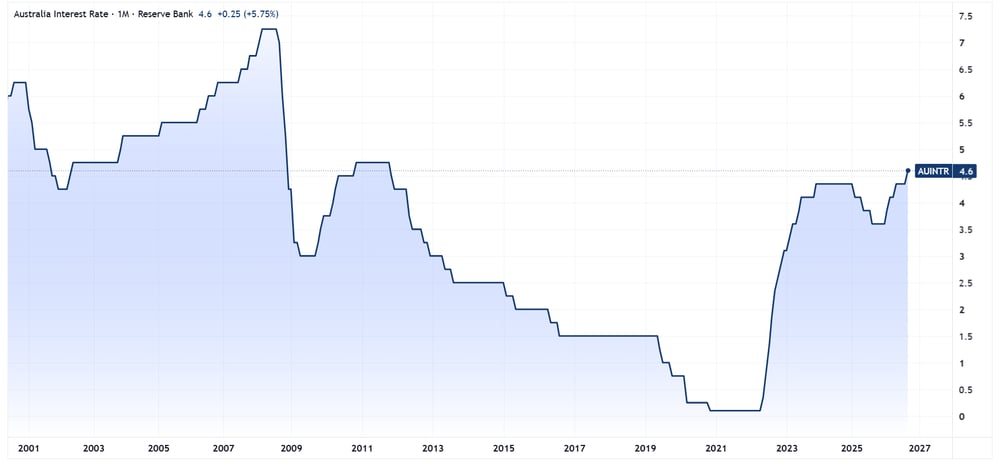
Australian Cash Rate (Source: Trading View)
Morgan Stanley said in a 1 October note that the resumption of the tightening cycle increases the probability of a loan loss cycle for the banks in 2027, and that this risk is not reflected in consensus estimates or bank valuations.
This article looks at Morgan Stanley's case for higher loan losses, how the banks came through the last hiking cycle, and what has changed since then.
Morgan Stanley's case for a loan loss cycle
Morgan Stanley agrees with the banks that credit quality is sound today, but says many of the lead indicators it tracks warrant caution for non-housing loans. Those indicators include house prices, fuel costs, business conditions, unemployment, insolvencies, business deposit growth and the number of loans banks have put on watch.
Consensus forecasts have the majors impairment charges to only tick up only slightly next year, which Morgan Stanley says leaves no room for error. The broker’s own FY27 forecast sits 12% above consensus for the four majors, ranging from 9% above at ANZ Group (ANZ) to 14% above at National Australia Bank (NAB), with Commonwealth Bank of Australia (CBA) and Westpac (WBC) both 12% above. It estimates a 10bps rise in loss rates would cut each major's FY27 earnings by between about 7% and 10%.
Morgan Stanley says the majors’ elevated trading multiples leave bank share prices vulnerable. The Big Four trade on an average PE multiple of 18x (or 15.8x ex-CBA), compared to the post-COVID five-year average of 16x (or 13.5x). The last time investors worried about a potential loan loss cycle, in 2023, valuations among the majors eased to 12-15x (or 10.5-13x ex-CBA).
Collective provisions are currently sitting above historical levels, which gives the banks room to release some of them and soften the hit to earnings if losses on individual loans rise. However, Morgan Stanley believes share prices would still fall if the banks made large releases at the start of a loan loss cycle.
Lessons from the last hiking cycle
The RBA lifted the cash rate by 4.25 percentage points between May 2022 and November 2023, yet the majors' losses only reached about 20 to 25bps of non-housing loans in FY23 and FY24. Morgan Stanley puts that down to COVID-era savings buffers, government spending, strong population and jobs growth, and rising house prices.
Losses have run far higher in past downturns, averaging about 120bps of non-housing loans from FY08 to FY10 during the Global Financial Crisis (GFC) and reaching about 115bps at the height of the pandemic. Morgan Stanley notes Australia hasn't had a "home grown" loan loss cycle, one driven by domestic conditions rather than a global shock, in about 35 years.
Since the GFC, the majors' losses averaged about 70bps of non-housing loans when the cash rate was last above 4.5%, and about 35 to 40bps when unemployment was last above 5%, excluding COVID, according to Morgan Stanley. The five years before COVID averaged about 41bps.
With the cash rate now at 4.60%, consensus has FY27 losses at about 30 bps, below the pre-COVID average and well below the 70bps the majors averaged the last time the cash rate was above 4.5%.
What's changed since 2023
Rising house prices were one of the buffers Morgan Stanley credits for keeping losses low in the last cycle, and they are now falling. Cotality's national Home Value Index fell 1.1% in September, its sixth straight monthly decline, leaving values 5.2% below their March peak, with almost every capital city suburb recording a fall over the past three months.
Household savings, another of those buffers, are much thinner than when the last hiking cycle began. The household saving ratio was 6.5% in the June quarter, according to the ABS, less than half the 13.5% recorded in 2021-22, the financial year in which the RBA started lifting rates.
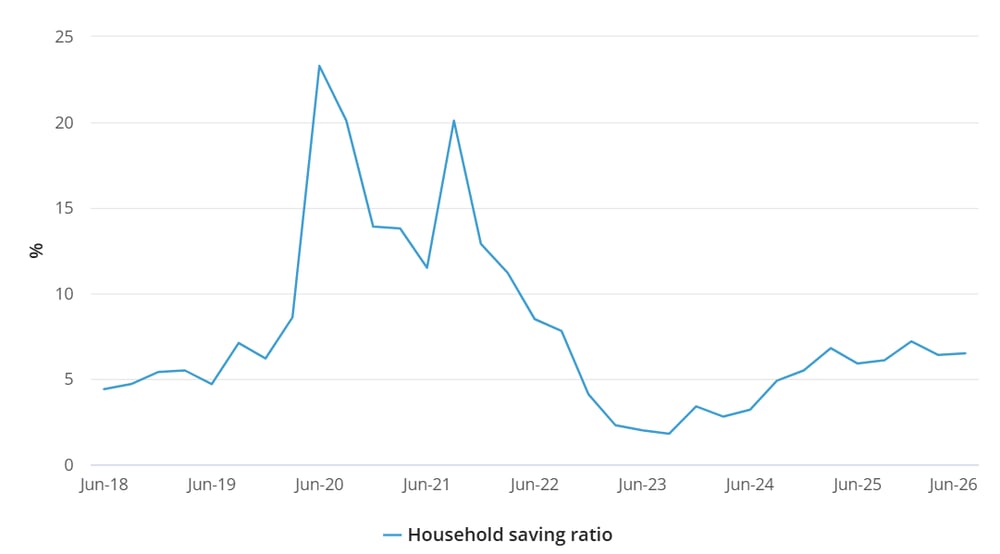
Australian Household Saving Ratio (Source: ABS)
The bottom line
The banks have been building provisions for a downturn that has yet to show up in their losses, and Morgan Stanley's argument is that consensus forecasts and share prices leave no room for that to change. With two of the buffers that protected the banks in 2023 weaker today and the RBA signalling it could hike again, the broker sees a rising probability of a loan loss cycle in 2027.
ANZ, NAB and Westpac hand down their full-year results in November, the first chance to hear how they view credit quality after the latest hike. Morgan Stanley has a cautious view on the sector, with ANZ its only Overweight-rated major, while CBA, NAB and Westpac are all rated Underweight.