How safe is your job? Australian economy sheds 43,500 jobs as unemployment hits four-year high
A second monthly slide in employment has pushed the jobless rate to 4.9% – and it lands as inflation and wages are still running hot.


Source: ChatGPT
Mentioned
KEY POINTS
- Australia's unemployment rate has risen for three straight months, from 4.5% in July to 4.9% in October – its highest level since October 2021 and a far cry from the labour shortages of the post-pandemic recovery.
- October's Labour Force survey showed 43,500 jobs lost against economists' forecasts for a 25,000 gain – the second large monthly fall in a row – with part-time workers and young Australians bearing the brunt.
- We look at where the job losses are falling, why ASX consumer stocks have been warning of exactly this, what the major investment banks expect next, and what it all means for the RBA's December meeting.
For most of the post-Covid period, the labour market was the Australian economy's strongest pillar. Recent data suggests that pillar is cracking. Over the 12 months to October, the number of unemployed Australians rose by 95,400, or 14.5%, while employment grew by just 83,500 – meaning more people joined the jobless queue than found work.
The Australian Bureau of Statistics' (ABS) Labour Force survey released today showed seasonally adjusted employment fell by 43,500 in October, well short of economists' forecasts for a 25,000 increase. It follows September's 36,400 decline, and pushed the unemployment rate to 4.9%, with 753,700 Australians now looking for work.
In this article, we unpack who’s losing their jobs, how corporate Australia has been flagging the slowdown for weeks, and what the economists at the major investment banks expect from here – including what today's numbers could mean for the Reserve Bank of Australia (RBA).
Part-timers first in the firing line
Part-time employment fell by 40,600 in October, while full-time employment slipped by just 2,900. September told the same story: full-time jobs rose by 35,400 while part-time jobs fell by 71,800. Across the two months, that's roughly 112,000 part-time positions gone against a net gain of around 32,500 full-time roles.
Consider that the Australian economy has shed jobs in three of the last four months, and the chart below appears to show a sharp downturn since July (i.e., following the first three of five RBA official cash rate hikes this year).
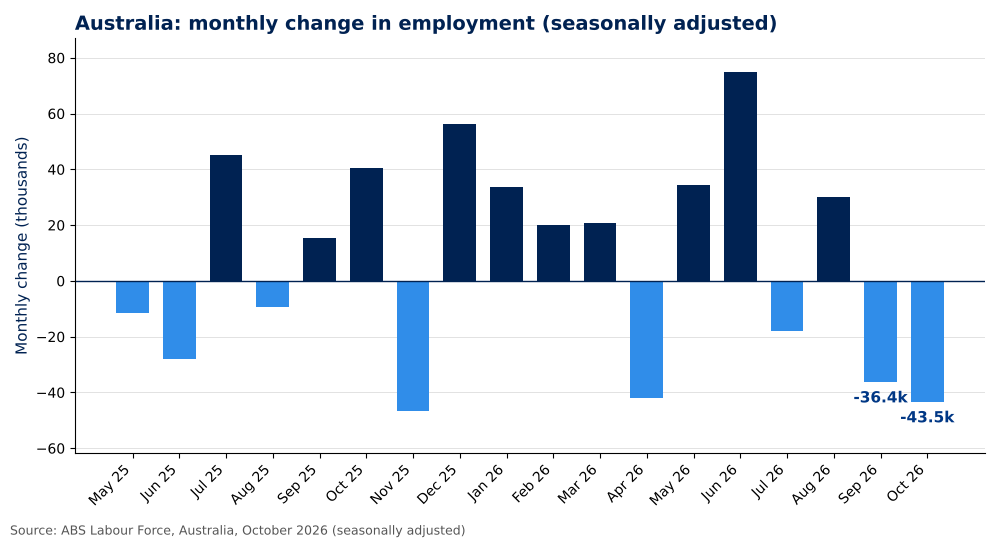
Australia: monthly change in employment (seasonally adjusted). Source: ABS Labour Force, Australia, October 2026 (seasonally adjusted)
Hours worked fell 0.2% and the participation rate eased to 66.6%. Fewer hours worked means there’s less work to go around – a leading indicator that employers are pulling back on their labour requirements. A falling participation rate, meanwhile, suggests more Australians are becoming discouraged about finding work and stepping out of the jobs market altogether.
Youth unemployment rose to 11.3% from 11.1%, the highest since October 2021, signalling that younger workers are taking the hardest hit. Consider that jobs for new entrants to the workforce are typically the first to go at the beginning of a protracted downturn in hiring.
Corporate Australia saw this coming
ASX companies have been sending a signal for months now that the local economy is beginning to bear the brunt of higher interest rates and a sharp downturn in consumer confidence.
Nick Scali (NCK) told the market on 21 October that Australia-NZ written sales orders fell 15% in the first quarter of FY27, with store traffic down about 10%. The furniture retailer expects first-half revenue for the region to land 11–14% below the prior year.
JB Hi-Fi (JBH) reported a 1.4% fall in comparable sales at JB Hi-Fi Australia for the September quarter, and said sales had slowed in October ahead of Black Friday and Christmas. Customers, it said, remain focused on value and are increasingly holding out for promotional events.
Eagers Automotive (APE) said on 5 November that third-quarter trading in Australia was hit by industry-wide headwinds, citing the elevated interest rate environment, persistent inflationary pressures and higher fuel prices. APE still expects record revenue for calendar 2026, largely on the back of acquisitions.
There are many more. The problem facing Aussie retailers is that margins are being squeezed from both ends. Just yesterday, the ABS reported the wage price index rose 3.5% over the year to the September quarter, above expectations according to Macquarie, which notes the result was largely driven by the Fair Work Commission's 4.75% award wage increase.
Meanwhile, UBS's reading of the latest business confidence survey showed selling prices easing to 2.4% annualised in October while purchase costs remain very high – which the investment bank says implies significant margin compression.
What the experts are saying
Macquarie also noted that SEEK job ad volumes were down 6% year-on-year in October, while applications per ad hit a record 239 in September – i.e., fewer jobs, and more people chasing what’s there. Looking forward, the bank sees limited evidence of a sustained recovery in ad volumes, pointing to weakening business confidence and rising unemployment.
Morgan Stanley, in its 2027 outlook for the Australian economy released this week, expects sticky core inflation to keep the RBA cash rate on hold at 4.85% through the first half of 2027, before rising unemployment creates enough slack for two rate cuts before year’s end.
UBS is on the same page regarding the next rate cut – tipping November 2027. Its analysts believe rates may ease 50 basis points from there, but they caution that risks are now shifting towards an earlier or larger round of cuts, given the sharper-than-expected housing downturn and rapidly weakening consumer and business sentiment.
What to watch next
Today's data is a sobering reminder that the economy is entering a dangerous phase – inflation still well above the RBA's 2–3% target, a labour market shedding jobs, and growth slowing. UBS expects October's monthly CPI to show headline inflation at a new cycle high of 4.7% year-on-year, suggesting the inflation picture is likely to worsen still.
That CPI print is due on 25 November (next Wednesday), and markets will be watching it closely. Then, we’ll have the RBA's December meeting on 8 December and November's Labour Force data on 17 December to round out the year. A third consecutive fall of the size seen in September and October would certainly get the RBA’s attention – and would make it harder for Treasurer Jim Chalmers to argue, as he did after September’s numbers, that the labour market “remains resilient and one of our greatest strengths”.
References: This article draws on the ABS Labour Force, Australia, October 2026 release (19 November 2026) and the ABS Labour Force, Australia, September 2026 release (15 October 2026); ASX announcements from Nick Scali (Trading Update and 1H FY27 Profit Guidance, 21 October 2026), JB Hi-Fi (FY27 Sales Update, 29 October 2026) and Eagers Automotive (Trading Update, 5 November 2026); and broker research from Macquarie (Australian Wages Growth, 18 November 2026; Australian job ad volumes, 18 November 2026), Morgan Stanley (2027 Australia Macro+ Outlook, 16 November 2026) and UBS (Australian Economic Comment, 10 and 13 November 2026).