Director transactions explained: What those ASX filings really tell investors
Nobody knows a company better than its directors – so when one buys or sells their own stock, it may be telling you something.


Source: Chat GPT
KEY POINTS
- Directors must tell the market when they buy or sell their own stock, and they can't do it whenever they like – companies lock them into trading windows and blackout periods, and even then, they can't trade on inside information.
- So what does it mean when a director buys? Probably more than when one sells, but there are subtle nuances in reading official director transaction filings.
- In this article, we explain what investors should consider when reading changes in directors’ interests and how to tell when a move might signal it’s time to buy or sell.
Most of us are guarded about our finances and what we trade is nobody’s business, but a director of an ASX company isn’t afforded that luxury.
Directors must declare how much they own of their company's stock and when that position changes. The Australian Securities and Investments Commission (ASIC) enforces that obligation under the Corporations Act – and since 2001, ASX listing rules have set the clock at five business days from the trade.
This article examines why directors must be transparent about their shareholdings and what investors might be able to learn when they buy or sell.
Who are directors and why must they declare their transactions?
A director of an ASX listed company is an elected member of the board who guides strategy, oversees management and represents the financial interests of public shareholders. They will meet around 8 to 12 times a year at board meetings to make important decisions.
Directors are paid, often very well, to fulfil these duties and most companies also incorporate mandatory or voluntary share ownership for those working on the board. As soon as a director becomes a shareholder, it is a strict requirement for them to declare both their initial shareholdings and any subsequent trades or changes to their interests.
Director transaction requirements are enforced to eliminate the heavy disadvantage everyday investors are at. This is because directors naturally possess private, forward-looking knowledge about a company’s financial health, product pipeline, or impending failures.
If a director is aggressively buying or selling their own company's stock, the broader market has a right to know, so they can price that behaviour into their investment decisions.
When can directors trade in their company’s shares?
To stop directors trading on confidential company information ahead of the rest of the market, companies restrict when they can buy and sell. Every company must have a trading policy, but they can decide on its shape. Here are the two common types:
Trading windows: Directors are typically permitted to buy or sell shares only during a 15 to 30 day window immediately following major public announcements. These windows open right after:
The release of full-year financial results.
The release of half-year financial results.
The release of quarterly cash flow or activities reports (common for mining and tech sectors).
The conclusion of the company’s Annual General Meeting.
The launch of a prospectus or a formal disclosure document offering new securities.
Blackout periods: Conversely, directors are strictly barred from trading during the lead-up to these major financial announcements. A blackout period usually locks down 4 to 6 weeks before half-year or full-year earnings are made public, as this is when financial data is being compiled and the risk of insider knowledge is highest.
The overriding legal vetos: Even if a company’s approved trading window is open, a director is legally banned from trading if they possess inside information (i.e., material, price-sensitive information that is not yet public). Trading while holding inside information is a severe criminal offence under the Corporations Act 2001.
How directors trade their holdings
An everyday investor can just hop onto a trading platform and buy or sell whatever they choose. A director, though, has to jump through hoops to execute a trade in their company's stock.
First, they must seek written clearance, by submitting a formal intent notice to the board chairman or designated compliance officer. Then they may execute their trade either on or off market, after which the director has a strict obligation to provide a written trade confirmation to the company secretary.
Then the company must lodge a Change of Director’s Interest Notice (Appendix 3Y) with the ASX within five business days of the trade occurring. This document then becomes public information, explicitly detailing the date of the trade, the exact number of shares, the price paid, and whether it was executed on or off market.
What does it mean when a director buys or sells?
It is not required for directors to provide a reason for why they made their trade, but there’s some logic to be followed for when any investor buys: nobody buys expecting to lose. Selling, however, may be far less meaningful because a director may sell for a hundred reasons that have nothing to do with the business. These could include paying a tax bill, settling a divorce agreement, meeting their personal expenses, or simply owning too much of their stock (portfolio risk rebalance).
There has also been some research that suggests insider trades make for useful signals as a colleague at Livewire has written. University of Michigan professor Nejat Seyhun, in his book Investment Intelligence from Insider Trading, studied more than one million transactions across 21 years, ending in the mid-1990s, and found stocks tended to outperform the market after insiders bought, and underperform after they sold.
According to Li, Wang, Yan and Zhang, whose 2019 study in the Journal of Portfolio Management covered insider trades from 1986 to 2017, director purchases carry more weight than sales. Their study found that the return difference between director buys and sells was more pronounced for buys.
The same authors found insiders are more likely to buy when their stock is near its 52-week low, and steadily less likely to buy the closer it trades to its 52-week high. But the rarer purchases near the high were the ones that paid: stocks bought near their highs returned at least 3.3% over the following 30 days than stocks bought near their lows.
These were studies conducted using US trades, but they provide transferable insights into director trades here in Australia.
ASX case studies
The research above describes averages across more than a million trades. Individual trades are often messier. Here are a couple examples from the ASX, one sale and one purchase.
WiseTech (WTC): An example of why the timing of a director’s sale attracts scrutiny. Richard White stepped down as chief executive in October 2024 and moved into what the company called a full-time consulting role, returning as executive chairman in late February 2025. White offloaded 3.6 million shares between 2 October and 20 December 2024 pulling in more than $440 million. Those sales were disclosed to the market and fell outside of the company’s blackout period.
From 24 December 2024 to 19 February 2025, White sold a further 1.87 million shares for roughly $229 million at an average price of ~$122 a share. These sales fell inside WiseTech’s blackout period and were not reported to the market.
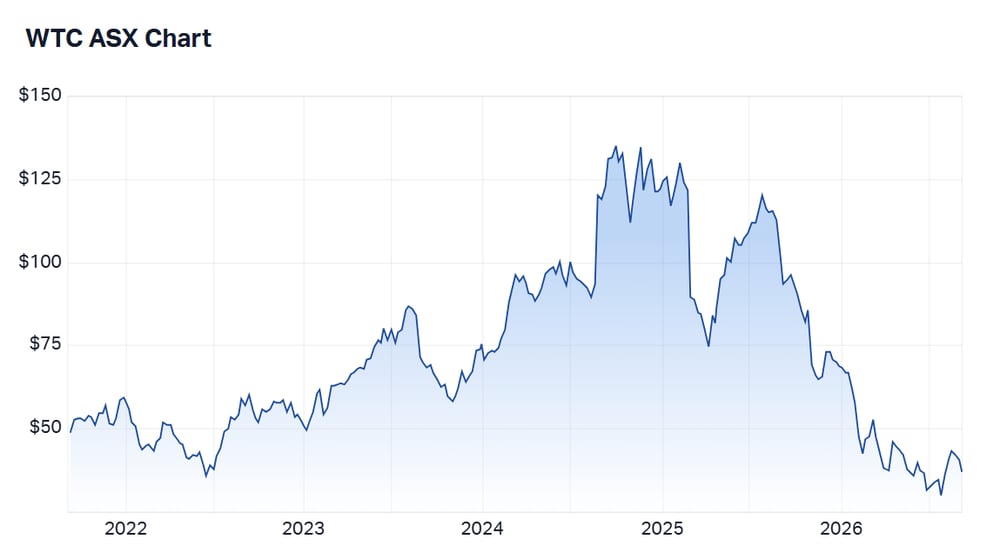
Wisetech 5-year price chart
In October 2025, ASIC and the Australian Federal Police executed search warrants at the company's Sydney office as part of an investigation into whether White engaged in insider trading. The shares fell about 16% that day to $71.52.
White has said he obtained legal advice before trading and was not an executive or director at the time, no charges have been laid against any person, and WiseTech has said there are no allegations against the company itself.
Wisetech’s shares are currently trading at $37.08, less than a third of the ~$122 White sold at.
Guzman y Gomez (GYG): Where Wisetech is an example of selling into a falling share price, Guzman y Gomez is an example of buying into one. Co-founder and co-CEO Steven Marks bought 45,000 shares on 19 November 2025 at $22.35 each, spending just over $1 million and lifting his holding to 9.88 million shares. The stock had fallen more than 40% that year. Marks said at the time that he thought the shares were grossly undervalued and that the company had another 20 years of growth ahead of it.
Marks’ timing wasn’t perfect – Guzman y Gomez kept falling to a low of $15.06 before the company announced in May 2026 that it would exit the United States and refocus on Australia, sending the shares up as much as 20% in a day. The recovery continued until the release of the company’s FY26 results in August, which showed a strong increase in profits, a buyback, and a special dividend – sending GYG’s share price soaring past $30. Marks is roughly 27% ahead on his purchases, seven months after buying.
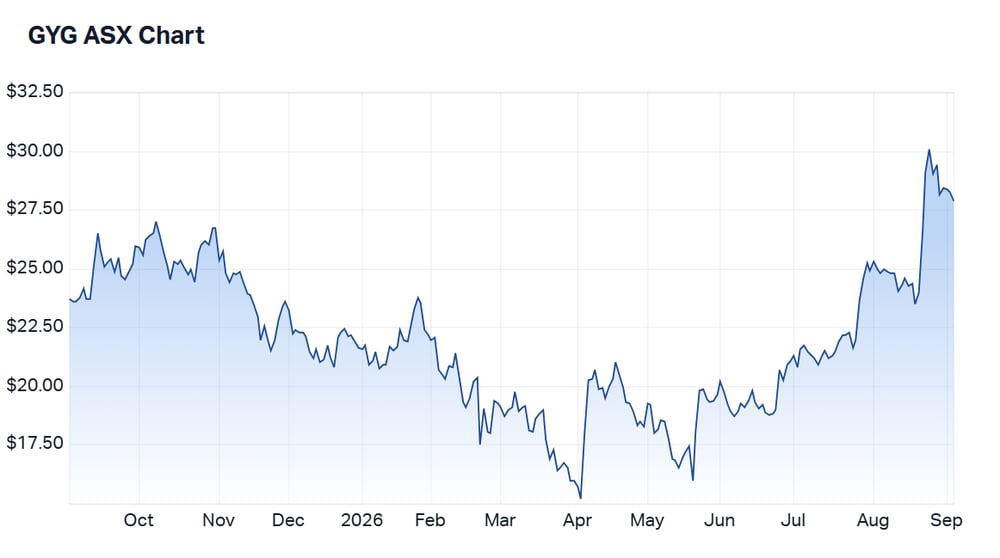
Guzman y Gomez 1-year price chart
Conclusion
Directors are held to a higher standard than everyday investors because they are privy to sensitive information which requires them to be transparent. Those disclosures are free and public, which makes them a useful check on how the people running a company view its prospects. Just remember that a purchase usually says more than a sale, and neither is a reason on its own to follow suit.
The research referenced in this article comes from two sources: Investment Intelligence from Insider Trading by H. Nejat Seyhun (MIT Press, 1998), and "Trading against the Grain: When Insiders Buy High and Sell Low" by Ruihai Li, Xuewu (Wesley) Wang, Zhipeng Yan and Qunzi Zhang, published in the Journal of Portfolio Management in November 2019.