CSL is back in form as FY27 guidance tops market expectations
A US$7.1 billion impairment drove CSL to a full-year loss, but FY27 guidance came in ahead of consensus and the dividend held.


Source: Shutterstock
Mentioned
KEY POINTS
- CSL's US$2.6 billion reported loss stems from US$7.1 billion of pre-tax impairments and US$799 million of restructuring costs, with underlying NPATA down 2% to US$3.1 billion.
- FY27 guidance for approximately 5% underlying NPAT growth sits ahead of consensus at roughly 2%, though Vifor revenue is guided to fall around 25% on iron generics and the end of the VELPHORO TDAPA period.
- CSL is on track to record its best one-day gain in over 20 years, with the share price trading at the highest since February 2026 but still down around 8% year-to-date
It feels like its been years since the words CSL, results and rally have come together in one sentence. Shares in the biotech giant are up 17% to $157.40 at noon, and on track to be its best session in over two decades, far outpacing the 10-12% rallies seen during the pandemic and GFC.
CSL (CSL) booked a US$2.6 billion loss after tax following US$7.1 billion of impairments, but underlying net profit fell 2% to US$3.1 billion, slightly above Macquarie's forecasts of US$3.05 billion. FY27 guidance was stronger-than-expected, with underlying NPAT growth guided to "approximately 5%", well-above consensus at 2%.
Interim CEO Gordon Naylor said: "CSL is positioned for a return to sustainable growth, supported by solid plasma market fundamentals, a simplified business and targeted investment in our commercial capabilities and development programs."
FY26 at a glance
Total revenue down 1% to US$15.8bn vs US$15,423m ests (2% beat)
Behring revenue down 1% to US$11.4bn, with Ig sales flat at US$6.2bn on US channel normalisation
Vifor up 3% to US$2.4bn
Seqirus down 8% to US$2.0bn on non-recurring avian flu revenue
Underlying NPATA down 2% to US$3.1bn vs. Macquarie ests of $3.05bn (1.6% beat)
Reported net loss after tax of US$2.6bn, after US$7.1bn of pre-tax impairments and US$799m of restructuring costs
Transformation program delivered ~US$176m of cost savings, ahead of target
FY26 total dividend flat at US$2.92 per share
Ahead of Macquarie ests of US$2.88, below Morgans ests of US$2.97
Announced a further $1bn on-market share buyback
FY27 guidance
Guidance is at FY26 exchange rates.
Revenue in line with FY26
Behring mid-single digit revenue growth, with Ig mid-to-high single digits, in line with the market
Seqirus low single digit revenue growth, with US immunisation rates expected to fall at a slower rate than recent seasons
Vifor revenue down approximately 25%, on iron generics
Underlying NPAT growth of approximately 5% vs. consensus of 2%
Key takeaways
RBC called it a good FY26 result with beats across revenue, EBITDA and NPATA, and said every segment exceeded revenue and gross profit expectations.
The FY27 guidance implies NPAT of around US$2.98 billion, tracking ahead of consensus at US$2.83 billion. On immunoglobulin (lg), RBC pointed to FY26 revenue growth of 4% and second-half growth of 14%, and expects the guidance beat and the second-half Ig performance to drive a strong share price move.
In the lead up
CSL had already rallied 49.5% from its 3 June low heading into the result, though it remains down 21.4% year-to-date.
Macquarie went into reporting season with CSL as its least preferred healthcare name, and nothing in this result changes that thesis. The concern is immunoglobulin, or Ig, the plasma-derived therapy that generates approximately 40% Group revenues.
They two key threats are:
Market share loss to Grifols. The Spanish rival is close to completing a Phase 3 trial for its Xembify product in secondary immunodeficiency, and a positive result would make it the first subcutaneous Ig approved for that condition. CSL's equivalent trial for Hizentra runs two to three years behind. Macquarie notes the same thing happened in primary immunodeficiency, where Hizentra also arrived second and CSL lost 2% of market share across CY24 and CY25.
The size of the Ig market itself. Complement inhibitors are a newer class of drug that treats some of the same nerve and immune conditions without plasma, and Macquarie estimates they could take 30% to 35% of Ig volumes. Argenx reads out Phase 3 data for empasiprubart in Q4 CY26 and again in 2H CY27. Dianthus Therapeutics' claseprubart comes later, and Macquarie rates it the bigger risk on how it works and how it is dosed.
The bottom line: The healthcare sector had already found its stride, with the S&P/ASX 200 Healthcare index up around 28% since early June. A broader barometer like the iShares Biotechnology ETF broke out to record highs in late June and is up 19.1% year-to-date.
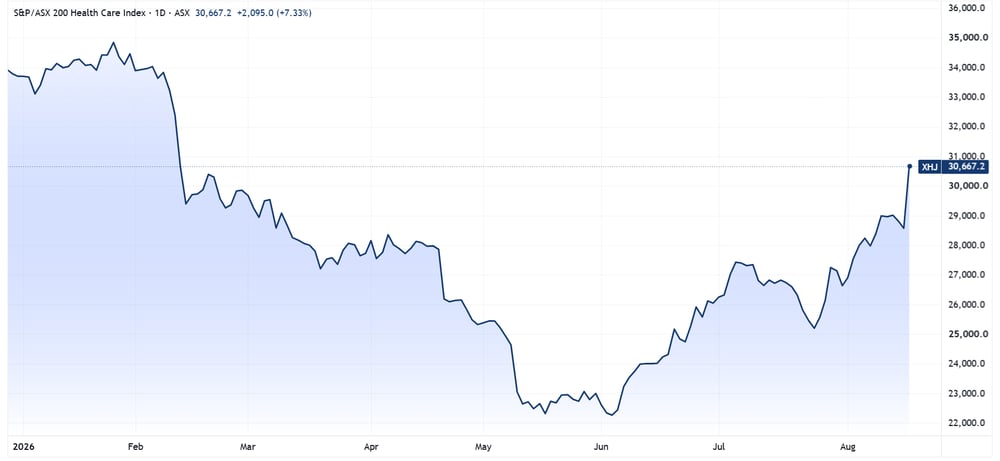
S&P/ASX 200 Healthcare Index (Source: TradingView)
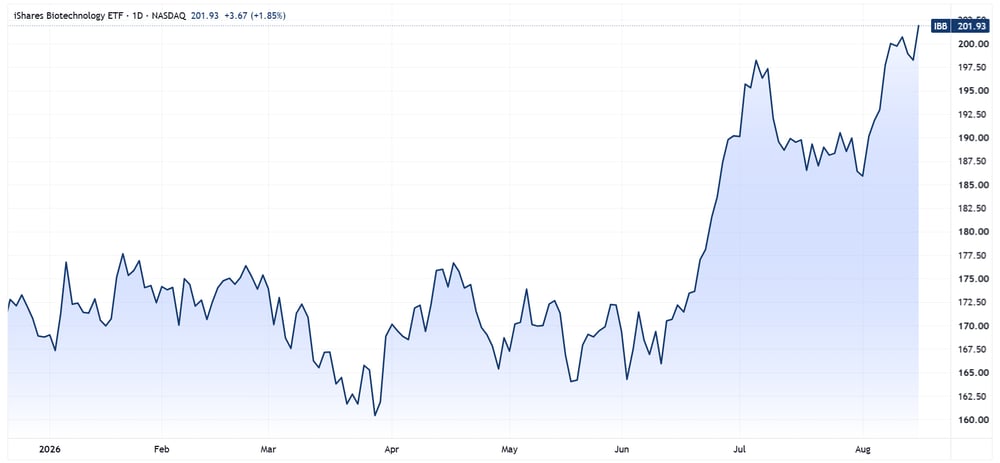
Nasdaq-listed iShares Biotechnology ETF (Source: TradingView)
Today's result is a breath of fresh air after five straight results from 1H24 to 1H26, where the shares fell between 4% and 16% each time. Today's gains take the rally off the June low to almost 75% and push CSL above its 200-day moving average for the first time since 18 August 2025. Above consensus FY27 guidance will likely drive consensus upgrades, and the second-half Ig momentum should ease some competition concerns. CSL is still far from its historic form, where it compounded at a double digit pace, but today's result marks the first sign of stabilisation.