CSL crashes to 2018 lows but now trades at cheapest valuation in 14 years
CSL shares fell to their lowest level since 2018 after a weak half-year result, $1.1bn in impairments and the surprise CEO exit.

Source: Shutterstock
Mentioned
KEY POINTS
- CSL reported a 4% drop in revenue to $8.33bn and 7% NPATA decline to $1.95bn, both missing analyst estimates, along with $1.1bn in impairments
- The company reaffirmed FY26 guidance for 2-3% revenue growth and 4.7% NPATA growth despite the weak first half and CEO transition
- CSL now trades at a trailing PE of around 17x, the lowest since 2012, though key metrics like return on equity have more than halved since the 2022 Vifor acquisition
CSL (ASX: CSL) opened 9% lower on Wednesday to its lowest level since May 2018 after reporting a weaker-than-expected half-year result.
The selloff follows a poorly timed announcement on Tuesday at 4:05 pm AEDT revealing the unexpected retirement of chief executive Paul McKenzie. Despite trading around 1.5% higher in the closing auction, the stock finished the session down 5%.
CSL has now suffered three major selloffs, including today, all tied to earnings:
19 August 2025: Shares down 16.8% after a weaker-than-expected FY25 result and poor FY26 guidance
28 Oct 2025: Shares tumbled 15.8% after the company downgraded its FY26 guidance
1H26 at a glance
The result missed expectations across the board and included hefty impairments related to its Vifor (acquired in 2022 for $16.4bn) and Seqirus businesses.
Revenue down 4% to $8.33bn vs. $8.51bn ests (2% miss)
Underlying NPATA down 7% to $1.95bn vs. $2.05bn ests (5% miss)
Interim dividend flat at 130 cps vs. 133 cps ests (2.2% miss)
Total after-tax non-restructuring impairments of ~$1.1bn, including $843m in intangible assets (CSL Vifor impacted by generics) and $170m in property, plant and equipment
FY26 guidance and outlook
CSL reaffirmed FY26 guidance, including revenue growth of 2-3% and NPATA growth of 4.7%. But reiterating guidance after a weak first half and CEO transition offers little reassurance.
The outlook statement noted:
CSL Behring: Second-half growth expected from Ig, albumin and newly launched products
CSL Seqirus: Lower second-half result expected due to normal seasonality of the global influenza business and non-recurring avian influenza outbreak revenue in FY25
CSL Vifor: Continues to face headwinds from generic competition in iron products
CSL remains focused on its transformation program to position for future growth
Where to from here?
CSL now trades at a trailing price-to-earnings of around 17x, the lowest since mid-2012 when the stock was trading around $45.
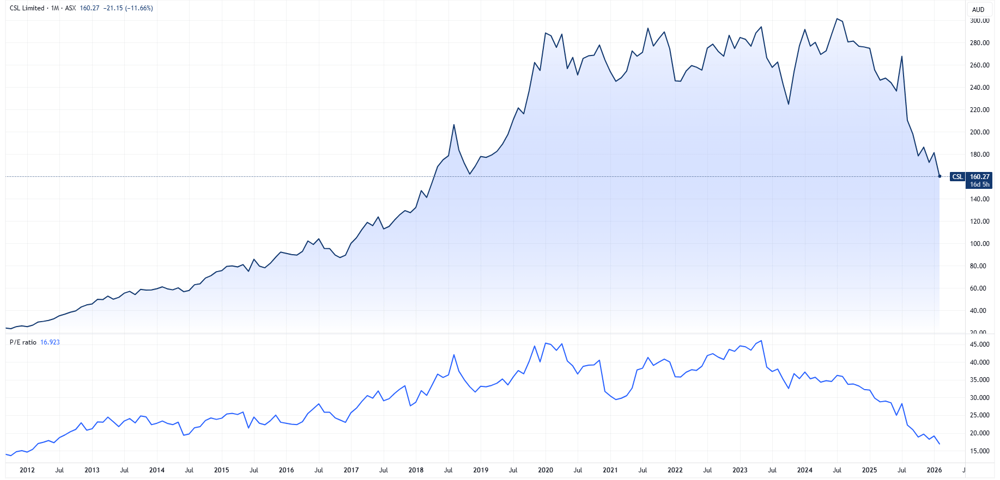
CSL share price (TOP) and price-to-earnings (bottom) | Source: TradingView
On one hand, CSL is trading at its cheapest level in 14 years, with a CEO reset and reaffirmed FY26 guidance.
However, this valuation reflects how dramatically its returns have deteriorated since the Vifor acquisition in 2022, compounded by ongoing structural challenges with albumin revenue in China and US vaccinations.
Before the 2022 Vifor acquisition, CSL delivered annual return on equity and return on assets of 30-40% and 14-15% respectively (FY16-21). These metrics have more than halved in recent years, falling to the low teens and mid-single digits.
The CSL we know today is very much a shell of its former self, facing structural challenges that explain the company's focus on cost cuts and efficiency.
While analysts have yet to update estimates on today's results, broad share price target cuts appear likely.
CSL has experienced a strong intraday bounce, likely driven by its cheap relative valuation and extreme oversold levels. The stock opened 8.9% lower ($156.01), dipped as much as 12.3% in early trade ($150.21) and is now down around 6% to $160.44.
A low valuation relative to history can work in CSL's favor if the company can show signs of a turnaround or meet its full-year guidance. But for now, the second-half growth task looks steep.