BHP pays highest dividend in four years as FY26 profits soar 30%
BHP’s $13.7 billion profit beat analysts forecasts and helped the miner pay its highest dividend in four years.

Source: Shutterstock
Mentioned
KEY POINTS
- Copper prices jumped 35% and dragged the whole result higher, lifting underlying profit past forecasts and making the metal BHP's biggest earner for the first time.
- That profit strength flowed to shareholders with its full-year dividend hitting a four-year high.
- This article looks at how FY26's star performer could take a step back in FY27, as Escondida's grade falls, before the growth pipeline pushes copper forward again.
BHP (BHP) was already positioned to deliver an operationally strong FY26 result, after its July quarterly confirmed record iron ore production and a second straight year of copper output near 2 million tonnes. Now the FY26 financial report is out we can see how good it was for the miner’s coffers.
The result underlined BHP's continued pivot toward copper, with the metal accounting for 54% of group underlying earnings for the first time as higher prices pushed it ahead of iron ore.
“We met or beat guidance across much of the portfolio and achieved industry-leading cost positions,” said BHP CEO Brandon Craig. “This reliability, together with strong prices, drove a big lift in earnings,” he added.
The operationally clean result, coupled with a better-than-expected dividend was well-received by the market, with BHP shares currently up 3.0% to $64.07.
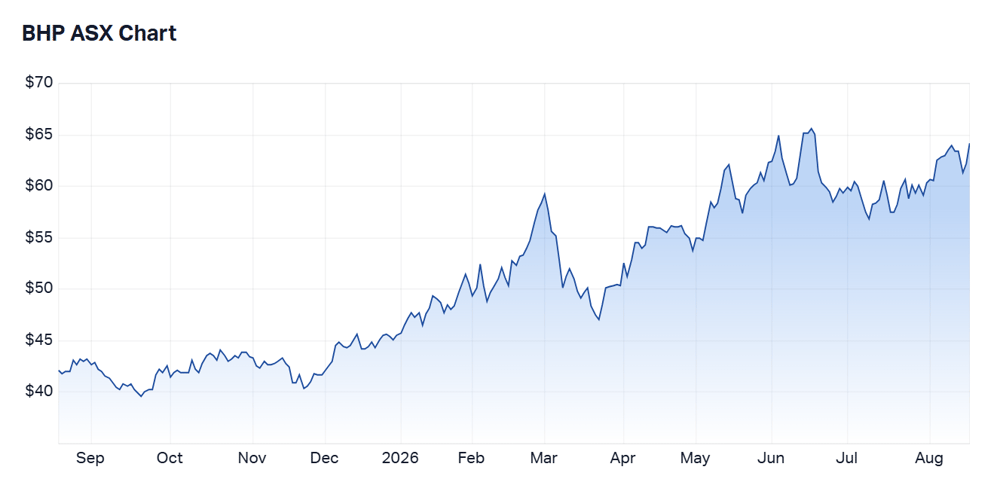
BHP 1-year price chart (Source: Market Index)
BHP FY26 financials in focus
Revenue up 15% to US$58.8bn vs US$57.96bn ests (1% beat)
Underlying EBITDA up 27% to US$32.9bn vs US$32.2bn ests (2% beat), with copper contributing 54% at a 70% margin
Underlying attributable profit up 30% to US$13.2bn
Free cash flow up 83% to US$9.8bn, with net operating cash flow up 17% to US$21.8bn
Net debt of US$8.7bn, below the US$10-20bn target range, with gearing of 13.4% and ROCE of 26.1%
Capex up 5% to US$10.3bn, funding a copper pipeline targeting ~40% production growth by FY35
Fully franked final dividend of US 99 cps at a 72% payout, the largest in four years
FY26 total dividend of US 172 cps vs. Morgans and Macquarie ests of 157.7 and 160 cps respectively (9% and 7.5% beat)
Average realised copper prices rose 35% to US$5.74/lb year-on-year, lifting copper’s underlying EBITDA 48% to a record US$18.2bn. Craig called copper "the engine that is driving BHP's growth," pointing to a self-funding pipeline across Chile, Australia and Argentina that could lift copper production by approximately 50% to 2.5Mt by mid 2030.
FY27 guidance
FY27 copper guidance of 1,650-1,800kt marks a step down of roughly 12% at the midpoint from FY26's 1,953kt, a planned fall driven mainly by Escondida's grade slipping to around 0.70% from 0.90%.
Iron ore guidance holds broadly flat while steelmaking and energy coal are both guided in line with FY26. Capital spending rises modestly, funding the copper pipeline alongside first potash from Jansen Stage 1 next year, with the tax rate guided broadly in line with FY26.
BHP’s economic outlook
In its economic outlook, BHP expects global growth to slow to around 3% in CY26 before improving in CY27, supported by fiscal policy, electrification and AI-related investment. China is seen holding broadly within its official 4.5-5% growth target and India remains the fastest-growing major economy, though the Middle East conflict is lifting energy prices and pressuring inputs such as diesel, sulphuric acid and ammonia, feeding into projects like Jansen.
The company added that it expects global demand for copper to rise from about 34Mtpa today to more than 50Mtpa by 2050, driven by electrification, data centres and AI.
The bottom line: BHP delivered a clean FY26 result, which continues to lean on its strengths, including its high-margin WAIO business, a growing copper earnings contribution and a better-than-expected dividend off a slightly higher payout ratio. While copper production is slated to fall in FY27, the company’s results presentation highlights an “attractive pathway to deliver a ~50% increase” in copper production to 2.5Mt by mid 2030s. Iron ore prices have been volatile and slumped to five-month lows of US$95 a tonne in recent weeks, yet with BHP costs sitting around US$19 a tonne, margins remain strong. Against a backdrop of copper prices pushing record highs and global copper supply struggling to grow, BHP again shows why it remains the pick of the majors.