Battered ASX small cap energy stocks might be turning a corner
Higher oil is lifting large ASX producers, but further down the market, what's working has nothing to do with the barrel price.


Source: iStock
Mentioned
KEY POINTS
- Brent's run to near US$110 hasn't been the deciding factor further down the energy market, where returns have hinged more on drilling results and project execution.
- Two of Macquarie's small and mid-cap picks carry Outperform ratings, and in both cases the reason sits inside the business rather than in the oil market.
- A third name stays Neutral despite being the most geared to Brent of the three, with the broker calling it a near-term tactical play rather than a value story.
The ongoing war between Iran and the US has played havoc with oil prices this year, rising with escalations and falling when peace gets closer, which right now is nowhere in sight. Brent is currently edging closer to US$110 a barrel, at levels not seen since May and around 50% higher than 1 July.
Since 27 February, the S&P/ASX Energy index has rallied 15%, and up 32% year-to-date. Over the same time frame, Brent is up 44% and 76% respectively.
Further down the market the same mechanism doesn't work quite the same. Smaller and mid-cap energy companies are struggling to deliver shareholder returns as they’ve either been hit by operational challenges, exploration disasters and/or development delays. And a higher barrel price today doesn't reach their shareholders the way it does at large energy companies that are exposed to oil prices like Woodside Energy (WDS).
Three of them have been updated by Macquarie in recent notes. This article takes a look at the Aussie investment bank's small to mid-cap energy picks and why the stock closest linked to Brent has remained a Neutral.
Macquarie’s outperform calls
Two of four Macquarie energy company updates carry an outperform rating, and in both cases the reason sits inside the business rather than in the oil market.
Strike Energy (STX): Strike has traded sideways for the last 12 months and is down over 70% in the last three years, largely due to a 50% selloff in February 2024 after the fallout of a failed gas well at South Erregulla-3. Not long after, its neighbouring South Erregulla-2 well produced a mix of gas and water instead of clean commercial gas flow.
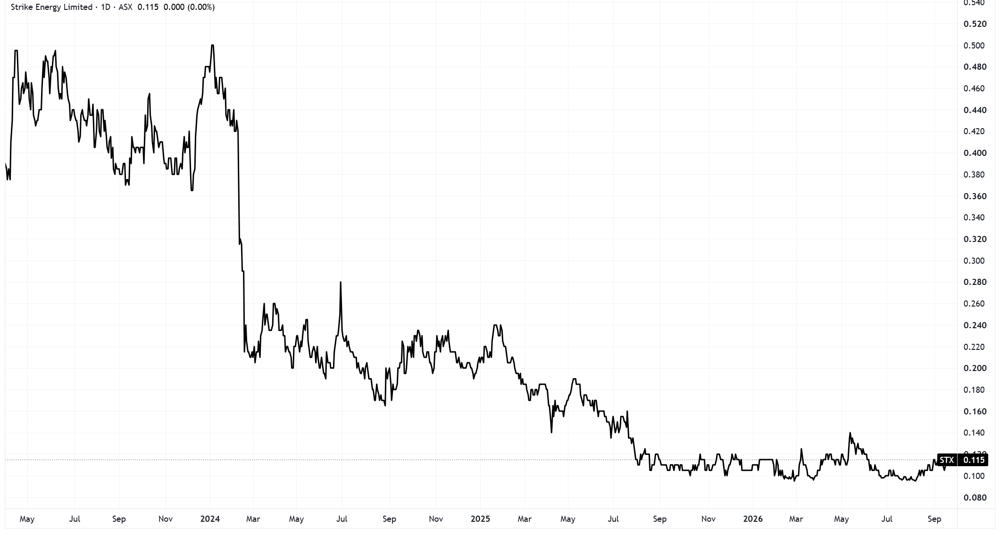
Strike Energy price chart (Source: Trading View)
Strike has also spent years sitting on gas it couldn't sell at its West Erregulla field in the Perth Basin. “Strike created considerable value (through the drill bit) in 2019-2024 at West Erregulla/Erregulla Deep, however this value has been ‘out of reach’ until an agreement with Hancock could be struck,” said Macquarie.
This new deal will allow Strike to process gas on a capacity toll at Hancock’s Belisama plant. Macquarie expects this to benefit both companies: “Hancock earns a healthy return on the tolling, Strike avoids equity dilution and proceeds to first gas more rapidly.”
The West Erregulla field is estimated to be sitting on a sizeable 251PJ of 2P reserves (on an attributable basis), which Macquarie expects to supply 87TJ/d of gross production (for perspective, that supplies enough daily energy to power roughly 400-500,000 homes).
All of which led the investment bank to lift the stock to Outperform, raised its price target to $0.15 per share, and called the agreement a turning point for the company.
Amplitude Energy (AEL): Unlike Strike, Amplitude has run into some exploration challenges of its own. On 25 June Amplitude shares fell 37% after the company announced that its Isabella gas exploration well in Victoria’s Offshore Otway Basin was not commercially viable.
Its luck turned a corner this month when the company announced its Juliet-1 well came in with “excellent” reservoir quality, though a flow test is still to come. Following the success Macquarie now expects the nearby Nestor well to be drilled, which was being held off until Juliet results came in. “Juliet-1 success increases confidence in ESCP. Whilst Orbost remains valuation anchor, we see emerging upside from Otway exploration success, with Nestor adding further upside,” said the investment bank.
Amplitude was already rated Outperform, but the note nudged its target price higher to $2.50.
Why Macquarie is holding back on Karoon
Karoon (KAR) acquired a 30% stake in the Who Dat assets in the US Gulf of Mexico for US$720 million. It was a costly acquisition funded via a US$312 million capital raising plus a US$340 million debt facility and cash. The capital raising was held at $2.05 per share, expanding the total share base by approximately 41%. Management justified the substantial dilution as the acquisition was supposed to lift Karoon’s FY24 production by 57-63%.
But Who Dat never lived up to expectations, with the latest update on 16 June cutting its 2026 production guidance from 2.1-2.5MMboe to 1.2-1.5MMboe, a 41% downgrade at the midpoint. Karoon shares tumbled 23% over the next two sessions.
Fast forward to today, Macquarie sees little upside, with a Neutral rating and a $1.85 target as of 14 September.
“Karoon continues to operate two late-life assets. Whilst Bauna has returned to strong production rates, Who Dat remains a longer-dated challenge,” noted the analysts.
The lack of upside reflects their view of the stock being “fairly valued on our oil price deck, and with limited near-term catalysts,” and holding it right now “is primarily a near-term tactical oil price call.” In other words, a leveraged play on the oil price.
Conclusion
From the companies covered its plain to see that smaller and mid sized energy companies have suffered some disasters in recent times. And while Macquarie sees value in Strike and Amplitude, both stocks have suffered painful operational disappointments in recent months and building confidence/execution is easier said than done. Meanwhile, Karoon is lugging the challenged Who Dat project, with the analysts viewing it as simply a near-term leveraged play on the oil price.
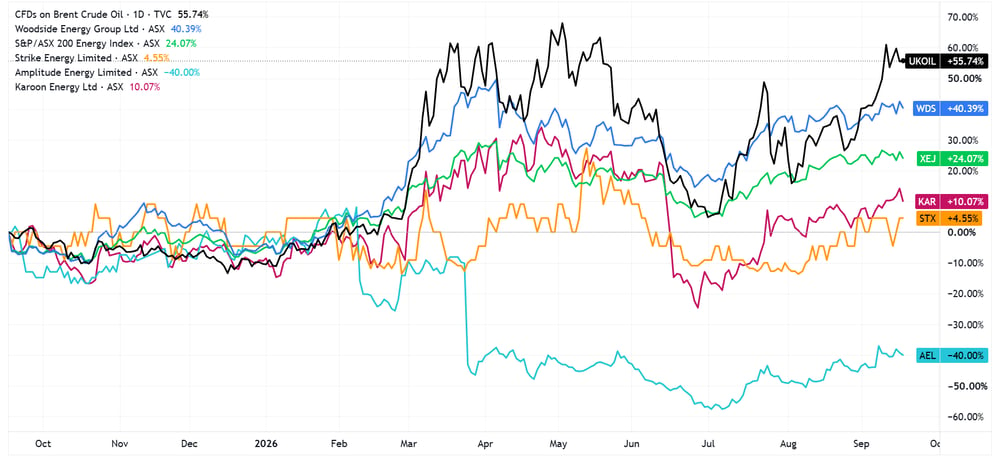
Brent vs. ASX energy stocks over the last twelve months (Source: TradingView)
Large caps aren’t operationally perfect but less susceptible to disasters. Looking further down the market the list begins to thin and unfortunately a good chunk of them have underperformed.