ASX stocks to buy as AI boom fades: Macquarie backs Transurban, REITs and healthcare
If AI capex cracks, yields fall first. Macquarie’s backtest since 1990 favours Transurban, REITs and healthcare early.

Source: Shutterstock
Mentioned
KEY POINTS
- Macquarie expects AI capex to slow in 2027, sparking a growth scare that drags yields lower before central banks cut. The pulled Firmus IPO and wider credit spreads are starting to stress the AI trade
- Transurban is the standout first-stage pick, beating the market by a median of almost 29% and outperforming in 10 out of 10 yield declines
- Macquarie would fund the rotation by selling mining and energy, which lag in both stages. Worley posted the weakest ASX 100 result in the year after the first RBA cut
Macquarie reckons the AI boom is running out of steam, and telling its clients to own defensives like toll roads, REITs and healthcare now, then switch to builders and retailers once the RBA starts cutting.
The broker's Australian equity strategists expect a slowdown in AI capital spending in 2027 to spark a global growth scare, which will drive bond yields lower, but well before central banks are ready cut. In their view, this opens a window of opportunity for defensive stocks that tend to trade like bonds.
Why AI capex is at risk
In September, Macquarie warned a failed high-profile AI financing deal could signal that the AI capex boom was turning. Since then, there have been a number of key developments:
The Firmus IPO was pulled and AirTrunk's delayed
The relative strength of AI Enabler stocks has weakened
Credit spreads have widened on funding concerns
The Fed hike lifted the cost of capital just as the AI build became more reliant on outside funding, and Macquarie says marginal projects are getting harder to finance.
The broker describes AI capex the linchpin of the cycle, where the buildout has buoyed global economic growth despite higher energy costs, rising yields and rate hikes. If marginal capacity stops getting funded, Macquarie expects the slowdown to spread through the entire ecosystem, spanning data centre construction, power infrastructure, equipment and commodity demand, turning an AI stock correction into a global growth scare.
What worked in past cycles
Macquarie tested 12 episodes since 1990 where the 10-year bond yield fell by more than 100 basis points, alongside the year after the first cut across eight RBA easing cycles. It ranked sectors and stocks by an "information ratio", which rewards outperformance that’s both large and consistent.
This produced four groups on what's worked:
Works in both stages: Banks, utilities, pharma and biotech, healthcare equipment and services, staples retail
Works as yields fall, fades after cuts: REITs and consumer services
Works after cuts: Cyclical retail, gold, financial services, technology, with infrastructure on the border
Avoid in easing: Mining, materials, energy, capital goods, transport, telecom, insurance, media, food and beverage
Macquarie says infrastructure, REITs and healthcare have historically done best in the initial dip in yields, while resources and energy have generally underperformed through both stages.
Large-caps to watch
Macquarie’s preferred Outperform-rated names for the first stage are:
Transurban had the most compelling historical outperformance, beating the market by a median of almost 29% and outperforming in 10 out of 10 yield declines. The stock also tends to keep working after cuts begin, so Macquarie says it can be held longer than most REITs.
GPT and Mirvac are earlier-stage trades. REITs get most of their benefit as yields fall, then lose relative momentum once cuts begin and investors move toward cyclical recovery plays. Goodman Group (GMG) should also benefit from lower yields, though its surging AI exposure partly offsets that.
James Hardie is the stage-two pick as it’s less sensitive to the initial fall in yields than Transurban or the REITs, but ranks highest of any ASX 100 stock on the broker’s measure of performance in the year after the first RBA cut. A slowdown in AI capex should drive US bond yields and mortgage rates lower, which in turn supports James Hardie’s US housing exposure. Macquarie concedes near-term earnings downgrades are possible, but says it would use any weakness to build a position.
Australian cyclical retailers come in as the RBA pivot becomes clearer.
Small caps lag the big end
Large-cap industrials have generally beaten small industrials in both stages. Lower rates support funding and valuations, but Macquarie says that can be outweighed by the earnings downgrades that come with a growth scare, which is why yields are falling in the first place.
Property and infrastructure still work first among small caps, and more continue to work once rate cuts start. Outside those sectors, the winners tend to be quality names with more earnings certainty or stronger balance sheets. The Outperform-rated small caps that have worked in both stages are:
Funding the rotation
Macquarie wants sectors like mining, energy and other stocks that lag in both stages to fund the market rotation. These sectors tend to underperform as yields fall and after cuts begin, and several of these companies are also exposed to the AI buildout. Worley, Whitehaven Coal, Dyno Nobel and Mineral Resources rank among the weakest ASX 100 performers across both stages, with Worley posting the weakest result of any ASX 100 stock in the year after the first RBA cut.
The bottom line
Markets are at an intriguing juncture, with bond yields starting to roll over not because inflation has peaked, but because growth expectations have eased. That still leaves some upside risk to yields, with oil prices elevated and the latest US core CPI up 2.6% year-on-year, a sign underlying price pressures are broadening.
The local backdrop is just as volatile. Inflation remains high, but employment unexpectedly fell by 39,300 jobs in September, against economist forecasts for a 20,000 gain. The Aussie 3-year yield fell 11 bps on the day (15-Oct) to a 5-week low of 4.81%.
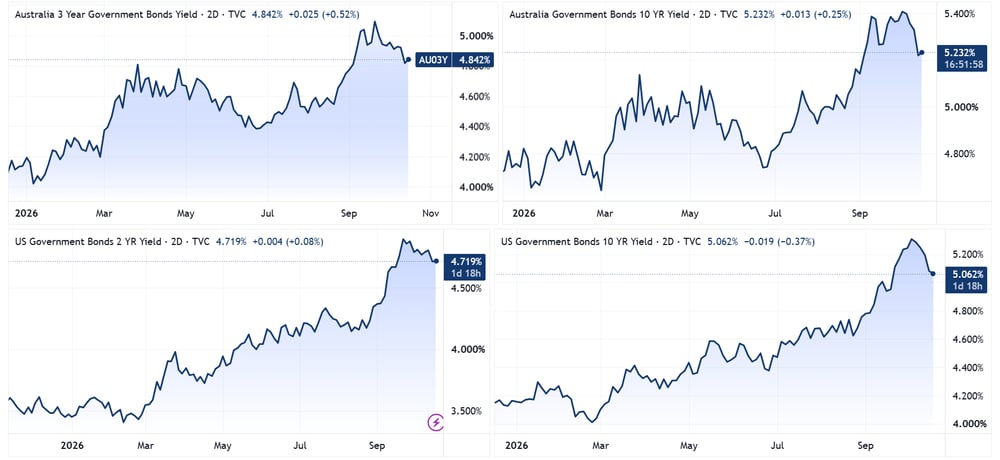
Australia 3-and-10-year yields (TOP), US 2-and-10-year yields (bottom) | Source: TradingView
That shift is already driving a dramatic sector pivot, where the S&P/ASX 200 Staples, Discretionary and Healthcare indices have all rallied around 6-7% in the past month, though their year-to-date returns remain mixed. Staples are up 18.4% and sitting at their highest since April 2023, Healthcare has bounced 45% from its June lows but is only breakeven for the year, while Discretionary is still down 7.5%.
At the end of the day, market leadership is changing, and possibly starting to pivot away from AI and miners, and towards energy and defensives like banks, supermarkets and utilities. Perhaps the lesson here is to stop fighting the pivot and follow where the money’s going.