ASX dividend stocks: A 5-6% yielder that just keeps hitting all-time highs
DBI's monopoly terminal, contracted revenue and inflation-linked pricing delivered another 8.1% fee hike and a juicy dividend bump.

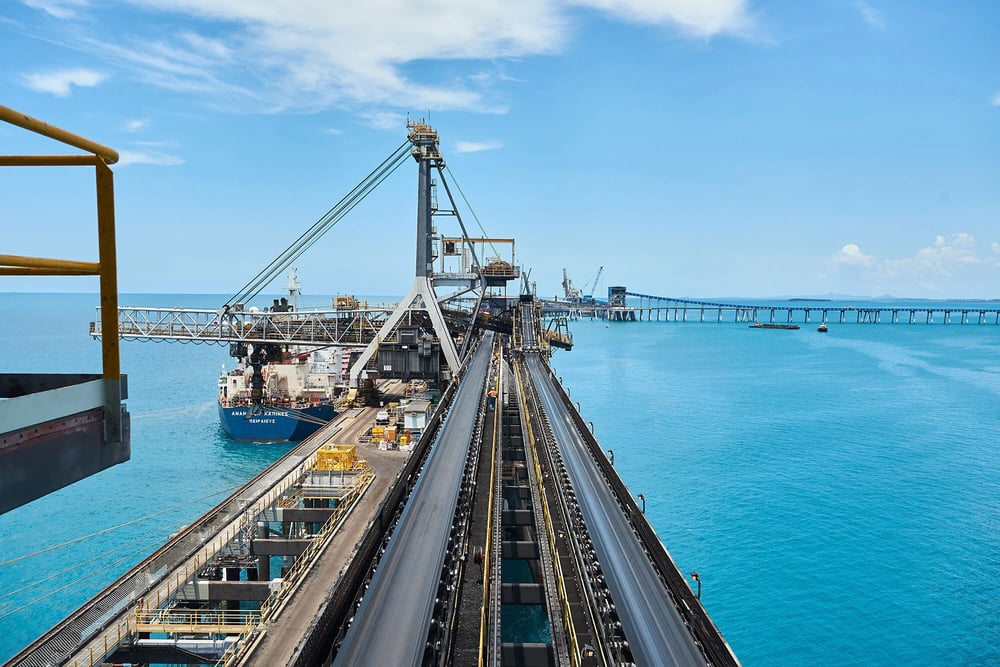
Source: Dalrymple bay infrastructure
Mentioned
KEY POINTS
- DBI hiked its Terminal Infrastructure Charge 8.1% to $4.02/tonne for FY26/27, with 84.2Mt contracted on a 100% take-or-pay basis regardless of coal volumes shipped.
- Shareholder distributions rise 8.5% to 28.62 cents per security, paid quarterly, supported by ~$75m in interest savings from recent debt refinancing.
- The stock's dividend yield doubles as a valuation guide, with a sub ~5% yield signalling the share price may have run too far.
Dalrymple Bay Infrastructure (ASX: DBI) is probably one of my most regularly covered stocks, and for good reason. The company offers near-certain revenue visibility, built-in inflation hedges, a steady dividend and a low-volatility share price that keeps grinding to fresh all-time highs.
While this sounds too good to be true, let me objectively explain why, along with the key takeaways from the company's latest quarterly result.
DBI in a nutshell
DBI operates the Dalrymple Bay Terminal (DBT), the lowest-cost export pathway for Bowen Basin mines, servicing major coal names including Peabody Energy, Stanmore Resources and Whitehaven Coal.
Capacity has grown from 14.5Mtpa in 1983 to 85Mtpa today across seven expansion phases. DBI doesn't own the terminal outright but holds a 99-year lease from the Queensland Government (50 years initial, plus a 49-year option).
The business model becomes clear in the P&L statement, where two pairs of offsetting line items tell the story. In its 2025 result, $351.7 million in 'Handling revenue' is matched by $351.7 million in 'Handling costs', while $185.2 million in 'Revenue from capital works' is matched by $185.2 million in 'Capital work costs'.
Here's a quick explainer for DBI's key earnings-related terminology.
Handling revenue: DBI passes all operating and maintenance costs straight to customers, so handling revenue always matches handling costs.
Revenue from capital works: DBI funds Non-Expansion Capital Expenditure (NECAP) projects, such as safety upgrades or equipment replacements, using its own cash or debt. These costs are capitalised and recovered over time through price hikes, including a return tied to bond yields. Revenue from capital works equals capital works costs.
Terminal Infrastructure Charge (TIC) revenue: DBI's core earnings stream, representing a fee charged per tonne of contracted coal capacity. DBI collects the TIC on every tonne of the terminal's 84.2mt annual contracted capacity, regardless of how much coal actually ships.
So regardless of how coal prices fluctuate or how many tonnes are exported, DBI receives the TIC on every contracted tonne. As of its 2025 result (Feb-26), the company had 84.2 million tonnes contracted on a 100% take or pay basis.
Another price hike
DBI's latest quarterly update (19-May) set the pricing and dividend plan for the next financial year (commencing 1 July 2026). The key highlights include:
TIC to increase by 8.1% to $4.02, comprising:
Base TIC ($3.66/tonne): The core fee, which rises each year in line with inflation (CPI). This year's increase is 4.09%.
NECAP Charge ($0.35/tonne): Up roughly $0.15, after DBI invested an additional $97.8m over the past year that now gets added to the recoverable asset base.
QCA Levy (~$0.00/tonne): A small pass-through cost from the Queensland Competition Authority, effectively zero this year.
Shareholder distributions will total 28.62 cents per security for TY-26/27, up 8.5% on the prior year. This will be paid in four quarterly instalments.
This powerful pricing mechanism, along with other tailwinds such as recent debt refinancing (interest savings of ~$75m) and capacity optimisation initiatives, has seen the share price soar 32% in the last twelve months and double in the last three years.
How to value DBI
Few companies have a business model like this, where almost all capacity is contracted and mechanisms are in place to offset operating costs, inflation, regulatory charges and capex. So how do you value a stock that has near-certain earnings visibility?
Here's some food for thought. What if you valued the stock based on its dividend yield?
DBI has a very low-volatility share price, though it still fluctuates from time to time. When the share price soars and the dividend yield falls below ~5%, that may suggest the share price is running ahead of itself and the dividend yield is starting to look sub-par. If the share price takes a hit and the yield starts approaching ~5.5–6.0%, that's a fairly solid appeal. Again, for a company with near-certain earnings visibility.
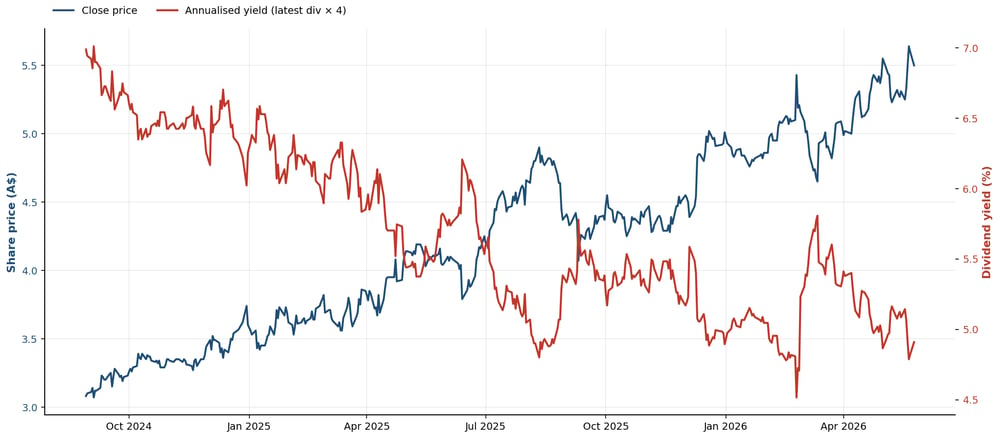
DBI share price vs. annualised dividend yield | Data compiled by author, chart generated using Claude
Why watching the yield works
While the above sounds like theory, it has worked in practice.
DBI's major shareholder, Brookfield Asset Management, exited its stake via two block trades last year.
First block (12-13 Jun): Sold 23.2% of the company or $428 million worth of stock, priced at $3.72, a 7.9% discount to the previous close. The stock fell 6.1% on the day but recouped the losses over the next six sessions.
Second block (9-Sep): Offloaded its remaining 26% stake through a $527 million block trade priced at $4.05 per share, a 6.9% discount to the previous day's close. The stock fell 6.4% on the day and recovered the losses over the next nine sessions.
DBI sold off because offloading a stake that size in one go requires the seller to price the block at a discount, and that discount effectively resets where the stock trades.
It's quite a mechanical selloff that doesn't change the underlying fundamentals. If anything, it made the dividend yield higher/more attractive, and likely why the stock bounced back rather quickly.
With Brookfield out of the register, you won't see these types of selloffs moving forward. But the yield is definitely something to keep an eye on.