ASX 200 winners and losers from the property downturn as interest rates soar
The housing downturn is going to hit the economy and the stock market, but there will be winners and losers, says Morgan Stanley.


Source: Shutterstock
Mentioned
KEY POINTS
- Investment bank Morgan Stanley expects national house prices to fall 10–15% from their March peak, which would be Australia's largest nominal housing downturn in more than 40 years.
- The bank holds a “near-maximum underweight” view on Australian equities, warning investors against assuming eventual rate cuts will stabilise stock and property markets.
- We unpack how the housing downturn could ripple through the ASX – from banks and retailers to property portals and miners – and which sectors Morgan Stanley expects could be the biggest winners and losers.
Morgan Stanley is no stock market bear. In its latest Asset Allocation Insights, released last week, the investment bank recommends an overweight position in equities globally, with the US its strongest preference. But Australia is the glaring exception: Morgan Stanley holds a near-maximum underweight on local shares, favouring resources over banks and cyclicals.
The reason for the bank’s tepid view is housing. In a note released Monday, Morgan Stanley argues the current downturn is deeper and structurally different from those that came before it, and that the playbook equity investors have relied on in past cycles – buying housing-linked stocks ahead of eventual RBA rate cuts – may not work this time around.
That's the bad news. The good news is that not every corner of the ASX is negatively exposed. This article will unpack how we got here, why Morgan Stanley sees housing as a critical pressure point for the economy and company earnings, and which sectors it believes are best and worst placed as the downturn intensifies.
What caused the property downturn
The Reserve Bank raised the cash rate by 25 basis points to 4.60% on 29 September, its fourth hike this year and a 15-year high. It was a unanimous decision, and many economists expect another 0.25% hike at the Board’s meeting next month. The RBA's September statement centred on the upside inflation risks it had previously flagged – mostly domestic in origin, but with energy prices and AI-related demand adding to the pressure.
Inflation is proving stubborn. Annual trimmed mean inflation held at 3.6% in August for a third consecutive month, while headline inflation rose to 4.0% as the fuel subsidy rolled off. Morgan Stanley's economists see clear upside risks over the coming months, before weaker growth broadens through 2027.
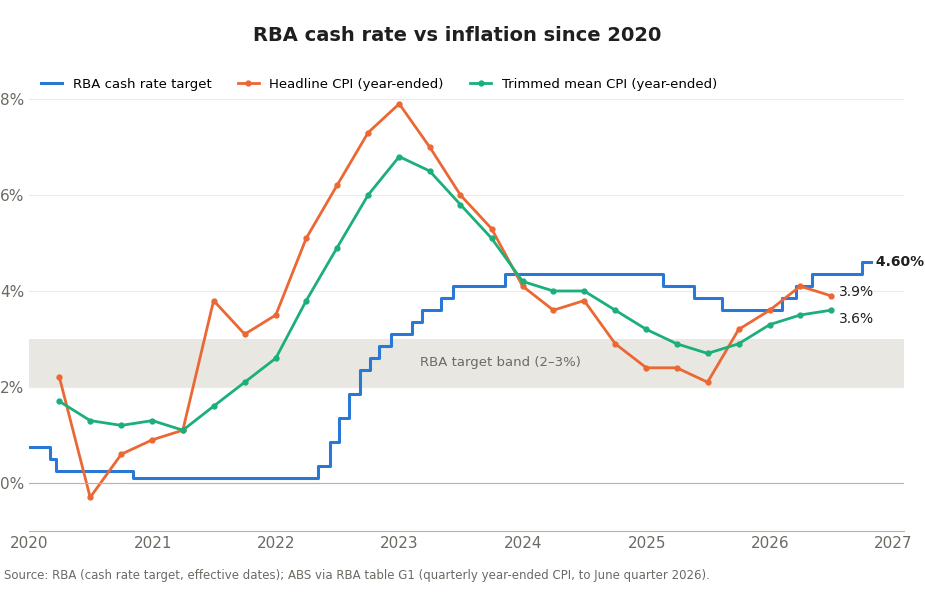
RBA official cash rate vs headline and trimmed mean inflation. Source: RBA, ABS
The global backdrop isn't helping. Morgan Stanley's US economists now treat an oil risk premium and sticky inflation as their baseline, with US 10-year yields near 5% and another spike in bond volatility the main threat to equity valuations.
Meanwhile, the domestic economy is showing signs of cracking. Employment fell by 39,300 in September against consensus expectations of a 20,000 gain, pushing unemployment to a five-year high of 4.7% – a level the RBA hadn't forecast would occur until late 2027. Morgan Stanley now expects unemployment to reach 5.1% by the end of 2027.
This downturn is likely to be different
National house prices have now fallen for six consecutive months and sit 5.2% below their March peak. Last week, Morgan Stanley lifted its forecast decline from 5–10% to 10–15%, with a trough unlikely before the second half of 2027. The usual catalysts for stabilisation are absent: the RBA is constrained by inflation, housing activity is deteriorating, and buying remains exceptionally expensive relative to renting.
Morgan Stanley argues the recovery will also be “flatter” – that is, slower – than in past cycles. Investor tax changes in the May Budget have lowered after-tax returns and borrowing capacity in established property, slower migration means less incremental demand, and capital-growth expectations must reset. A weaker return of property investors – who have historically powered rebounds – would mean less volume and earnings leverage for housing-linked ASX stocks.
The economic damage is largely still ahead, suggests Morgan Stanley, as construction and spending typically lag prices by several quarters. The bank now forecasts 2027 GDP growth of just 1.1% (versus consensus of 1.7%), with consumption growth slowing to around 0.9%. For the sharemarket, the key point is that consensus earnings forecasts for housing-exposed stocks have held up so far – but the median 7–12% downgrades relative to the market seen around previous downturn lows are, in the broker's view, still to come.
Morgan Stanley isn't alone. UBS expects dwelling prices to fall for at least another year, with a peak-to-trough decline of at least 8% and probably closer to 10% – around the largest since at least 1980.
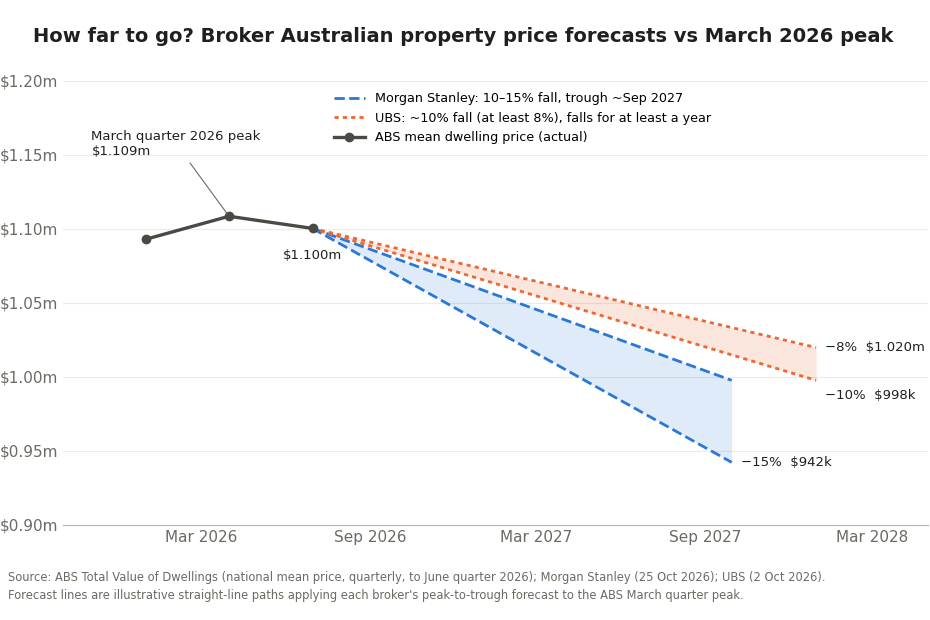
Illustrative paths applying Morgan Stanley and UBS peak-to-trough forecasts to the ABS March quarter peak. ABS data runs to June; private indices show prices 5.2% below peak by September. Source: ABS, Morgan Stanley, UBS
UBS adds a fiscal dimension to the challenges facing our economy ahead. State governments rely heavily on stamp duty and land tax – around 18% of revenue in NSW and 16% in Victoria – and under a UBS scenario where stamp duty falls 20% this financial year, state revenues could end up around $30 billion below budget across the forward estimates.
Higher bond yields could add a further $7–12 billion in interest costs across federal and state budgets over four years. UBS warns larger deficits could limit planned fiscal tightening, potentially complicating the RBA's task of bringing down inflation without crashing the economy.
ASX 200 winners and losers: a new playbook
Australian equities have typically rallied on the prospect of RBA easing ahead of a housing trough. Morgan Stanley warns that this cycle's mix of cyclical shock and structural change means investors risk "positioning for the wrong recovery" – an initial rate-cut rally in housing cyclicals may not be backed by a sustained earnings-led outperformance.
Overseas evidence supports the caution. Morgan Stanley's analysis shows housing-linked stocks in New Zealand, Sweden and Canada still lagging their markets more than two years after house prices stopped falling. In markets where house prices fell as much as Morgan Stanley expects they will here, housing-linked stocks fell much further than ours have to date.
Valuation risk is uneven, too. Morgan Stanley's analysis shows the housing-exposed group already close to its typical relative P/E trough, while banks and consumer discretionary would require a further meaningful de-rating to reach their historical downturn lows. Translation: on valuation alone, banks and consumer stocks have the most room to fall. Housing stocks already look cheaper, but that won’t protect them if earnings forecasts keep falling.
Consider how each exposure has traditionally benefited from rate cuts, and why Morgan Stanley believes this cycle could differ:
Banks: Rate cuts have historically lifted confidence, loan demand and valuations, but mortgage growth may stay soft, with margins and delayed credit deterioration the key risks.
Residential developers and A-REITs: Lower rates usually support asset values, presales and construction, but valuations may recover before projects, volumes and investor demand do.
Property portals and transaction beneficiaries: Turnover typically improves as prices stabilise, but a price trough may not bring back listings, transaction volumes or investors.
Housing-related retailers: Transactions and wealth effects normally support spending, but consumption may keep slowing after prices bottom, delaying an earnings recovery.
Diversified domestic cyclicals: Easing usually drives a broad earnings recovery, but that recovery may be later and narrower this time.
Morgan Stanley's preference is for balance-sheet resilience, earnings visibility and direct sensitivity to easing, rather than broad housing exposure. Its model portfolio runs resources (i.e., mining and energy stocks) as its largest overweight, at 7.4 percentage points above benchmark, and banks as its largest underweight, at 7.4 points below. The table below shows a list of its most / least preferred stocks across various S&P/ASX 200 sectors.
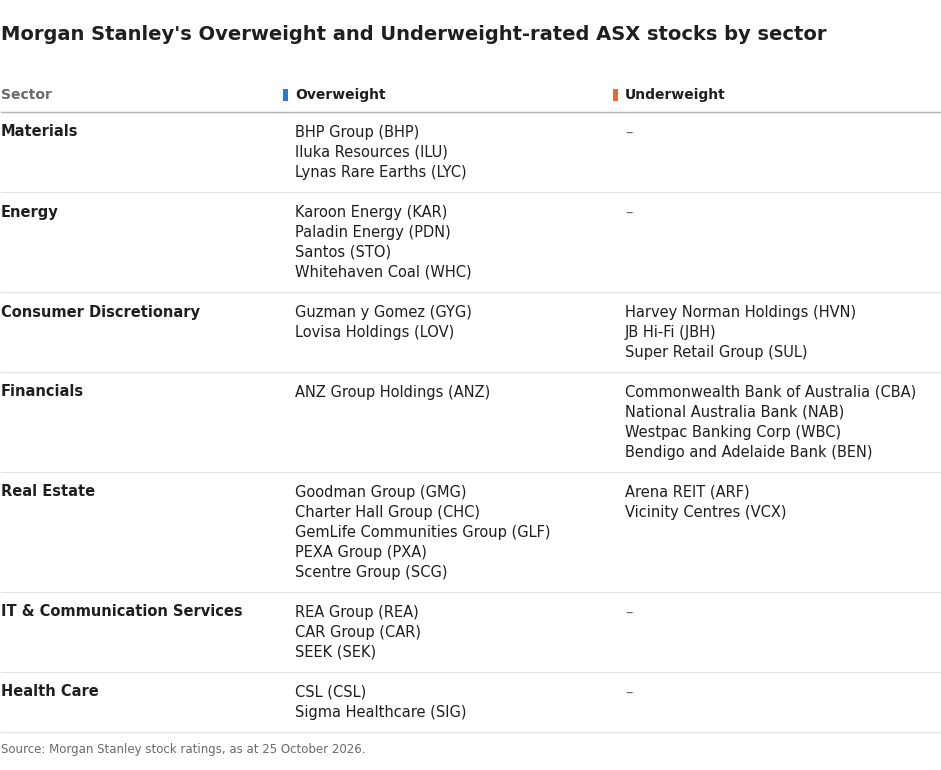
Morgan Stanley Overweight and Underweight rated stocks across various S&P/ASX 200 sectors. Source: Morgan Stanley
What to watch
The first test is tomorrow's September quarter CPI. Morgan Stanley expects annual trimmed mean inflation to hold at 3.6%. That’s enough, in the bank’s view, for the RBA to stay on hold at 4.60% in November, and for this rate to be the top of the current hiking cycle. A CPI print greater than 3.6%, it warns, would be harder for the Board to look through. UBS, on the other hand, continues to forecast a further 25 basis point hike, most likely in November.
Then comes the earnings test, with Westpac Banking Corp (WBC), National Australia Bank (NAB) and ANZ Group (ANZ) reporting over the next fortnight and AGM-season trading updates rolling in. Morgan Stanley is watching the tone against August guidance, particularly among consumer- and housing-exposed companies.
References: This article draws on Morgan Stanley's Asset Allocation Insights – Flying Cars, Stalling Markets (23 October 2026) and Australia Macro+ Week Ahead – Equities and Housing: Different Downturn, Different Playbook (25 October 2026), including its model portfolio and Crunch Time summary as well as other stock-specific research notes within the last three months, together with UBS's Australian Economic Comment (7 October 2026) and Australian Economic Comment – Double hit: Housing slump could cut revenues by ~$30bn; yields add $10bn interest over 4 years (2 October 2026). Chart data are from the Reserve Bank of Australia and the Australian Bureau of Statistics.