Askari went looking for gold nuggets on-site the WA Horry project. It found 31
That many nuggets sounds like something from bygone days. Good thing drilling starts this month

Source: iStock
Mentioned
KEY POINTS
- Gold stream sediment samples on-site the Horry project acreage has found gold mineralisation above and beyond ‘high grade’ spec
- Rock samples, though less dramatic, also return evidence of mid-grade mineralisation for both gold and copper
- Thirty one gold nuggets discovered across campaign; RC drilling starts August
Askari Metals’ (ASX:AS2) most recent exploration exercise on-site its Horry copper-gold project acreage has awarded the company some nuggets of information on where to prioritise an upcoming drill campaign.
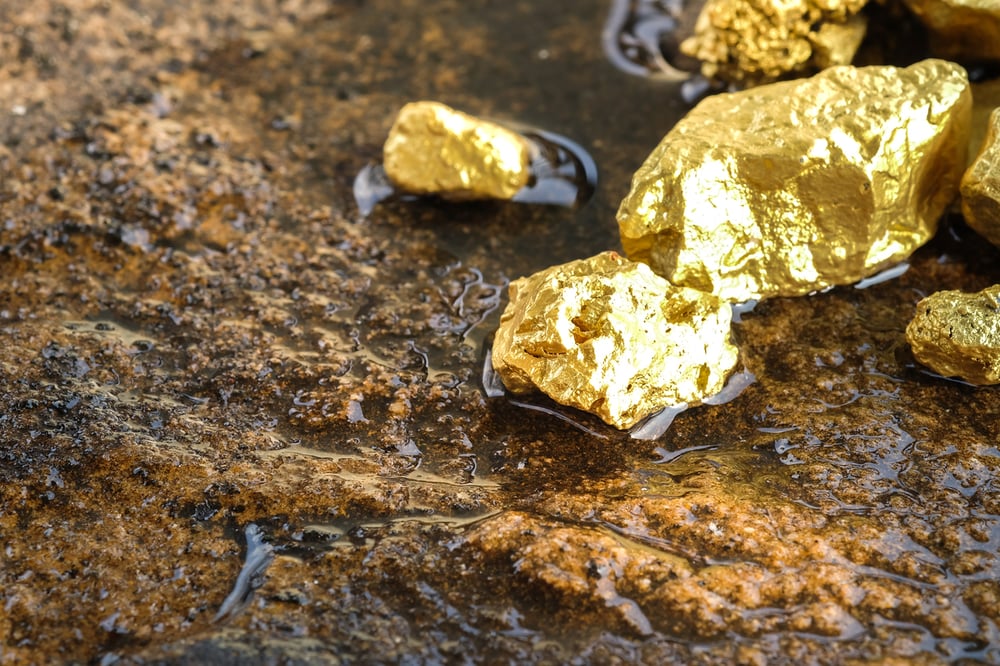
In fact, it found thirty one nuggets: all made from gold. Perhaps this is why the share price has jumped 14.75% in morning trade.
Stream sediment exploration at surface uncovered gold samples at grades far exceeding the generally accepted benchmarks of high-grade mineralisation.
What's this about grades?
Investor information provider Undervalued Equity notes gold grades above 5 grams per tonne (g/t) are classified as high grade, though, many projects in Australia, widely accepted as high grade by investors, boast grades at 4g/t.
Compare that to the following sediment sample results:
One sample @ 31.9g/t gold (Au)
One sample @ 11.1g/t Au
One sample @ 9.2 g/t Au
One sample @ 5.3g/t Au
Undervalued Equity also notes copper grades exceeding sample concentrations of 1.5% reflect high grade copper. As for copper, Askari found in rockchips:
One sample @ 4.3% Copper (Cu)
One sample @ 2.03% Cu
One sample @ 2.9% Cu
One sample @ 2.0% Cu
Investors should note sediment and rockchip samples taken from the surface do not necessarily indicate a mineable gold system sits under topsoil, making for a cheap open-pit operation. So far, that hasn’t been confirmed.
But what the samples do provide early evidence of is a fertile acreage with all of the right geological elements to support significant mineral systems underground. To figure that out, the company needs to start drilling.
Okay, so when does drilling start?
Currently, a follow-up sampling campaign (separate to that announced today) is currently in an assay laboratory with results pending. Assay laboratories across Australia are currently experiencing delays.
The maiden RC drill run, meanwhile, is scheduled for late August. Earlier this month, Askari noted it expects the RC assay results to be ready before December.
The RC run will target untested areas on-site, as well as priority targets identified upon the return of the soil sample assays.
While management has not given any timeframe indicating expected delivery of stage 2 surface sample assays, clearly, the company is confident in getting those results in the next two weeks.

Even after a shock mid-year sell off, Askari continues to outperform the AX200 on a one year basis. In the last month, the company has gained 40%.
Disclaimer: Market Index helps small-cap ASX listed companies connect with Australian investors through clear and concise articles on key developments. Askari Metals was a client at the time of publishing. All coverage contains factual information only and should not be interpreted as an opinion or financial advice.