2026-27 commodities outlook: Iron Ore, Copper, Uranium, Lithium and more
The government's forecaster expects resource and energy exports to peak at $422 billion in 2026–27 on higher energy prices, then fall.

Source: iStock
Mentioned
KEY POINTS
- Export earnings are forecast to rise to $422 billion in 2026-27, then fall to $379 billion by 2030-31, or $343 billion in real terms.
- Gold is forecast to overtake LNG as Australia's second-largest export at about $68 billion a year, while iron ore remains the largest.
- The forecasts assume world growth of 2.9% to 3.0% in 2026, slightly below the IMF's July forecast, as high energy prices weigh on import-reliant developing nations.
Australia's miners and energy producers are set to earn more from exports in 2026–27, but the federal government's latest Resources and Energy Quarterly (REQ) expects those earnings to fall over the following four years. The lift this year largely reflects higher energy prices caused by the conflict in the Middle East, which has disrupted shipping through the Strait of Hormuz.
Overview of REQ key findings
Export earnings are forecast to rise to about $422 billion in 2026–27, up from $403 billion in 2025–26, largely on higher energy and gold prices
Earnings are then expected to fall to $391 billion in 2027–28 and about $379 billion by 2030-31 ($343 billion in real terms)
Gold exports are forecast at $68 billion over the next few years, overtaking LNG as Australia's second-largest export, while iron ore remains the largest
World growth is assumed at 2.9–3.0% in 2026, slightly below the IMF's July forecast, as high energy prices weigh on activity in developing nations reliant on imported energy
Global growth is expected to lift to 3.4% in 2027 and settle at 3.1–3.2% for the rest of the outlook period
The resources and energy sector contributes around 11% of GDP to Australia, makes up about two-thirds of merchandise export value and directly employs around 300,000 people
Commodities forecasts
The REQ forecasts prices, volumes and export earnings for 21 commodities. Iron ore is set to remain Australia's largest resource and energy export, gold is forecast to overtake LNG as the second largest, and earnings from copper, lithium and rare earths are forecast to grow.
As the Australian government's commodity forecaster, the outlook tends to be very conservative, and like most analyst estimates, anything beyond the next few years falls into a long-term price forecast that tends to sit materially below current prices. In my experience, the insights on supply and demand are useful, and the near-term forecasts tend to hold directional value even when the exact numbers miss.
Iron ore
Source: Department of Industry, Science and Resources; Resources and Energy Quarterly, September 2026
Latest drivers: Benchmark prices (61% Fe, CFR China) fell about US$10 a tonne in the September quarter on seasonally weaker construction, lower Chinese steel mill margins, high port inventories and strong seaborne supply. Higher freight costs from the diesel surge briefly lifted prices above US$100 a tonne in early September, though rising freight lowers the FOB price Australian miners receive.
Price forecast: Australian FOB prices are forecast to average about US$88 a tonne in 2026 and US$82 in 2027, falling to US$64 a tonne in real terms by 2031 as new lower-cost supply arrives.
Demand and supply outlook: China's imports are forecast to fall from 1,260 million tonnes in 2025 to 1,152 million tonnes in 2031 as steel output eases, while India's rise from 10 million to 55 million tonnes. Guinea's Simandou project began ramping up shipments in the September quarter and is expected to reach up to 120 million tonnes a year by 2030, adding to growth from Brazil.
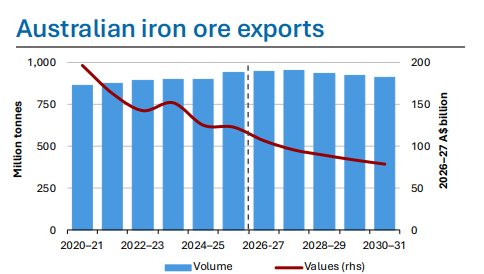
Australian exports: Volumes are forecast to peak at 951 million tonnes in 2027–28 before easing to 912 million tonnes in 2030–31. Earnings are forecast to fall from $118.7 billion in 2025–26 to $106.7 billion in 2026–27 and $86.9 billion in 2030–31 on lower prices, easing volumes and a stronger Australian dollar.
Copper
Latest drivers: LME prices reached a record above US$14,700 a tonne in early September on mine disruptions, the Democratic Republic of Congo's resumed concentrate export ban and strong US imports ahead of potential tariffs. Global mine output fell 4.1% year-on-year in the June quarter, mainly on weather and lower grades in Chile and disruptions in Indonesia.
Price forecast: Prices are forecast to average about US$13,500 a tonne in 2026 and 2027 and stay high through 2028, easing to US$11,600 a tonne in real terms by 2031 as mine supply lifts.
Demand and supply outlook: Electrification, grid expansion, AI data centres and defence are expected to lift consumption from 27.9 million tonnes in 2025 to 32.4 million tonnes in 2031. Mine output is forecast to grow from 23.6 million to 27 million tonnes, though the Middle East conflict could disrupt sulphuric acid supply and lift diesel costs.
Australian exports: Mine output is forecast to grow 6.6% a year from 704,000 tonnes in 2025–26 to 968,000 tonnes in 2030–31. Earnings are forecast to rise from $13.3 billion in 2025–26 to $16.3 billion in 2026–27 and $21.1 billion by 2030–31.
Gold
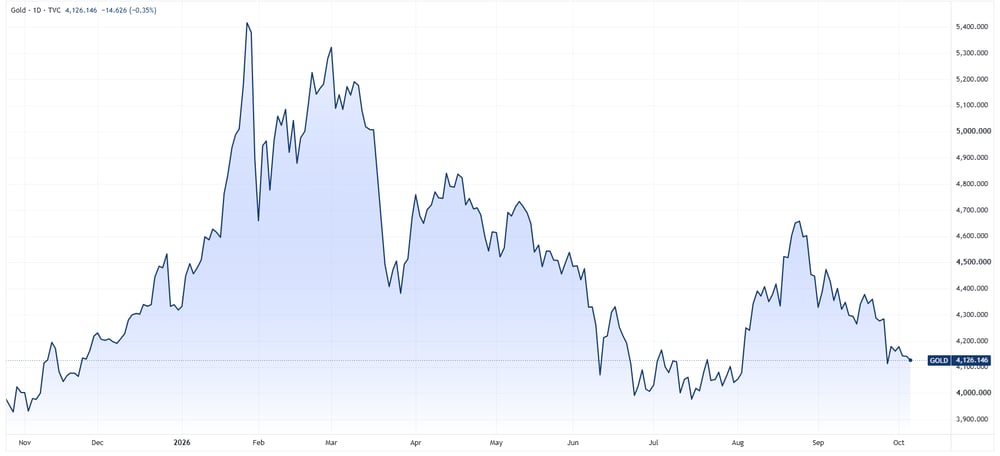
Gold year-to-date price chart, record high in late January 2026 (Source: Trading View)
Latest drivers: Prices fell to US$4,000 an ounce in late June and July on profit-taking and expectations of US rate hikes, then rose above US$4,600 as tame inflation and weak jobs data eased those fears. Central banks bought 289 tonnes in the June quarter, while ETFs saw outflows of 45 tonnes.
Price forecast: Prices are forecast to average US$4,600 an ounce in 2026, up 34% on 2025, and stay high through 2028 before easing to US$3,760 an ounce in real terms by 2031.
Demand and supply outlook: Central bank and investment buying is expected to support demand, though high prices are expected to weigh on jewellery and other price-sensitive demand in 2027. Mine output is forecast to rise gradually to 4,028 tonnes by 2031, led by Africa.
Australian exports: Volumes are forecast to rise from 216 tonnes in 2025–26 to 287 tonnes in 2026–27 and 325 tonnes by 2030–31. Earnings are forecast to ease from $69.7 billion to $68.1 billion in 2026–27 and hold near $68 billion to 2030–31 as lower prices and a higher Australian dollar offset volume growth. Gold is forecast to overtake LNG as Australia's second-largest resource and energy export.
Oil
Latest drivers: Brent rose above US$130 a barrel in mid-September after Houthi attacks damaged Saudi Arabia's East–West Pipeline, which had been carrying nearly 4 million barrels a day around the blocked Strait of Hormuz. Ukrainian strikes on Russian refineries and lower Chinese refinery runs have tightened fuel markets, pushing Singapore diesel from US$86 to US$185 a barrel.
Price forecast: Brent is forecast to average about US$97 a barrel in the September quarter and US$101 in the December quarter, then fall as Middle East supply returns and settle at about US$65 a barrel in real terms. Refilling depleted inventories is expected to keep prices higher than they would otherwise be.
Demand and supply outlook: World supply has fallen from 108 million to about 99 million barrels a day during the conflict and is forecast to exceed 108 million barrels a day by 2027, pushing the market into surplus. Demand is forecast to rise from 105 million barrels a day in 2027 to 107 million by 2031, led by emerging economies.
Australian exports: Volumes are forecast to fall from 247,000 barrels a day in 2025–26 to 182,000 barrels a day in 2030–31 as mature fields deplete. Earnings are forecast to ease from $10.5 billion in 2025–26 to $10.4 billion in 2026–27, then fall to $6.2 billion by 2030–31.
Uranium
Latest drivers: Spot prices rose from US$85 a pound in June to US$90 in August, with contract prices at US$97. Australia and India signed an arrangement in July to enable uranium exports to India, and China approved eight more reactors on 31 July.
Price forecast: Spot prices are forecast to rise from an average of US$89 a pound in 2026 to US$ 96.20 in 2027 and US$104 a pound in real terms by 2031, with the market deficit narrowing from 2029.
Demand and supply outlook: Consumption is forecast to rise from 97,000 tonnes in 2026 to 107,000 tonnes in 2031, led by China and India. Supply, including secondary sources, is forecast to rise from 89,000 to 106,000 tonnes, with inventories covering the deficit and new Canadian mines due from 2028.
Australian exports: Volumes are expected to steady at about 6,500 tonnes from 2027–28. Earnings are forecast to rise from $1.6 billion in 2025–26 to $1.7 billion in 2026–27 and $1.9 billion by 2030–31.
Lithium
Latest drivers: Spodumene prices rose from about US$720 a tonne in July 2025 to over US$2,200 a tonne in early September, while lithium hydroxide prices more than doubled. Resilient EV and energy storage demand, lower inventories and supply disruptions in China and Zimbabwe drove the recovery, including the suspension of CATL's Jianxiawo mine since August 2025.
Price forecast: Spodumene is forecast to average about US$2,410 a tonne in 2026, easing to US$2,287 in 2027 and about US$1,500 by 2031 as global supply expands. Lithium hydroxide is forecast to fall from US$21,100 to US$20,995 in 2027 and US$16,200 a tonne in real terms over the same period.
Demand and supply outlook: Consumption is forecast to grow more than 11% a year to 2031 on EV sales and battery storage, but the market is expected to stay in surplus for most of the outlook. Australia, China and Argentina are expected to lead new supply, with China forecast to overtake Australia in lithium extraction in 2026.
Australian exports: Mine output is forecast to grow 8.8% a year to 2030–31 on expansions at Greenbushes, Pilgangoora, Mt Holland and Mt Marion. Earnings are forecast to rise from $9.9 billion in 2025–26 to a peak of $16.6 billion in 2026–27, then ease to $15.0 billion by 2030–31.