Why Rio Tinto looks less like a miner and more like a growth stock
Rio Tinto is targeting faster growth, lower costs and a more diversified earnings base as commodities enter a powerful new up cycle.

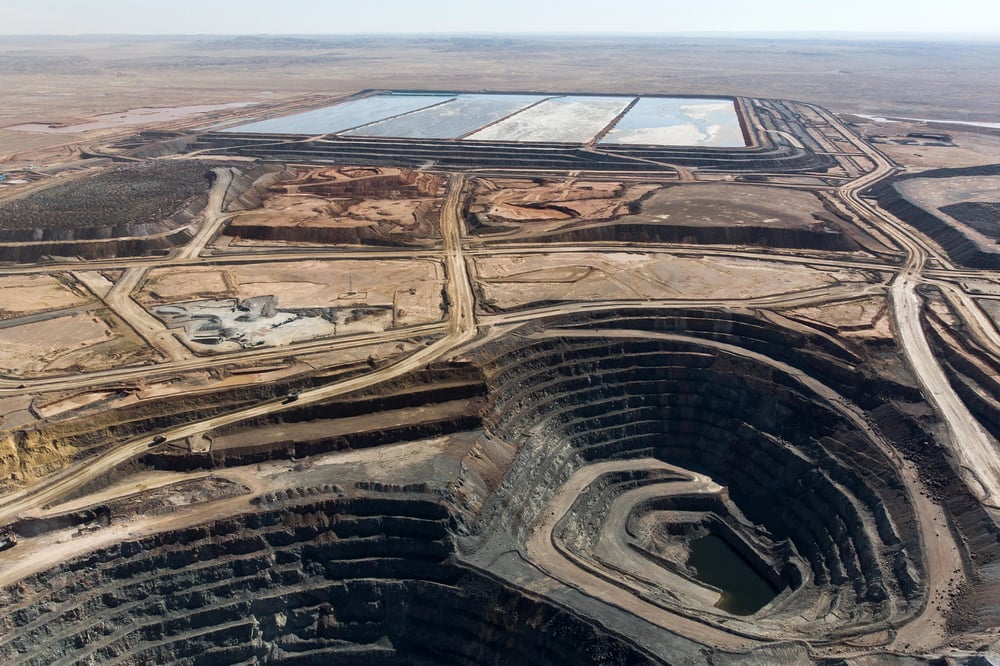
Source: Rio Tinto's Oyu Tolgoi (Source: Getty Images)
Mentioned
KEY POINTS
- Rio Tinto is targeting 3% compound annual production growth to 2030, underpinned by Oyu Tolgoi, Simandou and expanding lithium assets.
- Unit costs are expected to fall 4% through to 2030, supported by $650m in early productivity gains and tighter capital discipline.
- EBITDA is forecast to rise 40–50% by 2030 as earnings become more diversified across iron ore, aluminium, copper and lithium.
It's been a month since Rio Tinto's Capital Markets Day, which outlined substantial growth plans for the coming years. At the same time, the commodity complex is in the midst of a breakout that's been years in the making, with key commodities like copper and aluminium surging, iron ore holding firm, and lithium experiencing a V-shaped recovery. This may be an opportune time to take a closer look at Rio Tinto's growth aspirations, especially under the guidance of its new chief executive, Simon Trott.
The Capital Markets Day opened with slides titled "Stronger, sharper and simpler," a theme that carried through presentations on the company's iron ore, aluminium, lithium and copper operations.
Rio is also under the spotlight now amid preliminary discussions with Glencore about a possible merger of some or all of their businesses. The news has sent the stock 5.2% lower in early trade on Friday.
Key takeaways
Costs: Streamlining iron ore, copper, aluminium and lithium businesses, targeting $650m annualised productivity gains in first three months, with further upside over the medium term.
Unit costs: Expected to fall 4% from 2024–2030, with mid-term capex guidance under $10bn post-major project completions including Oyu Tolgoi, Simandou, Rincon, Pilbara and Amrun.
Volume growth: Compound annual production growth of 3% to 2030, supported by Oyu Tolgoi, Simandou, Arcadium and Rincon, while releasing $5–10bn from existing assets and cash where third-party funding is cost-inefficient.
EBITDA growth: To rise 40–50% by 2030 as earnings increasingly diversified across aluminium, copper, iron ore and lithium.
Capex: Medium-term guidance tweaked to "up to US$10bn" from prior US$10-11bn due to better execution, revised lithium capex and decarbonisation capex to 2030 revised to $1-2bn vs. prior $5-6bn.
Divisional highlights
Iron Ore: Prices remain resilient due to supply disruptions, declining ore grades, underperforming scrap steel and strong Chinese demand. ~800Mtpa of new capacity needed to 2035, with 650Mt uncommitted. Simandou 2026 sales guided 5–10Mt, Pilbara volumes to recover ~330Mt (+7Mt y/y) assuming normal cyclone season.
Aluminium: ROCE target up 5pp by 2030 vs 1H24, with encouraging bauxite and smelter performance. AP60 replacement project on schedule/budget, PFS for new smelters in Finland & India progressing.
Copper: 2026 guidance ~35kt below 2025 due to declining grades at Escondida but volume growth expected from Oyu Tolgoi and Kennecott (~15% y/y). Organic growth target 1Mtpa by 2030 vs. ~870kt in 2025.
Lithium: 2026 guidance 61–64kt LCE vs 75ktpa nameplate. On track for 200kt LCE by 2028 from current projects. Next phase could add 110ktpa in Argentina, 60ktpa in Canada, and 100–150ktpa in Chile, eventually reaching 470–520ktpa.
Analyst forecasts
UBS (December 2025) modelled the following earnings outlook for Rio Tinto:
2025e | 2026e | 2027e | 2028e | |
|---|---|---|---|---|
Revenue (US$m) | 56,188 | 59,116 | 63,608 | 67,286 |
% Chg | - | 5.21% | 7.60% | 5.78% |
Profit after tax (US$m) | 10,889 | 13,451 | 15,027 | 15,770 |
% Chg | - | 23.53% | 11.72% | 4.94% |
DPS (US cents) | 4.07 | 4.87 | 5.41 | 5.39 |
Dividend yield (%) | 4.4 | 5.2 | 5.8 | 5.8 |
Source: UBS (December 2025)
While the model doesn't state commodity price assumptions, most tend to be conservative (iron ore heading towards $90 a tonne, copper around $5/lb), suggesting there's further upside to these forecasts at current spot prices.
Record levels
While everything points to a more efficient, productive and profitable Rio Tinto, the share price has run hard in recent months, up 25% since September to record levels.
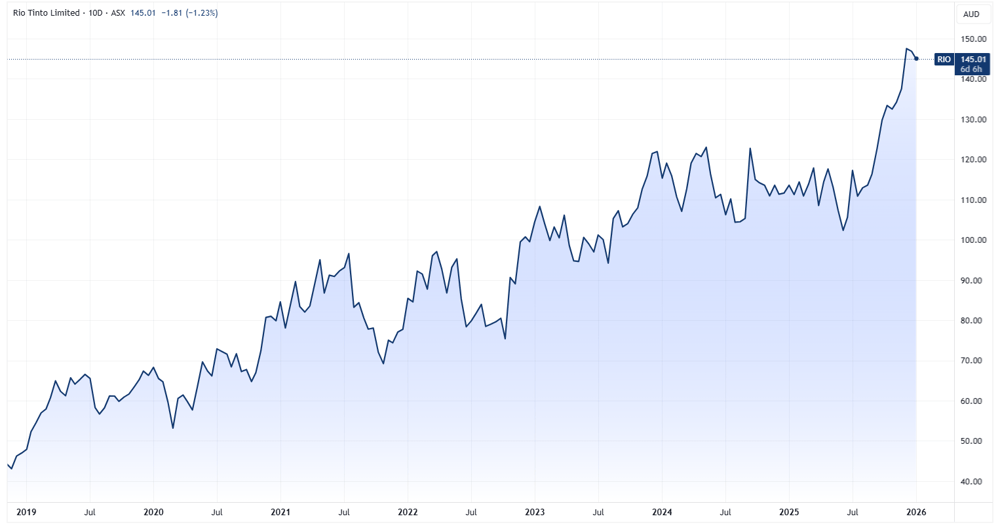
Rio Tinto price chart (Source: TradingView)
Much of the recent strength in copper, aluminium and lithium prices has clearly fuelled the recent price run. The question now is where Rio Tinto trades if it executes on its growth plans and the commodity complex continues this multi-year breakout.