Why Lynas Rare Earths is now one of the world’s most strategic ASX mining stocks
Lynas is at the centre of a transformational shift in rare earth markets as global powers scramble to secure supply.


Source: lynas rare earths on cell phone and computer screen 1280 x 720
Mentioned
KEY POINTS
- Lynas has secured a revised long-term supply deal with Japan Australia Rare Earths that introduces a floor price for NdPr oxide and locks in strategic demand through 2038.
- Brokers say the agreement significantly improves earnings visibility by insulating Lynas from some of the worst swings of the rare earth commodity price cycle.
- The deal also underscores how governments and industrial partners are moving to secure rare earth supply chains outside China as geopolitical tensions rise.
Rare earths producer Lynas Rare Earths (LYC) is once again at the centre of the global race to secure supply of critical minerals.
This week the company announced an updated long-term supply agreement with Japan Australia Rare Earths (JARE), a joint venture backed by Japan’s government and industrial groups. The revised deal locks in supply commitments for key rare earth materials for more than a decade and introduces a market-linked price floor for one of the most important magnet metals.
For Lynas, the agreement provides greater earnings certainty at a time when rare earth prices — particularly the critical magnet metal Praseodymium-Neodymium (NdPr) — have surged to their highest levels in around three years.
%20price%20chart%20as%20at%2010%20March%202026.png)
Praseodymium-Neodymium Oxide (RMB/mt) chart as at market close 10 March 2026
More broadly, the deal highlights the increasingly strategic role the company plays in global supply chains. As the US, Japan, Europe and Australia attempt to reduce dependence on China’s dominant rare earths industry, Lynas has emerged as one of the few large-scale producers capable of supplying the Western world.
In other words, the company sits at the centre of what could become one of the most transformational commodity trends of the next decade.
What rare earths are — and why Lynas matters
Rare earth elements (REEs) are a group of 17 metals that are essential inputs for many modern technologies, particularly high-performance permanent magnets used in electric vehicles, wind turbines, robotics, defence systems and consumer electronics.
Any discussion of rare earths must begin with China. Over the past three decades it has built dominant control of the supply chain — from mining and processing through to magnet manufacturing. Today the country produces most of the world’s rare earth minerals and controls an even larger share of refining and separation capacity, creating a strategic vulnerability for industries ranging from electric vehicles to defence.
Governments in the United States, Japan, Australia and Europe have spent the past decade attempting to build alternative supply chains. Efforts have included direct investment, long-term offtake agreements, and policies designed to support domestic refining and magnet manufacturing. While progress has been uneven, the direction of travel is clear: major economies want a reliable supply of rare earths outside China.
Among the most commercially important REEs are Praseodymium (Pr) and Neodymium (Nd), which combine to form NdPr oxide — the key ingredient in powerful NdFeB permanent magnets used in everything from EV motors to industrial automation.
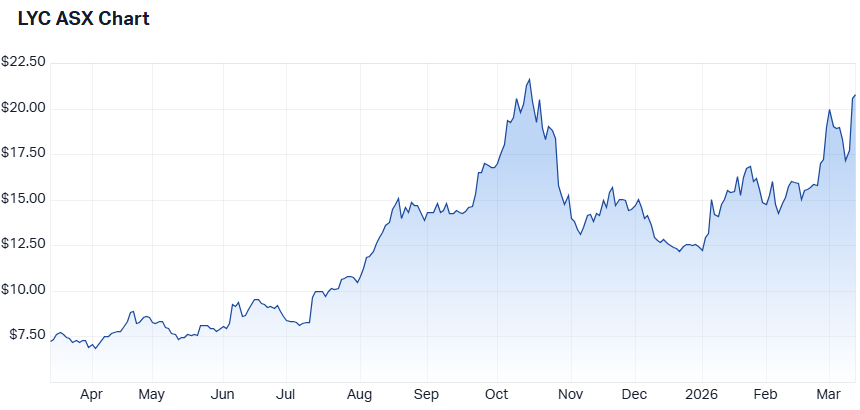
Lynas Rare Earths share price chart as at market close 10 March
Lynas produces several rare earth oxides, with NdPr representing the bulk of its revenue exposure. The company is unique among Western producers because it already operates a fully integrated rare earth supply chain outside China. Lynas’ operational highlights include:
Mt Weld mine (Western Australia) – one of the highest-grade rare earth deposits globally
Kalgoorlie processing facility – midstream cracking and leaching operations designed to expand capacity and reduce reliance on offshore processing
Lynas Malaysia (LAMP) – one of the world’s largest rare earth separation plants
Integrated production chain – from mining and concentration through to separated rare earth oxides
Together these assets have made Lynas the largest rare earth producer outside China, exporting separated materials to customers across Asia, Europe and the United States.
The company’s longer-term strategy goes further still. Management is pushing to expand production of heavy rare earth elements (HREs) such as dysprosium and terbium — critical materials used to improve magnet performance in high-temperature environments.
It is also exploring downstream magnet manufacturing, an area where Western governments are actively encouraging new capacity to reduce dependence on Chinese suppliers. The result is a business increasingly positioned as a vertically integrated rare earths champion for Western supply chains.
What the major brokers are saying about Lynas and JARE
Broker research released following the updated JARE agreement broadly points to the same conclusion: the revised structure materially strengthens Lynas’s earnings visibility while reinforcing its strategic importance in global rare earth supply chains.
At the centre of the update is a long-term supply agreement with Japan Australia Rare Earths (JARE) that introduces a US$110/kg floor price for NdPr oxide, alongside firm volume commitments running through to 2038. For analysts, that structure addresses one of the sector’s biggest challenges — the extreme cyclicality of rare earth pricing.
Morgan Stanley believes the deal meaningfully improves Lynas’s risk profile, arguing it effectively “de-risks Lynas’s through-cycle earnings” by guaranteeing a minimum NdPr price while preserving exposure to higher prices. The agreement still allows Lynas to benefit from stronger market conditions, with profit-sharing mechanisms only applying once prices move above US$150/kg [1].
Canaccord Genuity similarly emphasised the earnings stability provided by the revised structure, noting the deal should provide “greater certainty on margins and cashflow” while maintaining exposure to rising rare earth prices [2].
The broker also highlighted the strategic dimension of the agreement. In a market still heavily influenced by Chinese pricing benchmarks, locking in long-term demand from Japanese industry reduces Lynas’s exposure to pricing volatility in China’s domestic rare earth market.
UBS analysts broadly share that view, describing the updated structure as helping to “future proof” Lynas by securing demand while reducing commodity price risk [3].
Taken together, the brokers’ analysis points to a clear takeaway: the revised JARE agreement does more than secure offtake. It strengthens Lynas’s role as one of the few large-scale producers capable of supplying critical rare earth materials to Western and allied supply chains — a position that could become increasingly valuable as demand continues to grow.
The bigger picture
For decades, the rare earths sector has been defined by the commodity price cycle. Prices surge when supply fears or geopolitical tensions emerge, encouraging new projects and investment. But when those fears fade and supply begins to respond, prices can collapse just as quickly — often leaving developers stranded without financing and projects shelved for years.
That boom–bust pattern has repeatedly hobbled the development of rare earth supply chains outside China over the past two decades. Each downturn has forced Western projects into retreat, while China’s vertically integrated industry — supported by scale, policy backing and downstream demand — has continued to consolidate its dominance.
This is why the revised JARE agreement matters. By introducing a long-term NdPr price floor, the deal effectively insulates a significant portion of Lynas’s production from the most damaging swings of the commodity price cycle. In doing so, it provides a level of earnings stability that has historically been absent from the rare earths industry.
More importantly, the agreement demonstrates that governments and industrial partners remain determined to build reliable rare earth supply chains outside China. In that sense, the updated JARE agreement is more than a commercial arrangement. It represents a significant step in the effort by major economies to secure access to some of the most strategically important minerals in the modern global economy.
For Lynas, it reinforces the company’s position at the centre of that effort.
References
[1] Morgan Stanley (2026), Government support comes in, settling investor concerns — bringing our bull case in focus: Lynas Rare Earths, Equity Research Update, 10 March 2026.
[2] Canaccord Genuity (2026), Lynas Rare Earths Ltd — Raising Target Price, Australian Equity Research: Critical Minerals, 11 March 2026.
[3] UBS (2026), Updated JARE agreement future proofs LYC, Global Research – First Read, 11 March 2026.