
Hi there!
I’m starting to think, maybe just maybe, that solid markets and high yields can co-exist, provided earnings growth holds up.
Look at the US: The 10-year yield has soared from 4.75% in late August to 5.24% today, yet the S&P 500’s three-year forward EPS CAGR has climbed from 14.75% to 15.8% over the same stretch (so ~50 bps for yields vs. ~100 bps for growth). It feels like every day we’re reading that yields are at their highest since [insert some point 20 years ago], but perhaps a strong market can tolerate that as long as earnings estimates stay sound.
The catch for us is that, outside the miners, the companies that actually move the needle on the ASX aren’t delivering much earnings growth.
Anyway, it’s a bit of a quiet weekender as the Aussie market continues to linger around breakeven for the year.
Let's dive in.
Investor sentiment survey
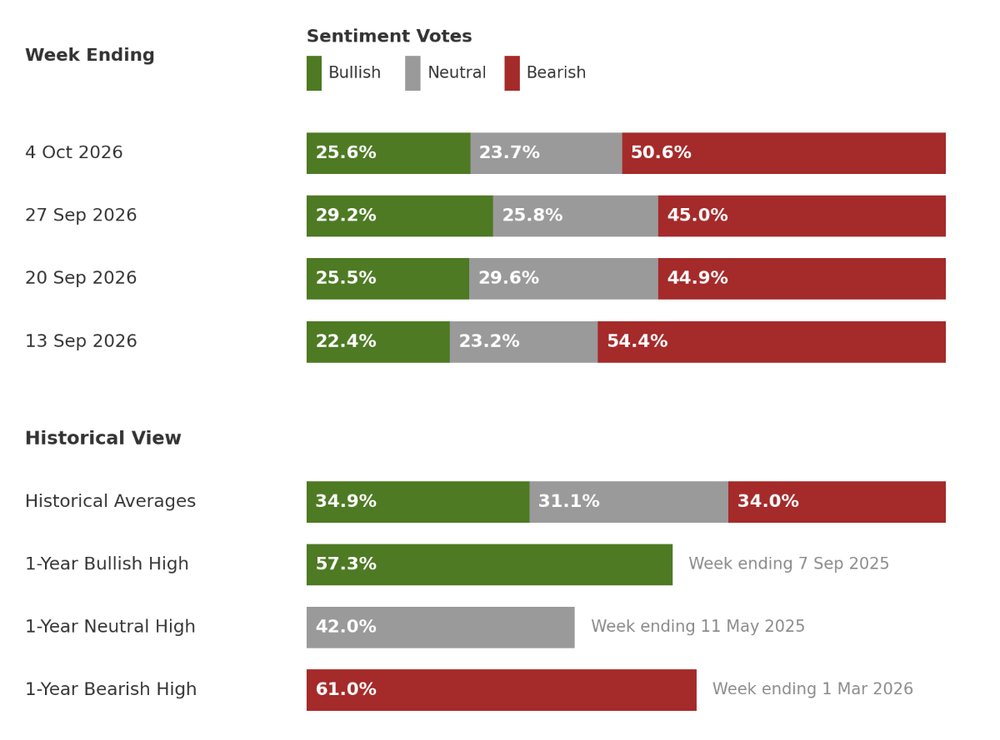
Bearishness is back above 50%, while the spread hit –25.0pp, the worst since the 13 September capitulation (the ASX 200 fell 3.0% in four days this week).
Bears at 50.6% is in the 96th percentile and third-highest reading since we started the survey in May 2025 (behind 61.0% on 1-Mar and 54.4% on 13-Sep).
Over the next three months, do you expect the Australian stock market to be:
Wisetech's short interest is going vertical
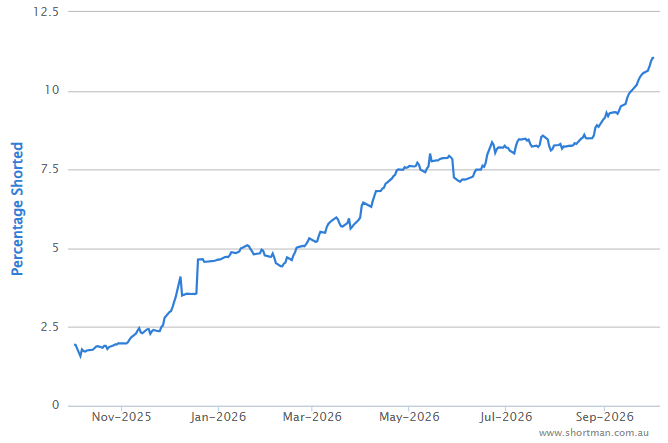
WiseTech has spent most of the past four months trading in the low $30s, aside from a brief pop above $40 in early to mid-August. What’s more striking is that near-vertical climb in short interest, which has reached 11.05% as at 2 October, up from 9.30% a month ago and around 4.5% at the start of the year.
The stock was already removed from the S&P/ASX 50 at the September quarter rebalance, and as poor as recent performance has been, it remains a long way from ASX 100 or 200 exclusion. That makes it hard to attribute the rise in short interest to index-driven fund flows.
Yet both the sell-side and buy-side have remained as bullish as ever. Some of the latest commentary include:
Macquarie (27 August) retained its Outperform rating and lifted its target 2.3% to $48.20, saying “with a new chair, WTC is extremely focused on results v guidance. We think FY27 is conservative on EBITDA margin, with E2Open cost-out on consulting exit excluded from guidance. At ~22x FY28 P/E, valuation is undemanding, but stock requires catalysts”
First Sentier Investors’ Dushko Bajic named WiseTech his top pick at Livewire Live, arguing its pricing model overhaul mirrors the shift that set up years of gains for US software giants a decade ago
Datt Capital’s Emanuel Datt sees WiseTech as the most undervalued stock in his portfolio, pointing to its refreshed board and management, outperformance on e2open synergy targets and shift to value-based pricing, despite trading at around half the valuation of its Nasdaq-listed peers
So something has to give. The price action and aggressive shorting might suggest Wisetech is struggling to return to prime growth rates, with organic growth easing from the usual 15-20% to 8% in FY26. Perhaps hopes of a reacceleration is just wishful thinking?
Picks and shovels take a breather
The failed Firmus IPO was the talk of the town this week, but it’s been covered to death, so let’s take a look at an adjacent play - the pick and shovel plays.
High-flyers like SKS Technologies, Southern Cross Electrical Engineering, GR Engineering and NRW have delivered extraordinary gains this year, with most up more than 50% year-to-date. But the Firmus news was probably the catalyst to spark a sharp pullback across the group:
SKS Technologies is down about 22% in three days, though a chunk of that came from Wednesday’s 12.2% fall after the founding Jinks family sold 10m shares at $10.60, a 5.1% discount
Southern Cross Electrical is down about 14% over the past four days
NRW Holdings is down about ~6% over the past four days
GenusPlus is down ~6% over the past four days
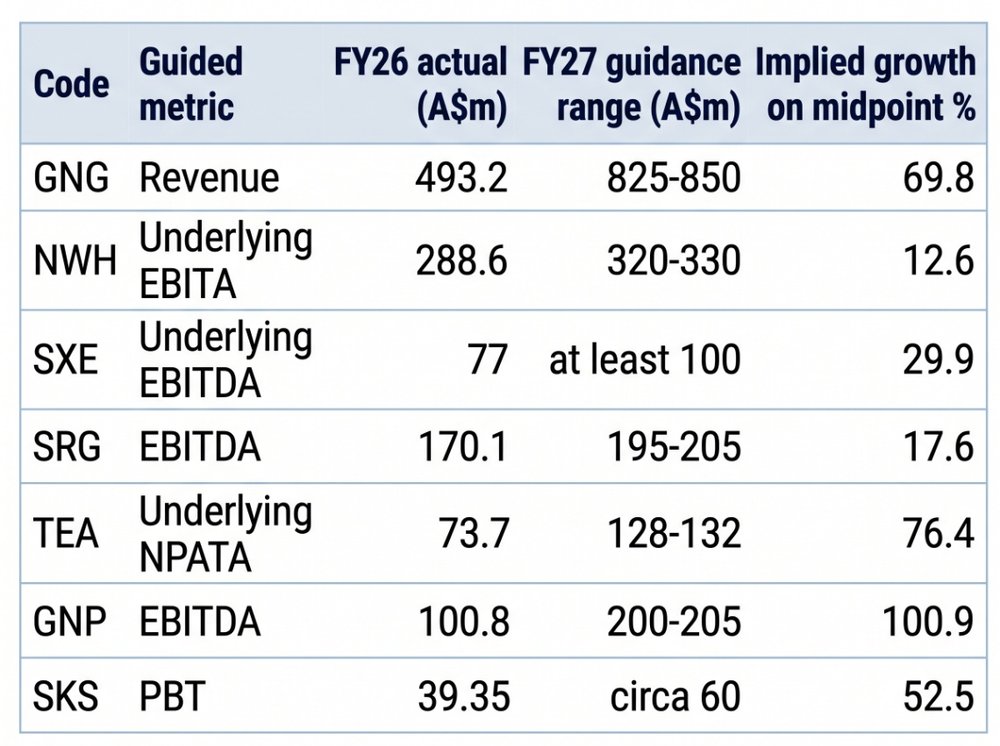
The thing is, these aren't alarming pullbacks. If anything, these stocks are just easing back into the 20 or 50-day moving average, and back into previous bases. Most have also guided to chunky growth at their recent FY26 results, so provided the data centre buildout doesn’t materially change, this could be a pullback worth keeping an eye on.
Best of Livewire
Here are some of my favourite reads from our friends at Livewire.
Buy Hold Sell – 5 high-scoring stocks: Rudi and Henry run the ruler over Market Index’s new Stock Scores screener, splitting on Capricorn, Cuscal and Duratec. Both back Northern Star and both bail on GQG.
David Tuckwell is still a raging bull: US exceptionalism intact, Mag Seven held, and the AI trade shifting from chips to physical infrastructure. He’s turned bullish on gold and says copper is a 2035 trade.
3 key moves young Australians can make: Start saving, salary sacrifice early, and tilt international. Starting at 20 instead of 40 turns the same $240,000 into $1.75m rather than $593,000.
Time to sell for a Praemium: Harley Grosser, one of PPS’s largest holders, wants the new board to run a strategic review. He pegs a takeover at $1.00-$1.40 against about 60c today.
Inside the portfolio: Ausbil’s Michael Price doubled his bank underweight, added Qantas after its result, and has BHP as his largest overweight. Refiners were the quarter’s best contributors.
4.5 – 5.0 stars is the new rating scale
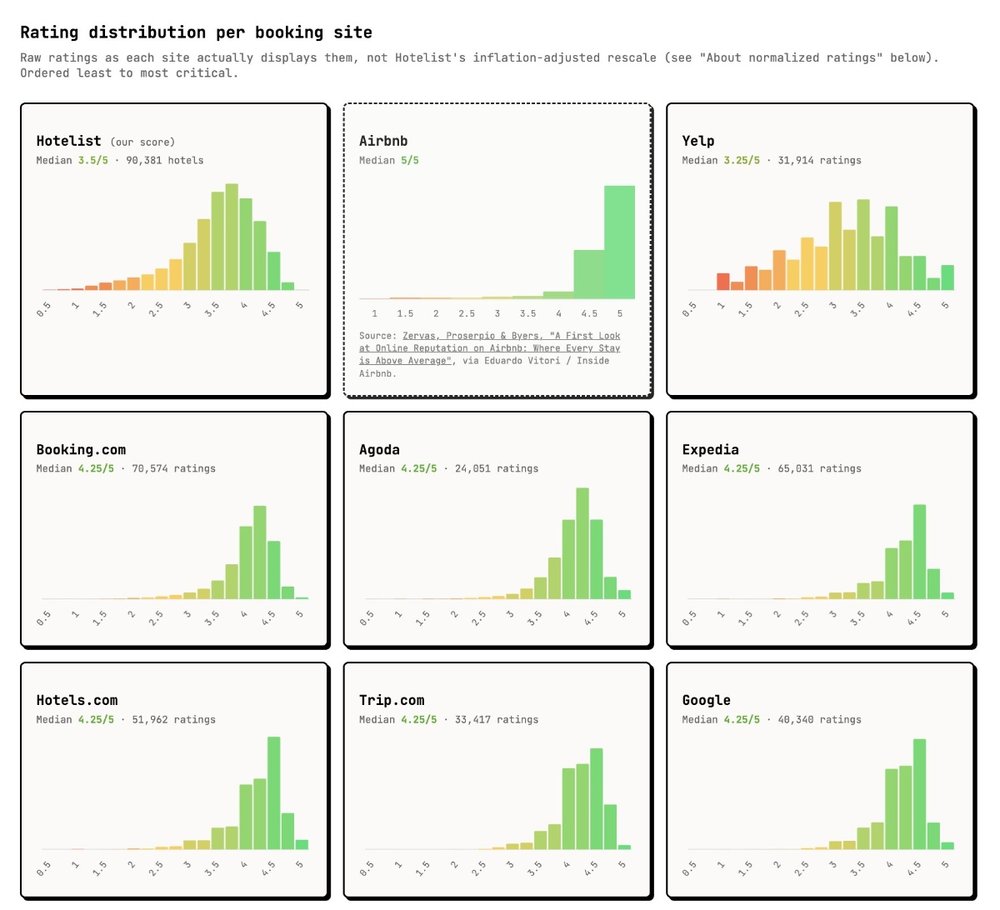
It’s been a while since we featured something outside of markets, so here’s a fun one. X user @levelsio went a little viral after analysing ratings across booking sites and finding that pretty much all of them sit between 4 and 5, with a median of around 4.25. He reckons Airbnb and most booking sites remove negative reviews, which pushes almost everything above 4.7.
It gets worse. Most ratings are rounded to the nearest 0.5, so the bulk of listings end up showing as five stars.
In other words, 4.5 to 5 is the new 1 to 5.
The most honest platform turned out to be Yelp, where ratings actually follow a normal distribution. Unfortunately, Yelp is also widely disliked by businesses for its strict rules on review transparency.
Last laughs
C’mon guys, it’s 50% off and still fresh!