Hi there!
Reporting season is over and I'm all out of brain juice.
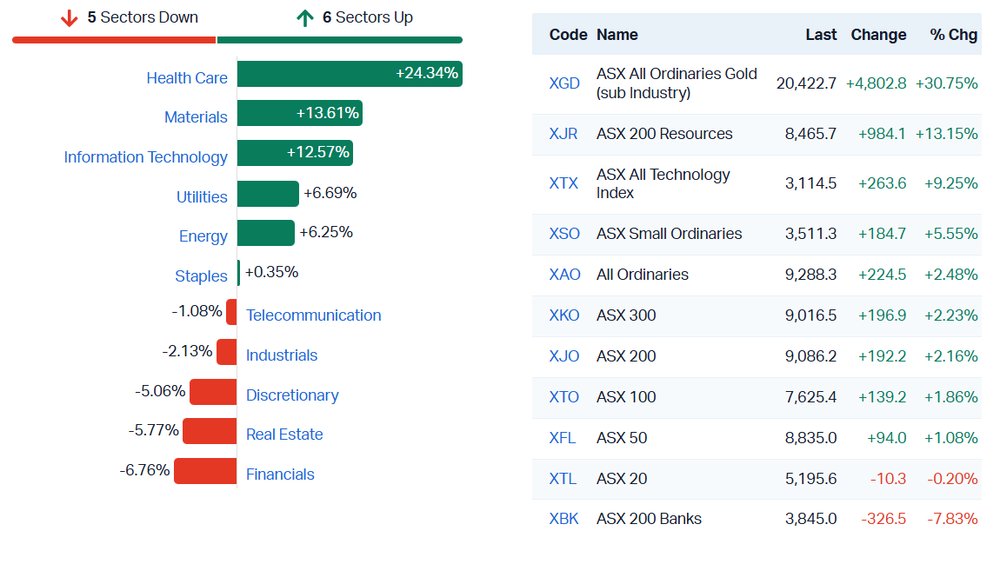
At the sector level, it was a fairly uneventful one outside of a healthcare revival and miners absolutely printing cash (1-month sector and index performances above). Share price volatility is the new norm and ~10% moves are now extremely common.
Here are my biggest takeaways from this earnings season.
Don't underestimate the trend. The S&P/ASX 200 Healthcare sector was already up 28% from its 3 June low heading into the CSL and Cochlear results, against a backdrop of a strongly trending S&P 500 Healthcare Index at record highs. Both local heavyweights beat earnings and guidance expectations, and the sector has run another 11% since.
Miners are printing cash. Miner results are usually uneventful, since most of the data lands at the prior quarterly. Not this time. It felt like every miner had surprises regarding capital management. Sandfire declared its first dividend since 2022 (US 22.8 cents, 34% ahead of Macquarie's US 17 cents), Aurelia Metals a maiden 1 cps payout against expectations of nil, and Alkane its first capital return ever at 2 cps plus a $50 million buyback. And many, many more. With commodity prices holding up, it's prime harvesting time.
Listen to the peers. Westpac was one of the first banks to flag the slowdown, with its 3Q26 update on 10 August showing average monthly mortgage application volumes down 11% quarter-on-quarter and the post-budget run rate down 20% on 2Q26. It wasn't a good look, and pretty much every other major bank echoed it. The S&P/ASX 200 Financials Index fell 2.2% on the day of the Westpac update and is down a further 6.2% since.
A fairly light one for this week. Let's dive in.
Investor sentiment survey
.png)
A big jump in bears, a -12.1pp spread, taking bearishness back in the 85th percentile. The past six weeks has shown a rather uneasy investor, but not an outright bearish trend, with spreads of −12.4 → −21.5 → −23.7 → +6.4 → +0.3 → −12.1.
Over the next three months, do you expect the Australian stock market to be:
What CEOs are saying
After sifting through (too many) earnings calls, here are some of my favourite lines from management.
Qantas on leisure demand: "Still in our research, we see that travel intention is high and the prioritisation of travel high. I think there genuinely has been a structural change in the desire for travel and experience in the last few years, and we are seeing that hold and in some ways strengthen... Jetstar had a record week last week, in fact, but very strong intakes across both domestic and international.”
Sigma Healthcare on the consumer: "I cannot really say we are feeling the impact of the consumer pressure at the moment. Certainly categories like vitamins or ladies' fragrances, which tend to be a little bit more discretionary, we can probably see a little bit of impact there. Then we are picking it up in haircare, in healthcare, and a whole lot of other categories.”
MinRes on copper growth: “Copper is high on the agenda for everyone, and it is something that we are paying attention to. We are more interested in partnering with an owner that has, say, a copper project somewhere in the world, and it would be probably near shovel-ready … We are really focused on copper as our next commodity, and we really do not want to grow too much more in the lithium and the iron ore.”
Paladin Energy on utilities’ buying behaviour: "We are seeing requests for proposals in the 2030s, well into late 2030s, in fact. Which has been quite unusual with utilities being a lot more forward-thinking.”
Woodside on new energy: "... taken the disciplined decision to retire our Scope 3 investment and emissions abatement targets", as markets for hydrogen, ammonia and CCS "have developed more slowly than anticipated"
Woolies on the state of the customer: "Consistent inflation, global volatility, and consecutive interest rate rises during the year have continued to put pressure on our customers. With over 40% of customers telling us that they are struggling to make ends meet... value-seeking behaviours like shopping across multiple retailers remain elevated"
Woolies on what Ooshies actually changed in behaviour: "We see a portion of customers who are already shopping with us and might add a few more items to their basket so that they qualify for the Ooshie. We also then see some customers who might not have shopped with us for a while, come and try us again"
Coles on the underlying demand backdrop: "June picked up again a bit versus where we had been in May, and then actually going into July, we saw a further pick up again. So there is definitely strength in the grocery market at the moment... but also more and more customers telling us that they are eating more at home than they are out of home"
Best of Livewire
Here are some of my favourite reads from our friends over at Livewire Markets.
Good result, wrong price. Why Airlie is underweight Wesfarmers: NPAT rose 8.3% to $2,874m and the dividend went up 7.8%, but shares fell 6% on a softer outlook. Vinay Ranjan says 30x FY27 is too rich when JB Hi-Fi trades on 15.
Perpetual on why Eagers keeps widening the gap: Record first-half revenue of $8.1b, up 24%, with CanadaOne beating expectations in its first two months. James Rutledge is a buyer, with Canada at just 2.5% share the medium-term growth engine.
The Ooshie edge: Woolies outpaces Coles in FY26: Woolworths lifted EBIT 12.7% and the dividend 15.5%, with Ooshies worth 1.5-2% of sales growth. Ausbil's Michael Price is underweight both on valuation, seeing sub-10% total returns.
"It's an execution year": Aussie Broadband CFO on a promising FY27: Underlying EBITDA rose 19.6% to $165.3m with a 20% dividend beat and a $115m buyback, though FY27 guidance landed 4% below estimates. Darren Rowland says the NBN migrations set up a bumper year.
Vanguard's 6 shocking charts about retirement in 2026: 48% of Gen Z expect to retire still carrying a mortgage, against 24% of Boomers, and under-45s think they'll need $90,000 a year. Engaging with five basic planning steps tripled modelled retirement confidence.
The brutal new maths of saving for a house deposit: Stockspot modelling puts the CGT change at three months extra for an average-income couple, 12 months for a $400,000 household and 18 for a single buyer. Geoff Wilson wants a tax-free First Home Investment Account.
Last laughs
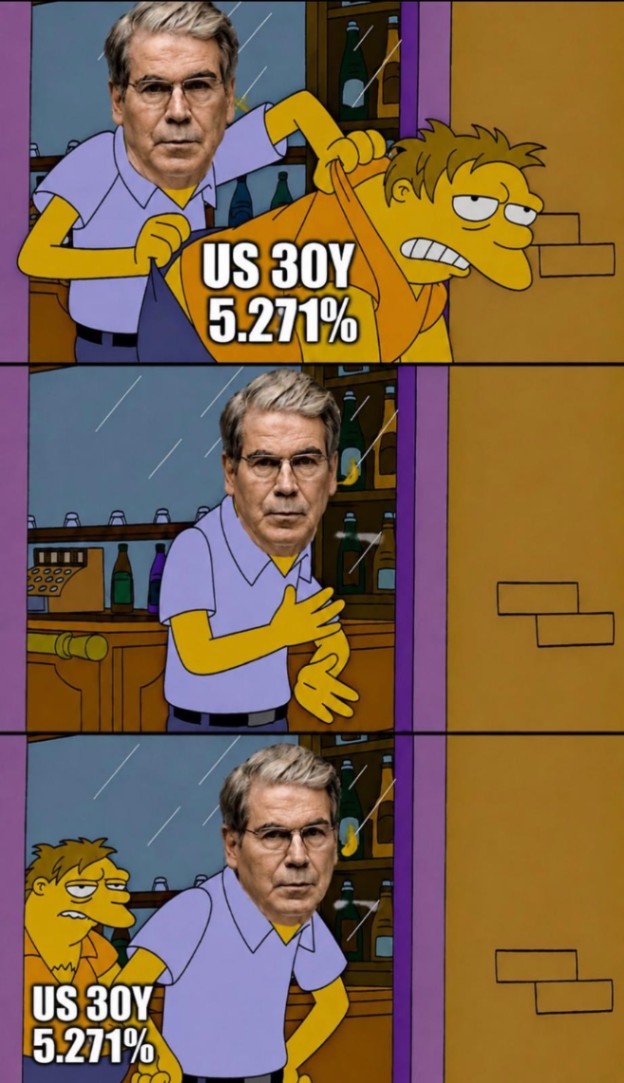
A day in the life of Bessent: Talk up the 30-year bond, buy some Yen, call up Axios, rinse and repeat.