Hi there!
It's getting rough out there. Oil is still hovering around US$95, every long-dated bond yield chart looks vertical, and central bank chatter has gone from a hopeful hold to talk of more hikes. After a brief reprieve, prices at the pump are back above two bucks.
Hopefully, as oil drifts closer to US$100, we see some TACOs. And with the US 30-year floating around 5.2%, Bessent will probably unleash a verbal barrage. Very effective stuff, I know. But markets are a bit like that. A good run, straight into a stretch without a single bullish catalyst in sight. The thing is, anyone who let pessimism get the better of them these past few years has missed a huge rally. So perhaps we call it another episode of keep calm and worry when the crisis actually hits.
Let's dive in.
Investor sentiment survey
.png)
The week ended 30-Aug was a -1.9 percentage point spread, marginally net-bearish but the gap had closed sharply from -12.1 in the prior week. Neutral voters surprisingly tumbled to 25.2%, the lowest since 7 June and in the bottom decile of the year.
Over the next three months, do you expect the Australian stock market to be:
How does the ASX 200 perform in September?
.xlsx%20-%20Excel.png)
September. The most feared month on the equity calendar. Since 2001, the S&P/ASX 200 Total Returns Index has averaged a 0.65% decline in September and finished higher just 44% of the time, the worst month on both measures.
Seasonality should never drive a buy or sell decision. But if there's one month to bring an umbrella, this is it.
Macquarie’s reporting season takeaways
August reporting season is all but in the rear view mirror. So what were the big takeaways? Here's Macquarie's view.
Margins did the heavy lifting, supported by cost-out, productivity and better mix, with expectations possibly cut too far after the Iran conflict lifted cost concerns. The market rewarded margin improvement more where it came alongside revenue growth rather than cost control alone
Guidance misses exceeded beats by 12ppt, in line with the usual August pattern, with most companies still guiding in line. Guidance became the strongest driver of share price reactions as the season progressed
Two economies emerged, with household and housing-facing activity weakening while business lending, infrastructure, defence, mining services and data centre investment held firm. Labour, component availability, power and funding now constrain parts of the investment economy more than demand does
Mortgage applications fell 12-15% after the Budget, with residential sales weakening and buyer conversion slowing. Credit losses remain low but arrears, SME impairments and interest-accruing card balances have started to rise
Inflation remains concentrated in less rate-sensitive areas including regulated wages, insurance claims, energy, industrial inputs and construction, with another RBA hike possible by year-end and global banks also tightening.
Macquarie continues to favour Quality and Defensives, including RMD, ALQ, REA, COL and ALL on the quality side and SIG, RHC, CSL, TCL, GMG, GPT, AMC and MPL on the defensive side
Corporate Travel makes its return
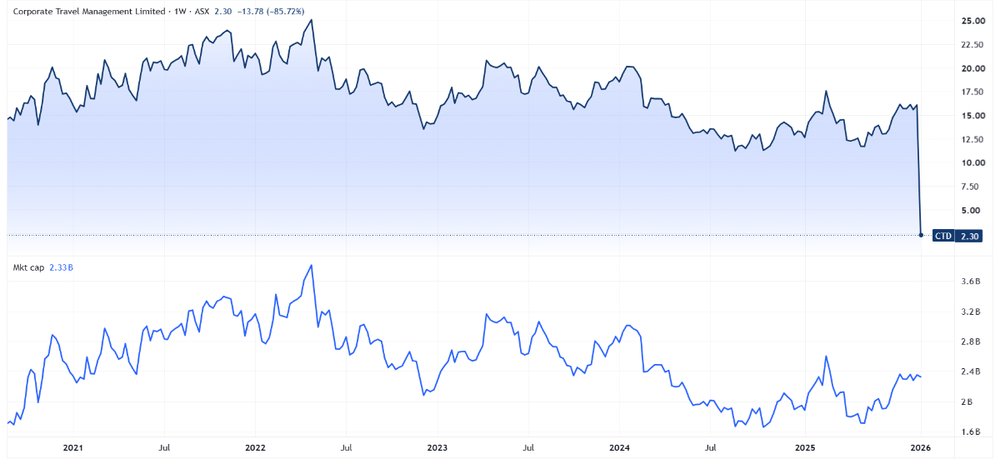
Corporate Travel is back and recorded probably one of the largest one-day declines for a $2 billion market cap company on record.
The company reported its FY26 result on Wednesday, after a comprehensive audit concluded "there was no evidence of widespread systemic overcharging". The stock resumed trading on Thursday following a year-long suspension and closed down 85.5% at $2.32. Market cap went from $2.35 billion to $340 million!
The numbers weren't all that bad at face value but materially below what analysts had pencilled in before the suspension.
TTV up 2% to $9.8bn, with transaction volumes up 13% to 18.3m across all four operating regions
Underlying EBITDA up 36% to $113.6m. Europe swung to $24.7m from a $1.2m loss and ANZ rose 53% to $39.2m, while North America was broadly flat at $62.3m
NPAT of $17.7m against a $348.5m loss in FY25
Cash of $106.9m
Net tangible assets of -15 cents versus -52 cents a year ago and $1.24 at Dec-24
The AFR also reported on an absolute generational short by GCQ's Doug Tynan, who closed the position at 17 cents against a last traded price of $16.07 in August last year. Plenty of fundies had already marked the stock to zero during the suspension, so anything above nil was a win worth taking.
Microcaps of interest
With reporting season done and dusted, here are a few microcaps that caught my eye. No adjectives, just numbers. The usual caveats apply (that being, extremely illiquid and like a lot of microcaps, they can trade nowhere for a very long time).
Raiz Invest (RZI) – $65m market cap, FY26 revenue up 21% to $29.2m, underlying EBITDA up 93% to $5.5m, funds under management up 28% to $2.3bn and $15.4m cash. What’s interesting is that investing platform Superhero raised $20m last month at a $176m valuation, according to the AFR. In FY26, their revenue rose 46% to $27m, with underlying EBITDA of $6.8m and $4bn in FUM. All else equal, that values Raiz somewhere around $140m.
Harmoney Corp (HMY) – Fast-personal loans platform, trades at ~$78m market cap. FY26 cash NPAT of $13.5m (vs. $13.0m guidance and $5.7m in FY25), so a price-to-earnings of 5.7x. Targeting FY27 cash NPAT of at least $16m. Resumed a buyback of up to 5% of shares after the result.
Wisr (WZR): A financial health platform and lender, $49m market cap, reported its first full-year cash NPAT profit of $1.0m on loan origination growth of 65% and revenue growth of 19%. The company is targeting FY27 cash NPAT of “at least $5.0m”
Ashley Services (ASH): A labour hire, recruitment and training services company trading at $41m market cap. FY26 saw revenues rise 16% to $602m and NPAT up 189% to $6.3m, plus a final dividend of 1.15 cents per share (~5.8% yield).
Best of Livewire
Here are some of my favourite reads from our friends at Livewire.
Panning for gold after reporting season: Only 24% of ASX 200 companies beat expectations, yet the index rose 1.6%. VanEck's Cameron McCormack says the finds were in resources, A-REITs and small caps.
Buy Hold Sell: Small cap winners, losers and best ideas: Forager's Steve Johnson and Seneca's Ben Richards split on almost every name, agreeing only that SKS is a sell. Bonus picks were HMC Capital and Motorcycle Holdings.
Surprise ASX beats and misses, sleeper stocks: Yarra's team liked Guzman y Gomez and GR Engineering, flagged Goodman and EML as misses, and named Auckland Airport and TPG as sleepers.
6 ASX best ideas Morgans is backing: Almost 60% of results now move shares more than 5%, and many reverse, so Morgans says rebalance after results. New picks: WES, DBI, REA, MND, CVL and IMR.
A near-perfect storm is hitting housing: AMP’s Shane Oliver has lifted his top-to-bottom call to a 10% national fall, with 3.6% done and Sydney off 7.1%. Another rate hike is expected by November.
Last laughs
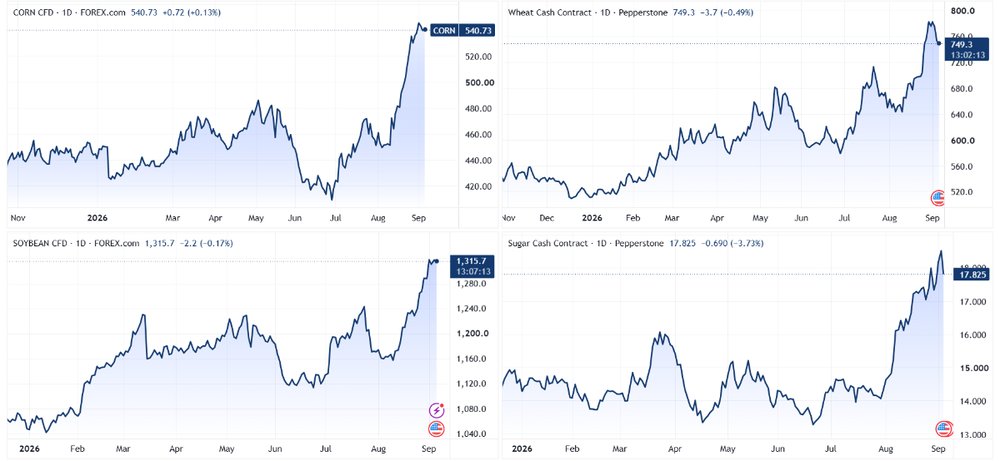
Anyone checked the price of grains and soft commodities lately? It's a good thing we can eat data centres.