
One Day Decliners and Tech Obliteration
Hi there!
I’ve never experienced an earthquake before – but this reporting season might just simulate the same thing. I don’t think any of us have seen so many stocks suffer so many 20-30% selloffs before. The face value moves and volatility is simply out of this world. On top of that, commodities experienced a sharp pullback on Thur-Fri and how could we forget about tech stocks. Just when you think they've found a floor, they just keep folding.
A few things to unpack in this weekender. Let’s dive in.
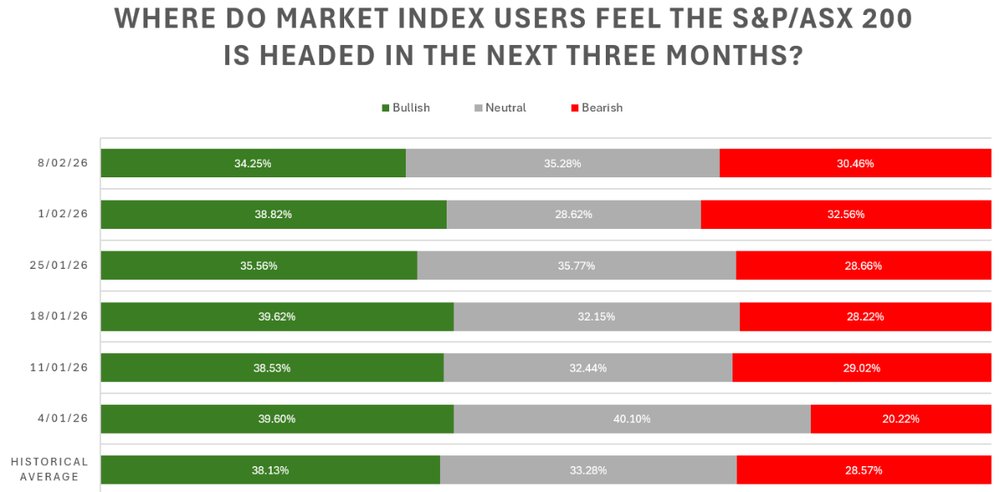
Investor sentiment survey
Down down, tech is down
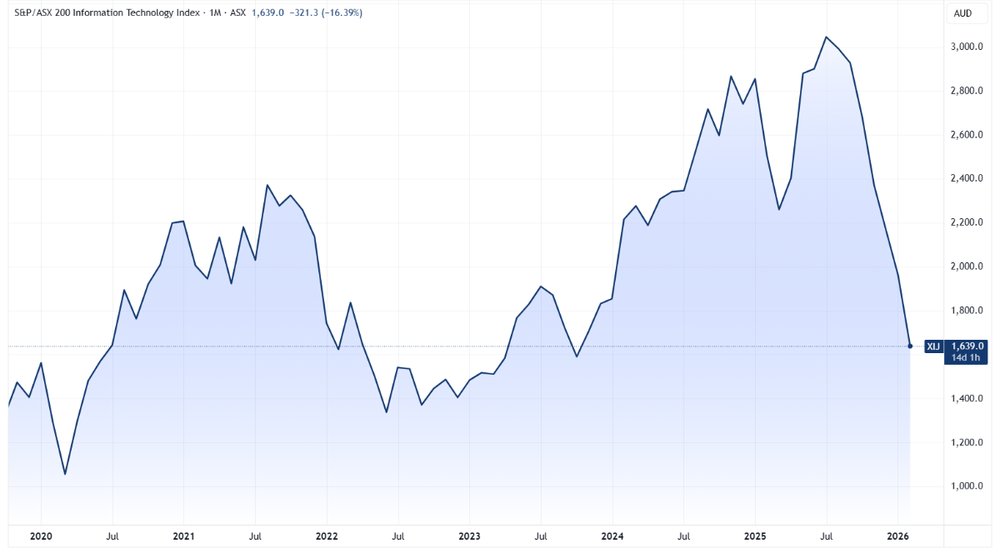
What a painful downward spiral for tech – it feels like these stocks are just bleeding 5-10% every week, for the past couple of months. The S&P/ASX 200 Tech Index has almost halved since September, and trading just 5% above pre-pandemic levels.
What makes me feel extra bad for tech is that:
The frequency of new AI tool releases is accelerating. It's gone from vibe coding, to early-stage tools for financial analysis, insurance broking and as of Thursday, trucking and logistics
Lots of local ex-tech sectors look relatively appealing:
Banks have smashed market expectations this reporting season. Net interest margins have fallen less than expected, credit quality has been very strong, and net profits/dividends have all broadly beaten expectations
Pockets of the resource sector are printing cash. The broader resource sector is in a good place against a backdrop of still-elevated commodity prices.
AGL and Origin have rallied sharply (XUJ up ~8% in the last three sessions) off the back of better-than-expected 1H26 earnings
There’s no doubt that a big portion of this is sentiment driven – how could AI possibly replace the IP, hardware and data of a name like Life360? At this point in time, it seems impossible. But that doesn't mean Life360 can't fall from its September peak of 300x to 120x today (at face value, 120x still feels pretty expensive eh?).
The 20-40% club
This reporting season has been, simply put – miss expectations and die.
Here are the week-to-date returns of recent reporters:
Pro Medicus (-46%)
Temple & Webster (-44.9%)
Cochlear (-23%)
ARB Corp (-23%)
AMP (-23%)
Nick Scali (-21%)
Some of these results weren't even that bad. If there were 12 months ago, PME would've opened a little lower and probably finished the session flat (and then rip to fresh all-time highs the next day).
Meanwhile, Nick Scali reported a broad 1H26 beat:
Revenue up 7.2% to $269.3m vs ests $267.5m (1% beat)
EBITDA up 18.1% to $96.6m vs ests $90.2m (7% beat)
NPAT up 23.1% to $41.0m vs ests $38.0m (8% beat)
But margins were slightly below expectations and the trading update for ANZ like-for-like sales at 3.2% was seen was disappointing. Miss expectations and die I guess ...
GQG is getting interesting
GQG is a global fund manager that decided to avoid the AI trade like a plague. This defensive positioning over 2025 was a major headwind for its portfolios and all-important FUM. A few snippets of commentary from last year include:
Jul-25: “We remain defensively positioned in our strategies in an effort to reduce risk within client portfolios. Sticking to our discipline, we are avoiding areas where we see extreme valuation and frothiness.”
Sep-25: “Our sustained defensive positioning in our investment strategies led to relative underperformance in September and the third quarter … As stewards of capital, we continue to believe that our portfolios are well-positioned to help protect client assets in the event of significant volatility.”
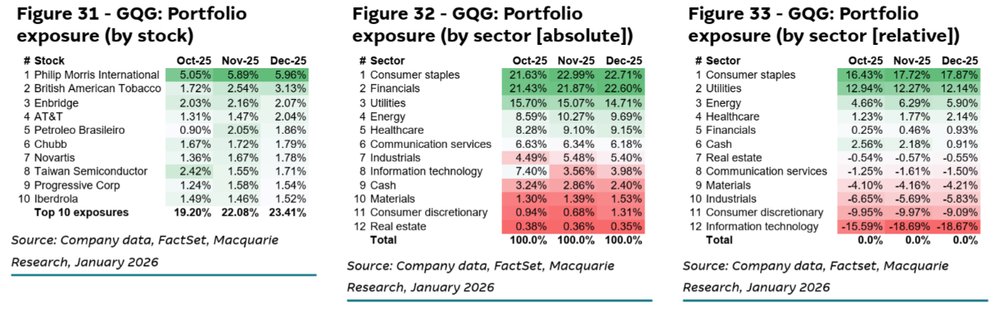
At a time where tech and software is starting to falter, GQG is starting to look interesting. The below tables outline GQG's largest exposures by stock and sector – and they're very heavy on Staples, Financials and Utilities.
Volatility on Wall Street
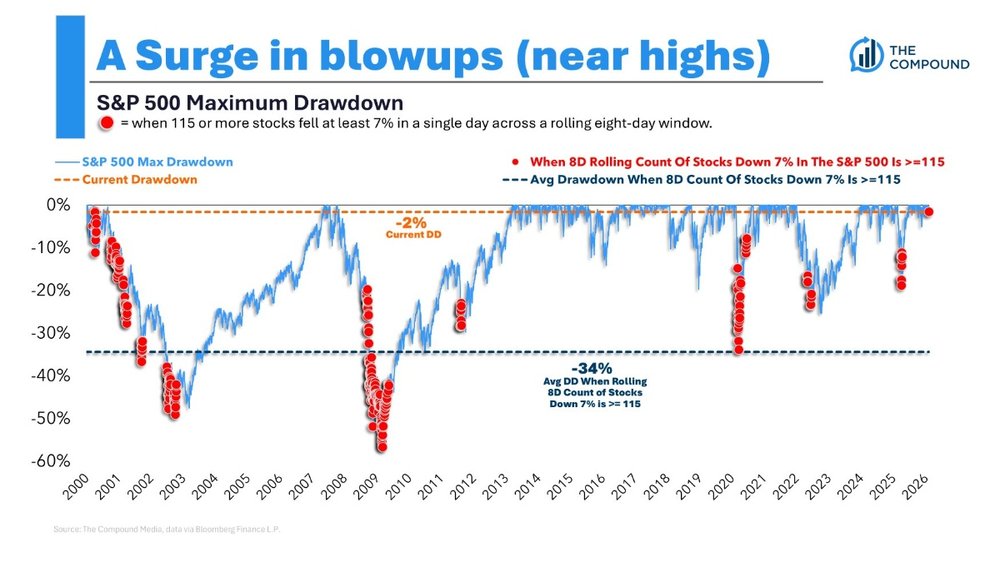
I’ve come across some interesting posts from Noruma and The Compound about the underlying volatility we’re seeing on the S&P 500.
As Noruma puts it: "Over the past month, SPX was up 0 bps while stocks on average moved almost 11%. McElligott points out that we’re seeing stunningly large, and highly divergent, moves across single-name equities and their volatility. But those moves are effectively offsetting each other at the index level, muting spot performance and suppressing index volatility via a classic “correlation crunch.”
The Compound also observed these wild moves as something we haven’t seen since the dot-com bubble burst. Over the past eight sessions (to 12-Feb), 115 stocks in the S&P 500 experienced a decline of 7% or more.
The forward returns after such a surge in blowups is 34% (and the S&P 500 is currently ~3% from all-time highs).
Last laughs
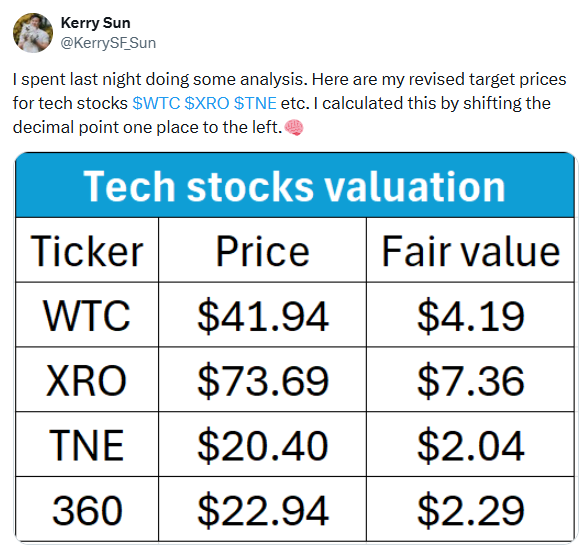
I'm making a return to X after several callouts that I used to post more funny stuff.
(And you're right – I've become a sad old man that looks at numbers all day).