
Hi there!
Geez, it's rough out there. The ASX 200 finished Friday on a more positive note, but what's a 0.6% bounce next to Thursday's 2% selloff?
The market feels stuck in a loop, where pessimism and hawkishness get a little extreme, paving the way for a relief rally that amounts to nothing because nothing has really changed. Yields remain uncomfortably high, and every time oil slips, another escalation headline comes along. I think all the market wants is some evidence that yields have topped and oil is flowing again.
On the plus side, the US-Iran war is now in its eighth month, which means we're not far from the inflation base effect kicking in. Because inflation is measured year-on-year, the energy price spike from when the war began will eventually drop out of the comparison. Even if prices stay elevated, annual inflation should start to ease once we lap that higher starting point.
Let's dive in.
Investor sentiment survey
.png)
Bearishness didn't move at all last week (44.9% to 45.0%), holding in the 89th percentile, so pessimism seems entrenched rather than easing. The small spread improvement (+3.7pp) came entirely from Neutrals turning bullish, not from bears capitulating.
Over the next three months, do you expect the Australian stock market to be:
A not-so-October start
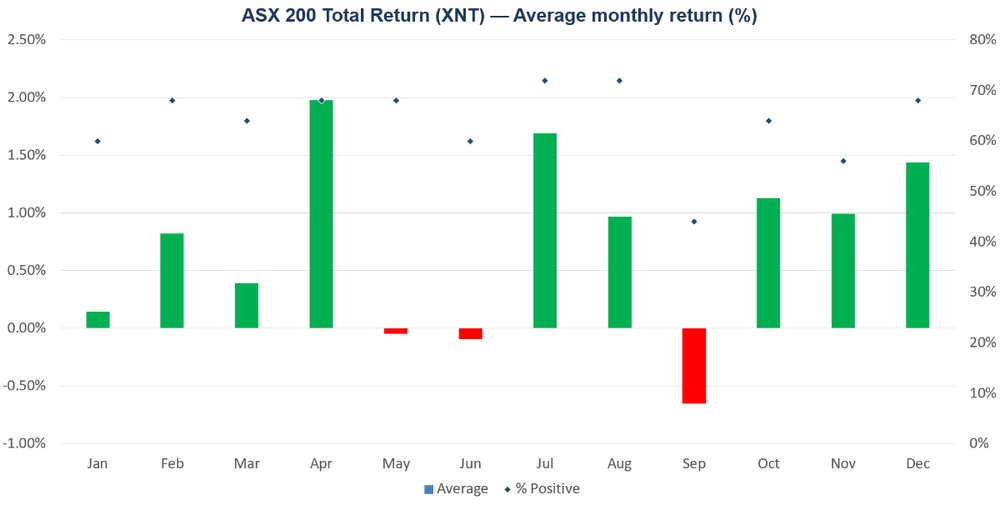
We're clearly not feeling that great after September, which lived up to its reputation as one of the weakest months of the calendar. The ASX 200 fell 3.1%, its second-worst month so far this year behind March's US-Iran-driven 7.7% tumble.
October, on the other hand, is widely regarded as the 'bear market killer'. Historically, the month has often marked the final low of bear markets and the start of the usual Q4 momentum.
This is the part where we remind you that past performance is not a reliable indicator of future returns. The ASX 200 tanked 2% on Thursday, the first trading day of October.
The table above tracks S&P/ASX 200 total returns back to 2001. Over that period, October has averaged a 1.13% gain and finished higher 64% of the time.
My other data set covers the S&P/ASX 200 price index only, which strips out dividends, and goes back further to 1980. On that measure, October has averaged a 0.17% decline.
Why the negative read? Because the ASX experienced a 42% (not a typo) dive in October 1987, including the catastrophic "Black Tuesday", when the index fell around 25% in a single session. Excluding that year, the average instantly flips to a 0.77% gain.
The formidable Codan
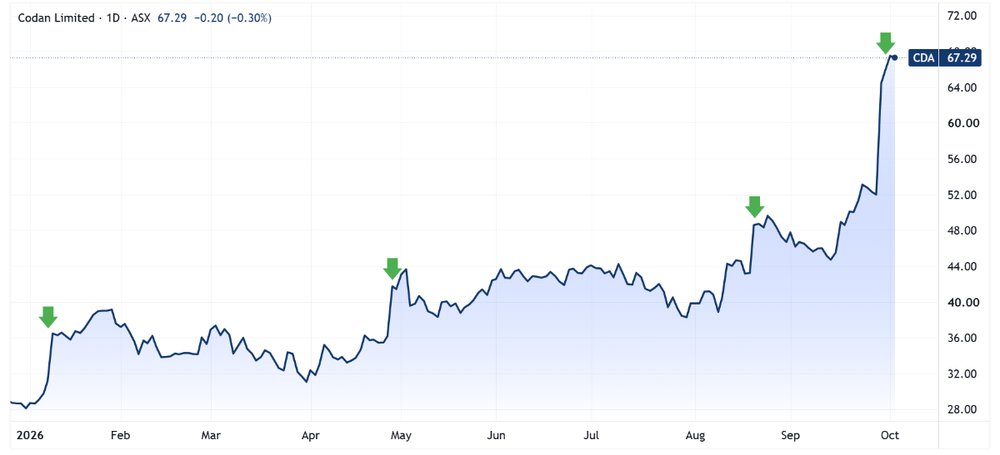
Codan has got to be one of the best growth stories in recent years. Like seriously, they're selling gold detectors amid a generational move for gold, and defence and communications gear against the backdrop of Russia-Ukraine and US-Iran. They've hit the lottery, and have the team/operational excellence to leverage it.
The stock is up 131% year-to-date and surpassed WiseTech in market cap earlier this week, making it the largest tech stock on the ASX.
But it didn't rally on hype or multiple expansion. Codan has delivered four earnings upgrades or beats this year, and each one sent the shares up by double digits to fresh all-time highs. I've marked the below catalysts in the chart above.
1H26 trading update (9 January) sent the shares up 16.8% to $36.89, with revenue up 29% to about $394m and underlying NPAT up about 52% to at least $70m, both ahead of ests
FY26 guidance upgrade (29 April) lifted the shares 15.4% to $42.00, with NPAT guidance of about $170m beating $152.5m ests by 11%
FY26 result (20 August) drove a 12.4% rally to a record $48.88, with NPAT up 69% to $175.2m vs $169.4m ests and FY27 revenue growth targeted at about 20%
1H27 trading update (today) sent the shares up as much as 21% to a record $63.07, with 1H27 NPAT guided to at least $160m, up at least 125%, and the FY27 Communications growth target lifted to 30-40%
The most incredible part came on Thursday. The ASX 200 fell 2%, every sector finished in the red and roughly 88% of constituents closed lower, yet Codan finished the session up 2.5%. That's after a 26% rally over the prior two sessions!
It's a reminder of a couple of classic lessons about holding your winners, and not being afraid to buy into upgrades.
Is there a floor for iron ore?
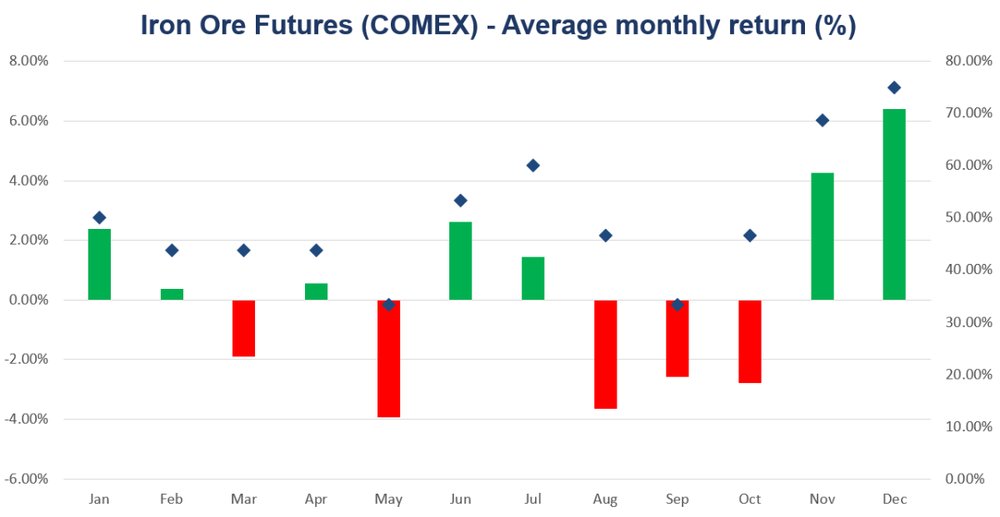
Two interesting pieces of research this week have made a fairly counter-consensus bullish case for iron ore (because let's be honest, no one is ever upbeat on the steelmaking ingredient).
The first was UBS, which raised its long-term iron ore price forecast to US$93 a tonne from US$85. Its rationale:
New demand phase sees China pivot to manufacturing and exports, while the "Global South's" ~3 billion people, led by India, drive enough steel demand growth to offset China's construction decline through 2035
Iron units tighten the market more than ore tonnes suggest, as ~800Mt of depletion and falling grades offset 120Mtpa of Simandou supply
Cost curve support is still rising on persistent industry inflation, with spot prices of ~US$95/t at around the 93rd percentile and ~100-150Mt of supply at breakeven or cash negative
The second was Macquarie, with some more incremental comments:
Benchmark iron ore prices are down more than 10% year-to-date, and higher shipping costs are cutting into what miners actually receive. That's forcing some marginal supply cuts. Though Rio's Simandou and softer Chinese steel demand limit the upside
Fortescue remains the broker's counter-consensus pick as the cleanest large-cap exposure to a near-term iron ore recovery. Macquarie sees any weakness tied to China Mineral Resources Group (CMRG) at the upcoming quarterly as a buying opportunity
It all comes as iron ore heads into its best three-month stretch of the year, from November to January.
The Lynas and Meteoric tie-up
This is probably one of the biggest deals to go down in recent weeks, with Lynas acquiring the globally significant rare earths developer Meteoric Resources.
Key numbers: An all-scrip deal at an exchange ratio of 0.0207 Lynas shares per MEI share, implying $968m or a 68.4% premium to MEI's last close. MEI shareholders would own 5.9% of the combined group
The benefits: MEI's flagship Caldeira project in Brazil would lift Lynas' Measured and Indicated resources of total rare earth oxides (TREO) by about 79% and Ore Reserves by about 26% on a pro forma basis
About Caldeira: The definitive feasibility study (DFS) targets average annual output of about 3,862t of NdPr and 127t of DyTb over the life of mine. That's equal to ~53% of Lynas' FY26 NdPr output. It also adds heavy rare earths to the mix and a third jurisdiction beyond WA and Malaysia
MEI shares rallied 47% on the day to 25 cents, while Lynas tanked 8.6% to $12.64. You get the idea of how the market felt.
So why was the market so downbeat on Lynas?
Well, Caldeira's DFS, released on 31 July, put capex at US$498 million (about A$720 million). That means Lynas isn't just acquiring MEI. It's also inheriting a capex bill that would eat about 60% of its $1.2 billion cash pile. And don't get me started on the risks of building projects these days. It's rare to see one delivered without a capex blowout or delay.
So yes, MEI only accounts for 5.9% of the group, and adds a lot of muscle to the resource. But the other way to think of it is that 5.9% of the company would eat 60% of its cash pile.
Best of Livewire
Here are some of my favourite reads from our friends at Livewire.
5 shocking predictions for 2027 and beyond: CBA halving, a US debt spiral, China's next trillion-dollar cohort, a once-in-a-century bond opportunity and an Australian gas renaissance. Notably, not one of them was about AI.
Buy Hold Sell – The ASX's top management teams: Roger and Koh rate CBA, Pinnacle, Wesfarmers, Breville and Nick Scali, with valuation the sticking point on most. Picks: Aspen Group and Aristocrat.
Seneca's Special Situation #2: Forrestania bought the Edna May mill for $300m and still doesn't have enough ore to fill it for a year. Ben Richards thinks Golden Horse is the obvious target.
The home price downturn continued in September: AMP’s Shane Oliver has widened his call to a 10-15% top-to-bottom fall, with 5.2% done and Sydney off 8.6%. Distressed selling is the new risk in the mix.
Where is the value on the ASX? Fund managers Bajic, Hawkins and Jennings all look below the top 20, pitching WiseTech, Lottery Corp and GenusPlus. They couldn't agree on where the index lands in 12 months.
Last laughs
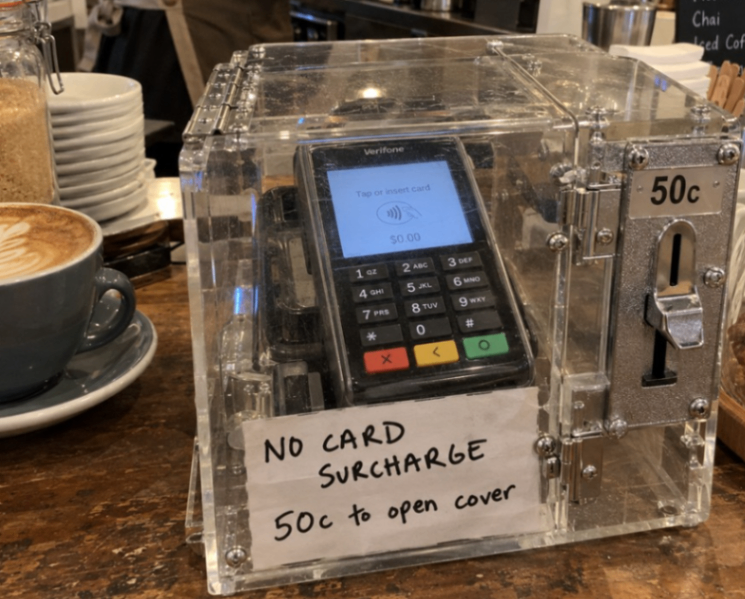
Gosh it feels good to pay $5.50 for a $5.00 coffee that cost us $5.08 yesterday.