
%20%D9%85%D8%AD%D9%85%D8%AF%D8%A8%D8%A7%D9%82%D8%B1%20%D9%82%D8%A7%D9%84%DB%8C%D8%A8%D8%A7%D9%81%20_%20MB%20Ghalibaf%20on%20X_%20_Straits%20Taylor%20Rule_%20i%20%3D%20r_%20%2B%20%CF%80_%20%2B%201.5.png)
Hi there!
Choppy conditions continue, but at least we finished the week slightly above breakeven.
There was so much anticipation ahead of the Fed hike that the event itself felt like a nothingburger. Markets only started to tank once Warsh began speaking, and even that was mostly a function of his remarks driving yields and the US dollar higher. The DXY rallied 0.7%, and moves of that size are usually a major drag on global assets.
Still, Hormuz remains effectively closed, and while bond yields are starting to edge lower, it's only a start.
On a side note, Iranian Parliament Speaker Mohammad Baqer Ghalibaf found one of the more creative ways to threaten the US (above).
The Taylor Rule is a famous monetary policy formula that sets the interest rate at the neutral rate (r*) plus target inflation (π*), plus 1.5 times the inflation gap and 0.5 times the output gap.
Ghalibaf tacked α(SOH−SOH*) + β(BEM−BEM*) on the end, referring to the Strait of Hormuz and Bab el-Mandeb. The implication is that the more those chokepoints are squeezed, the more the Fed has to tighten to offset the resulting inflation.
Or to put it another way: Iran is setting rates for the Fed.
Let's dive in.
Market Index PREMIUM is live
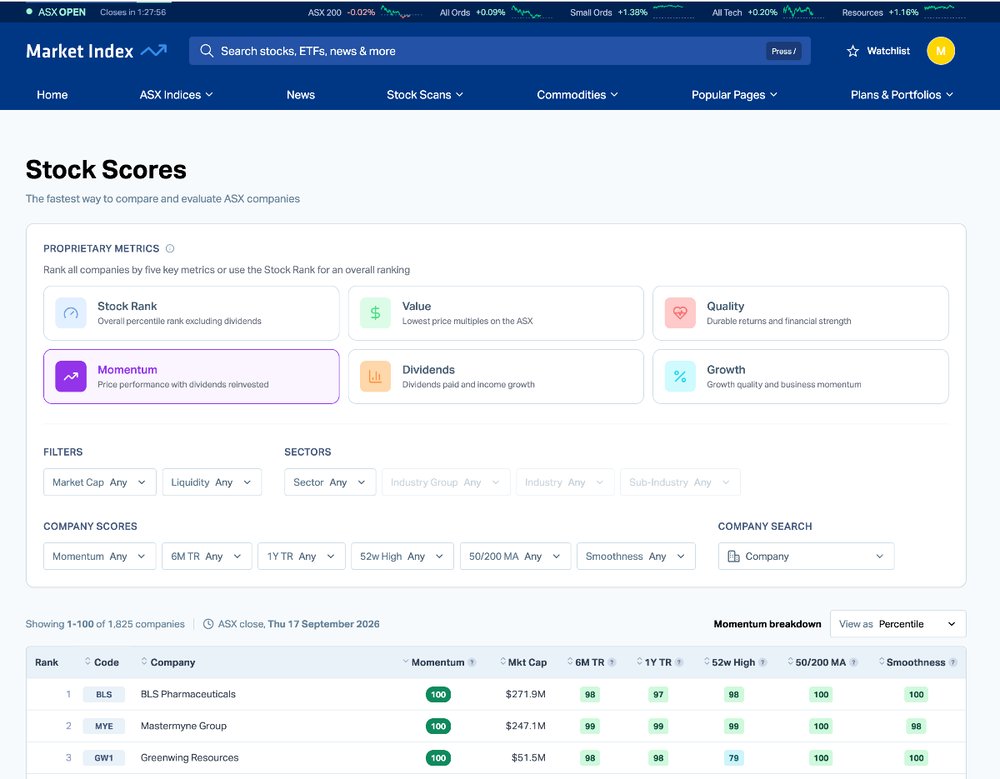
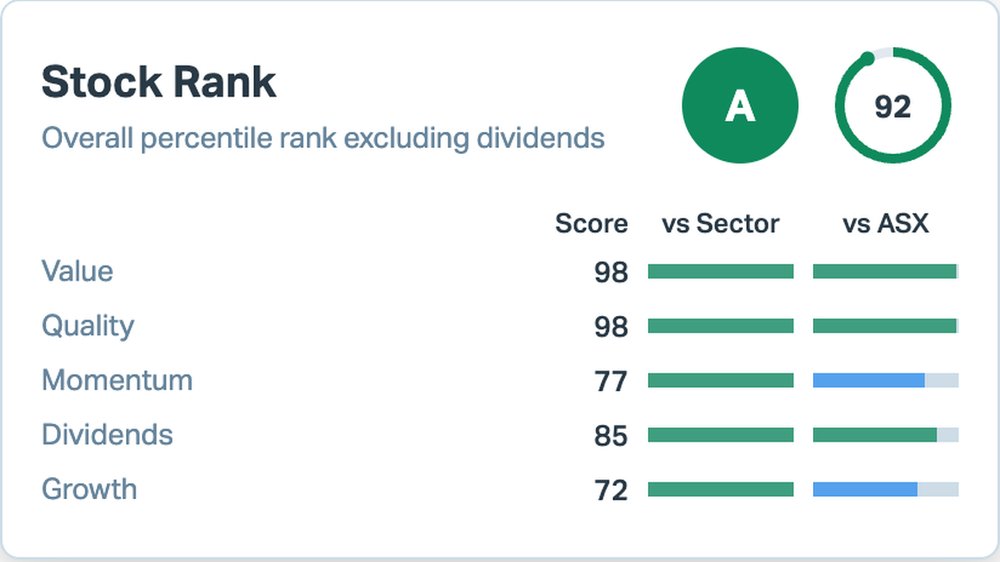
We've just launched Market Index Premium, bringing together two of our products, Stock Scores and ASX Top 5, in one subscription.
To mark the launch, the first 100 subscribers can get 20% off the annual plan, reducing the price from $588 to $470 for the first year.
That’s also a 33% saving compared with paying $59 month-to-month.
14-day money-back guarantee.
ASX Stock Scores
Australia’s fastest way to evaluate ASX companies is now available to every Premium member.
Compare 1,800+ ASX companies instantly across five investment styles:
Value
Quality
Momentum
Dividends
Growth
...everything accessible from a single table.
Every ASX company, ranked your way: Sort by raw data, percentile rank, or A to F grade
See what’s behind every Score: 24 data points and 5 proprietary metrics
Filter the whole market in seconds: Market cap, liquidity, sector, or specific company search
Investor sentiment survey
.png)
Last week marked the deepest pessimism since the March market low (ASX 200 tumbled ~9% between 2-23 March) and a second consecutive week of sharp deterioration.
Bearishness at 54.4% is the second-highest since we started the survey in March 2025, behind only the 61.0% peak on 8 March 2026.
Over the next three months, do you expect the Australian stock market to be:
What performed well after the last Fed hike cycle?
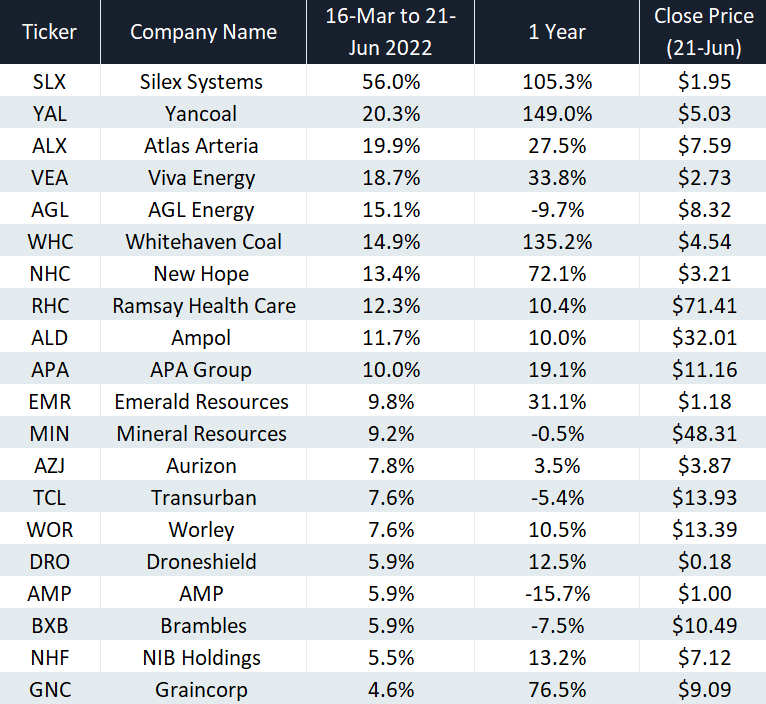
Let's jump back to 16 March 2022. The Fed had just hiked for the first time in almost four years, weeks into the Russia-Ukraine war. Bond yields were already going vertical, albeit from around 1%, with the Aussie 10-year up 862 bps year-to-date.
The ASX 200 initially rallied 5.8% between 16 March and 21 April. As yields continued to trade vertical and inflation prints reinforced higher-for-longer, the index fell 15% into 17 June, or 10.3% below where it sat on the day of the hike. Choppy conditions held all the way to October 2023, when yields finally peaked.
So which stocks actually performed well during that first leg down? The answer was fairly unsurprising: Russia-Ukraine beneficiaries (coal, utilities, refiners), industrials (toll roads, engineering), classic defensives and gold miners.
In terms of sectors:
Industrials — 7
Energy — 5
Utilities — 2
Materials — 2
Financials — 2
Health Care — 1
Consumer Staples — 1
Discretionary, Tech, Telcos and Real Estate — nil
Historically, yields at 5% is very normal
.png)
The Aussie 10-year yield is trading above the 5% level, it's uncomfortable for both markets and the real world. But looking back at history, the ASX 200 has spent 27.1% of all weeks since 1990 at the 5% handle. It's the most common state for bond markets in 36 years. And forward returns during these periods averaged 7.7% over 12 months with a 72% hit rate, slightly better than the all-periods average of 6.0%.
Nearly half the 5% handle's observations fall in 2003–2007, when the mining sector was running hot, very hot. Strip those out and the same bucket averages 1.1%, positive just 58% of the time.
Now before you read into this too much, statistically, yield levels explain essentially nothing about forward returns (if you're a math nerd the R-squared accounts for under a quarter of a percent at every time horizon). So the table is more so a collection of market episodes, not so much a relationship between returns and yields. If you want to know where the ASX goes from here, the absolute level of yields isn't the place to look.
The threat of higher rates
UBS Strategist Richard Schellbach always delivers some banger insights and his latest piece on rate worries talks about where you should be positioned.
Schellbach wrote that "high rates are associated with late economic cycles. In such an environment capacity constraints produce inflationary conditions which favour 'price makers' over 'price takers'. We think Mining and Energy stocks are best placed to outperform in this phase of the economic cycle"
Most ASX sectors have been negatively correlated with higher short-term bond yields over the past three years, with Energy the only sector showing a notable positive correlation
Real Estate, Consumer Discretionary and Consumer Staples are the most impacted by shifts in short-term rate expectations
Within the ASX 100, the stocks most pressured by RBA hikes include Stockland, Mirvac, Wesfarmers, JB Hi-Fi and Seek
Stocks most exposed to upward pressure on longer bond yields include Transurban, APA, Wesfarmers again and CBA
Best of Livewire
Here are some of my favourite reads from our friends at Livewire.
Buy Hold Sell – Small caps in a macro storm: Nick Sladen (LSN) and Matthew Nicholas (1851) were split on Integral Diagnostics, Bravura and Zip, but agree COG is a buy on novated leasing. Guest picks were Cogstate and FDC.
TMT: It's dynamite: Ophir's Andrew Mitchell says the long-semis, short-software pair fell 55% over July and August, the worst in 25 years of data. US software had its best August since 1999.
Why is everyone telling you to buy copper? Near-term forecasts range from a 700,000 tonne surplus to a 620,000 tonne deficit, but the supply side is broken: the last six years account for 0.6% of copper discovered since 1990.
L1 backs the house behind the lottery: L1's James Hawkins bought The Lottery Corporation after a one-in-45-year jackpot drought knocked 15% off the price. He recently exited Chorus.
18 red flags and a $600m wipeout: Plato's David Allen shorted EchoIQ, which tripped 18 red flags including four name changes. An FDA knockback wiped about $600m in a single open.
Last laughs
Yeah you're right, if you remove expenses, Anthropic is actually highly profitable.
I've also found something that's actually hilarious, but I'll leave it for you to find and interpret. It's on page 4 of this company announcement.
%20History%20_%20X.png)