
Hi there!
As the saying goes – there are years where nothing happens, and there are weeks where decades happen.
With quite a bit to unpack, let's get right into it.
Investor sentiment survey
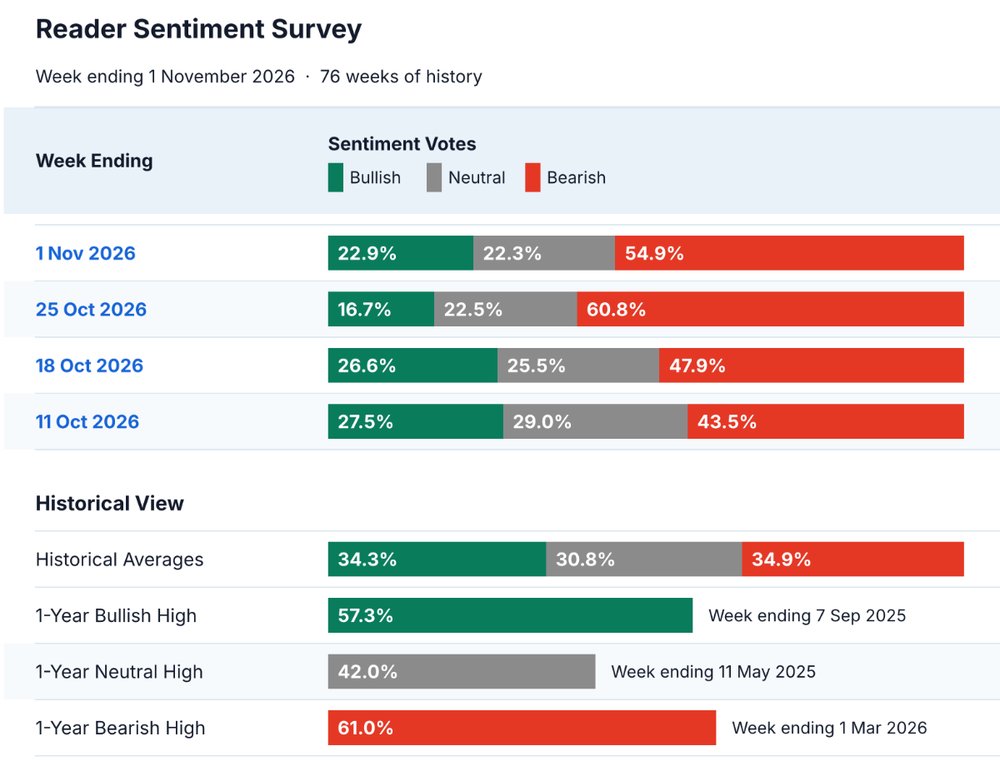
Bearishness eased off last week's record, but 54.9% still sits within the 97th percentile and the fourth-highest ever. We've now seen nine consecutive net-bearish weeks, with bearishness above 40% in every single one.
Over the next three months, do you expect the Australian stock market to be:
How Wall Street went from relief rally to AI rout
While a shifting majority in Congress was widely anticipated, the magnitude and geographic scale of the Democratic sweep heavily surprised political analysts and markets. Here's the sequence of events.
US futures fell sharply on Wednesday afternoon as early results pointed to a decisive Democratic win, with Nasdaq and S&P 500 futures down as much as 2.2% and 1.3% respectively. By the open both had flipped to trade around 0.9% higher, and closed slightly above those levels, while the Dow rallied 1,569 points (+3.0%)
Oil’s 9% slide drove much of the rally, on hopes a Democratic Congress would erode Trump’s political capital to keep the war going. With the result largely expected, markets experienced a broad rally, even as semis, chipmakers and Musk-linked stocks fell
The S&P 500 then fell 4.3% on Thursday, its worst day since April 2025, while the Nasdaq tumbled 5.5% to close in correction territory
The unwind in semis, chipmakers and AI stocks spilled into the broader market as investors priced in Democratic scrutiny of data centres, and weaker-than-expected guidance from Qualcomm and Arm added insult to injury
My favourite take on the selloff comes from Goldman Sachs.
“The indices' rebound has been completely wiped out, and the pressure is once again focusing on AI and its entire infrastructure ecosystem. The phone hasn't stopped ringing—everyone's asking us what's happening.”
“Long-only managers remain frozen, once again. Investors had sharply reduced their risk before the midterms. Caught off guard by yesterday's rebound, they've come back into the market. Hedge funds quickly resold some of the stocks they'd bought back yesterday, particularly the hyperscalers.”
“The pressure on positions is very real. Leverage is unwinding, which adds to the selling as prices fall. The aggregate gross exposure of our prime brokerage clients is at the 97th percentile over five years. The market is struggling to absorb these sales, especially in the most crowded segments of tech, media, and telecoms. The short-term price trajectory is particularly hard to predict.”
Post-midterms historically bullish for equities
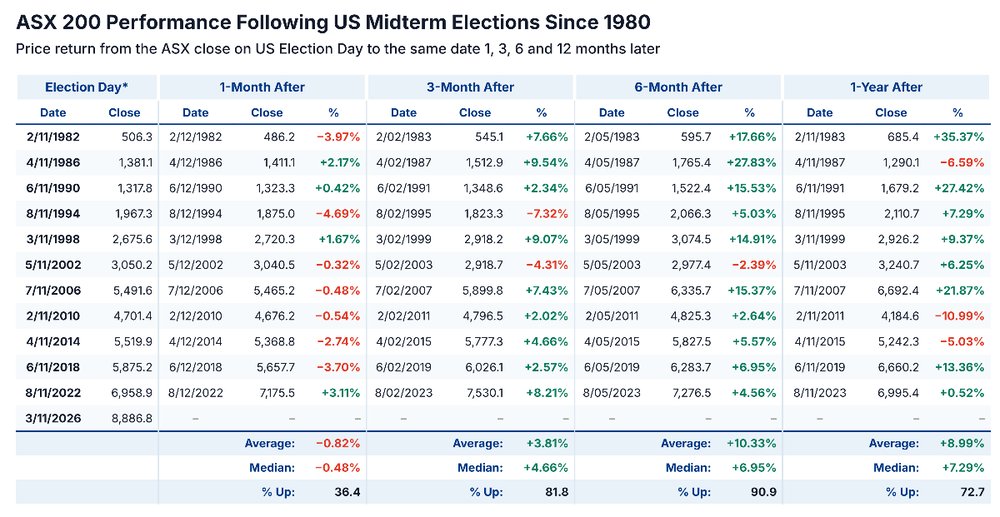
There’s been plenty of coverage on how strongly the S&P 500 tends to perform after US midterm elections. Across the 19 midterms since 1950, the index has averaged:
A 1.6% gain one month later, finishing higher 79% of the time
A 7.7% gain three months later, finishing higher 89.5% of the time
A 14.1% gain six months later, finishing higher every time
A 15.2% gain one year later, also finishing higher every time
What nobody seems to have crunched is the same numbers for the ASX 200. So here they are (it's basically a weaker version of the US forward returns).
The data centre buildout is at risk
UBS says the Democrats’ midterm sweep will hit AI infrastructure hardest through state-level data centre curbs, though relief in oil and rates could cushion the blow.
Here are their key takeaways.
About 30% of expected 2028 US data centre additions are at risk from construction pauses, with Texas alone accounting for 18GW
Semiconductors and AI infrastructure are most exposed, but much of the hit looks priced in, with valuations near multi-year lows and positioning cut sharply
A slower buildout could ease financing concerns, while lower oil prices and rates, a key driver of equities and the AI trade before the vote, are loosening financial conditions
S&P 500 3Q EPS growth is tracking 30.6%, and AMD guided 4Q revenue to US$17bn vs US$16.3bn ests on data centre strength
Buybacks are set to pick up after earnings season with a big step-up into 1Q, providing support while positioning is light
Restoring Inflation Reduction Act credits is a Democratic ask in any debt ceiling deal, which would support renewables
So what’s the takeaway? The peak in Big Tech’s capex growth is likely being pulled forward to 2027, rather than stretching out closer to 2030. And we all know what happens when growth rates peak and the market has to price in a slightly slower structural growth outlook.
VIX posts third-biggest jump since 1990
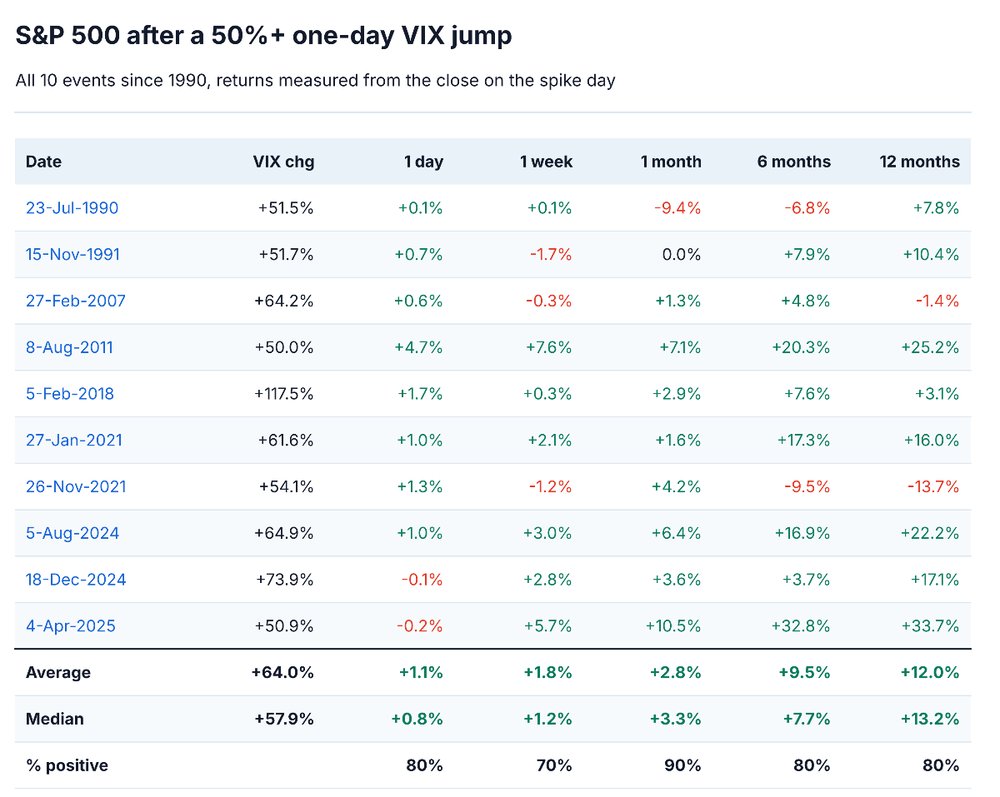
As fear and panic rippled through Wall Street, the VIX surged 69.5% to 28.1, its third-largest one-day jump since 1990.
Surprisingly, none of the pandemic selloffs make the top 10. That’s because the VIX never rose more than 50% in a single session back then. Instead, it climbed 40% or more on four separate days within three weeks.
Historically, fear spikes like this have proved to be good buying opportunities. The S&P 500 was higher a month later on nine of the past 10 occasions when the VIX jumped 50% or more in a day.
Following the historical playbook is easier said than done, though. Buying the dip rarely feels right in the moment, and your conviction will be tested, as the market’s best and worst days often sit right next to each other. And of course, there’s always the chance that this time really is different.
Best of Livewire
Here are some of my favourite reads from our friends at Livewire.
Nasdaq just tanked. What next? Elston’s Alastair MacLeod notes tech drove about 70% of global equity returns over the past year, which is a lot riding on one theme. He’s adding healthcare, duration and looking at the yen.
How Forager turned a SaaSpocalypse stock into a 50% gain: Gareth Brown bought Wix in July and sold by October. He’s also in Sage, ING and MTU, sold Builders FirstSource at a loss, and is eyeing emerging markets at 15-year low multiples.
The art of unlocking value in listed companies: L1’s James Hawkins makes the case for activism as its own asset class, using BlueScope as the example. Activist targets are nearly five times more likely to see a sale or major transaction.
10 best ASX dividend stocks and income ETFs for 2027: Livewire’s new Dividend Rockstars list has five fundies pick two each, from Coles and South32 to Deterra and Qantas. It starts with a 6.48% grossed-up yield against VHY’s 4.91%.
Australian small caps: a coiled spring: Small caps have trailed large caps by 19% over 12 months, a gap seen only three times since 2002. Maple-Brown Abbott’s Phillip Hudak lists five catalysts, starting with rates at or near their peak.
Last laughs
X users had a field day with the market annihilation. After all, humour is the best coping mechanism, isn’t it?