
Coles cops it, Anthropic's IPO and a very weird market
Hi there!
What a weird market. The ASX 200 is holding up remarkably well and sits just shy of a fresh two-month high, but beneath the surface there’s a lot of volatility and pivoting as investors try to work out what to price in.
The week kicked off with a four-day bounce in some of the market’s most battered pockets, like specs, small caps, tech and miners, before all of them slipped on Friday. It's a very awkward spot as the Small Ords, Emerging Companies and Materials sector are all down around 15-20% since late August, and this is the first sustained turn we’ve seen in a while.
As they bounce, you want to see all the stuff that shows an increasing likelihood of a bottom (higher highs and higher lows, signs of accumulation, pushing through key moving averages/overhead resistance etc). Friday’s session said the opposite, with defensives back in the spotlight.
So right now, things are all over the place, and it's hard to have conviction anywhere.
Let's dive in.
Investor sentiment survey
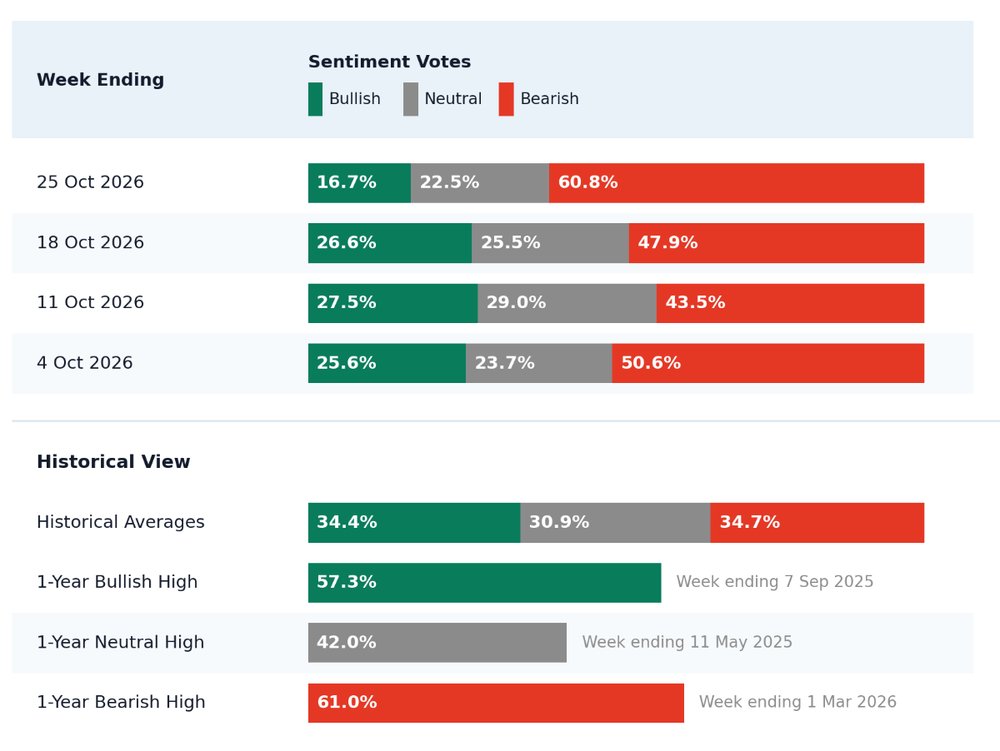
Last week (25-Oct) marked the most extreme bull-bear spread (-44.2pp) since we started the survey last May.
I don’t usually bother with the vote count because it tends to hold fairly steady. Last week was the exception. Bear votes were roughly in line with prior weeks, but bull votes dropped about 40%. So really, it felt like they just gave up and stopped voting.
Over the next three months, do you expect the Australian stock market to be:
Last week, a reader asked if there’s any correlation or insights between the sentiment survey and market performance. I lined em up and here's what I found:
Readers follow the market, they don’t predict it. When the ASX has been rising, they turn bullish and when it’s been falling, they turn bearish. But knowing this week’s sentiment tells you essentially nothing about where the market goes next, the correlation with the following month’s returns is literally zero.
The “everyone’s bearish, time to buy” idea doesn’t hold up here. On the five occasions readers got this gloomy, the ASX fell another 3% on average over the next month, and didn’t rise once.
This week is the odd one out. At 60.8% bearish, it’s the gloomiest reading in the 18-month record — but the ASX actually rose 1.5% over the past month. Readers have never been this far out of step with what the market’s been doing.
One thing fear does reliably signal: a bumpier ride. When bearishness spikes above 45%, the following month’s market swings are noticeably wider, even though the direction is a coin flip.
What retailers are saying
A lot of retail AGMs and trading updates landed this week, and most painted a fairly downbeat picture of the consumer (Coles reported on Friday, the rest on Thursday).
Coles Group
Supermarkets comparable sales rose 2.7% in 1Q27, below FY27 ests of 3.4–3.7%, with first-half Supermarkets EBIT now expected flat at about $1.23bn vs $1.32bn ests (7% miss, so a very big unexpected downgrade)
CEO Leah Weckert said “we know household budgets are under pressure and customers are shopping more deliberately across retailers and channels”
JB Hi-Fi
JB Hi-Fi Australia comparable sales fell 1.4% in 1Q27, The Good Guys fell 0.4% and JB Hi-Fi New Zealand rose 10.7%, with sales slowing in October (most figures in-line with ests)
JB Hi-Fi said “the Group continues to see variability in trading and heightened competitive activity, with customers remaining focused on value and increasingly shopping during promotional events”
Super Retail Group
Group like-for-like sales rose 0.2%, with Supercheap Auto up 2.5% and rebel up 0.3%, while BCF fell 1.1% and Macpac slumped 11.7% (broadly softer-than-expected)
Super Retail pointed to higher fuel prices weighing on BCF and promotional timing and a milder winter hitting Macpac, while Supercheap Auto and rebel both gained market share
Wesfarmers
Bunnings sales growth has moderated since 2H26 on weaker seasonal and commercial sales in recent weeks, while Kmart and Officeworks are tracking broadly in line with 2H26
Wesfarmers said “elevated inflation and higher interest rates continue to impact demand in parts of the Australian economy and are placing pressure on household and business budgets”
Vicinity Centres
Portfolio sales rose 3.0% in 1Q27, with specialty and mini-majors up 3.6% from 2.0% in 4Q26 and occupancy steady at 99.6%
CEO Peter Huddle said “shoppers remain deliberate in how they spend... discretionary spending remains evident, with jewellery, cosmetics, and Apparel & Footwear performing particularly well”
Coles got absolutely obliterated, falling as much as 12.7% on Friday. Woolworths, meanwhile, traded around 1% higher, which suggests the downgrade is very much a Coles problem rather than a sector one.
The commentary is downbeat, but it’s landing at a time when the Consumer Discretionary sector is already down around 10% since August and roughly 20% from where it was in August last year. The market also feels like it’s getting more visibility on the RBA’s last rate hike, and being forward-looking, it wants to start pricing in the good stuff.
It’s not supposed to make sense right now. JB Hi-Fi bottomed in November 2023 and went on a ~150% run through to August 2025. The update before that run showed total sales growth of -0.1% for 1Q24, and the 1H24 result that followed had NPAT down 20%. None of it made sense until after the fact. The catch is that JB Hi-Fi was trading on a PE of around 10x back then, versus 16x today.
Best of Livewire
Here are some of my favourite reads from our friends at Livewire.
Buy Hold Sell – 5 high-yielding ASX stocks: The guests were split on Telstra, Woodside, Suncorp and JB Hi-Fi, agreeing only that AGL is a sell. Both expect soft but not terrible bank results.
Lithium stocks that look cheap but aren’t: Jason Teh uses two decades of memory chip cycles to argue a low PE marks the top for cyclicals. Lithium PEs haven’t started expanding yet, so the bottom isn’t in.
Yield or dividend growth? ECP ran the numbers back to 2015: high yielders paid $55 per $100 against $33 for low yielders, but 58% ended the decade paying less. Dividends followed earnings.
Like October 2022. Are small caps ready to rip? Seneca’s Luke Laretive sees the same setup as late 2022, when the Small Ords fell 26% then rose 53% over three years. He likes HMC, Universal Store and Lovisa.
“The knife has stuck”: Regal’s Charlie Aitken says all the elements of capitulation are in place in small caps. He’s backing Chrysos, Forrestania, Artrya, Lindian and Zip.
The Anthropic prospectus
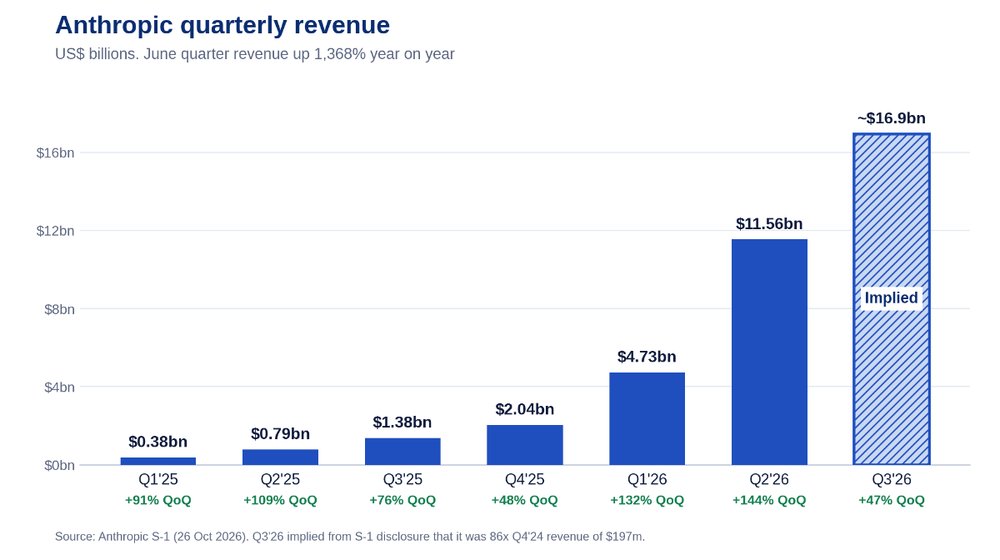
We can’t not talk about the Anthropic IPO filing. It’s been written to death, so here are hopefully a few different data points.
The short version: there’s no valuation yet, though reports suggest it could land around US$2 trillion. The company is burning a lot less cash than expected, revenue growth is explosive but slowing down, and operating profit/margins have expanded massively. The only problem is that Anthropic has a massive compute obligation to pay off over the next few years, so growth must remain stellar.
Quarterly revenue growth is slowing, from tripe-digit QoQ rates in Q1-2 to 47% in Q3. The company expects growth rates to continue moderating
Gross margin hit 85% in 1H26, up from 12% a year earlier, making Anthropic a stronger business than its US$80.7bn net loss suggests
Compute contracts total about US$637bn, with US$430.6bn owed to Google, Amazon, Microsoft and Broadcom on take-or-pay terms. So revenue growth must accelerate over the short-to-medium term
A growing share of compute bills can be paid in ANT shares through convertible notes and facilities with Broadcom, Amazon, Google and AMD, adding a lot of ongoing dilution
Credit is tightening for the AI build, with CoreWeave bonds yielding above 16% and Meta’s Hyperion data centre bond falling to about 92 cents. So this listing very much represents a funding shift from debt, to equity markets
A US$1.5–2tn listing implies 22–30x annualised 3Q26 revenue, well below the roughly 52x OpenAI is seeking in private markets
Last laughs
Almost a third of the Anthropic IPO talked about risks, including: "The scale of harm that could result from a catastrophic AI-related incident, no single insurer, and potentially the insurance industry in the aggregate, may have sufficient capacity or expertise to underwrite insurance commensurate with such exposure."