
Hi there!
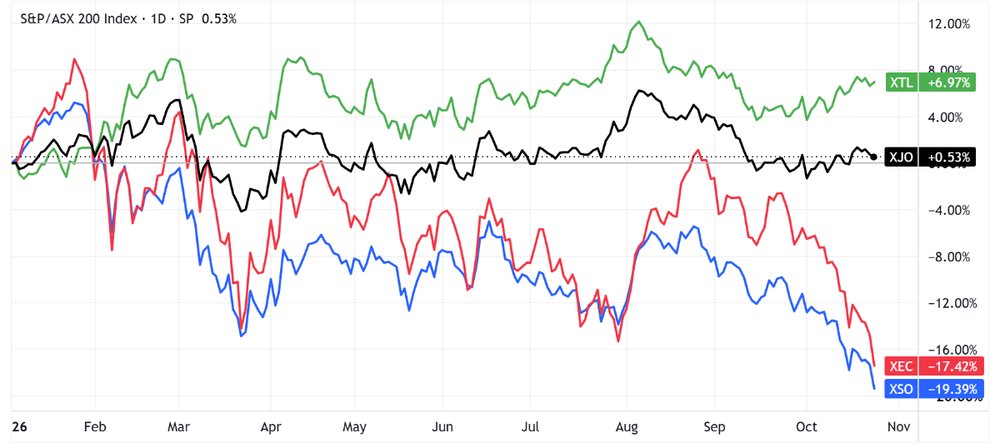
What a weird market … It’s been a genuine flight to safety, with Staples, Utilities, Healthcare and Banks taking turns to lead on any given day. The result is a dramatic outperformance from the ASX 20 (green), while the small end of town – the Small Ords (blue) and Emerging Companies (red) – has been sold into oblivion. So check in on your small-cap friends and make sure they’re ok.
Let's dive in.
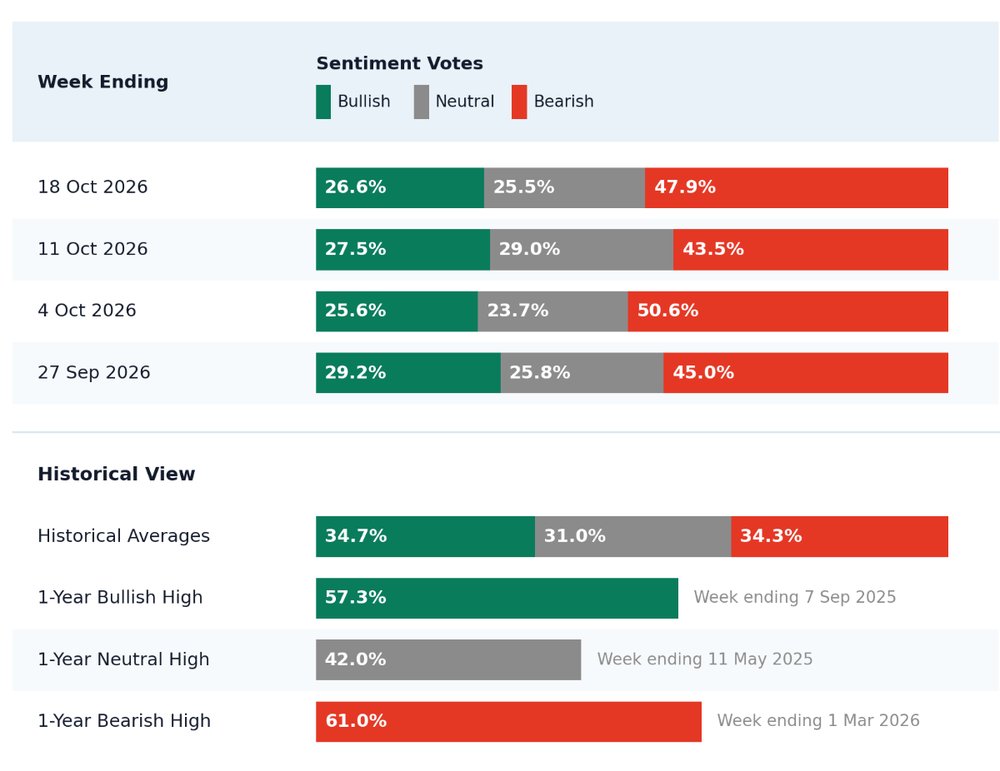
Investor sentiment survey
NextDC’s 40% selloff
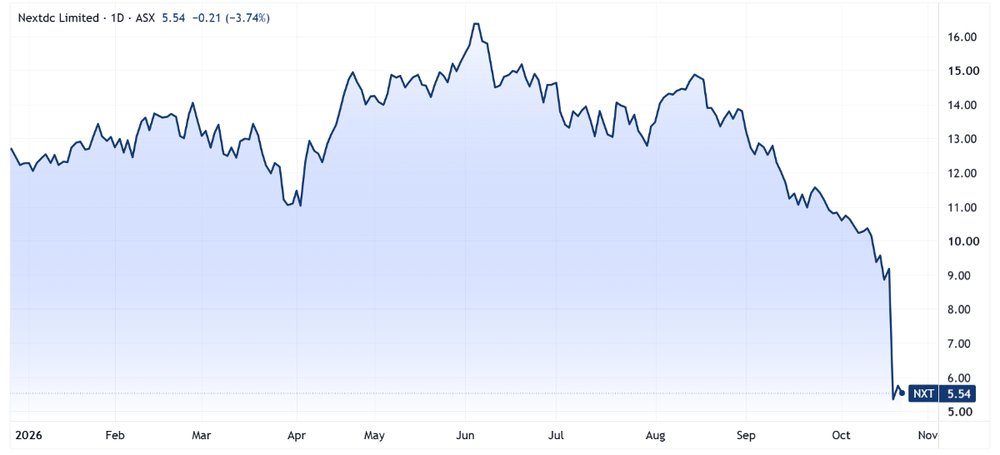
NextDC was already down around 40% since June heading into this week, so Wednesday’s 41.7% selloff was really just half as painful for most holders.
The catalyst was electricity distributor Jemena suspending the network connection works needed to lift grid supply to NextDC’s M3 Melbourne data centre. That forced the company to cut its FY27 guidance:
FY27 net revenue guidance cut to $475m-$500m from $615m-$640m, 22% lower at the midpoint
FY27 underlying EBITDA guidance cut to $245m-$265m from $385m-$410m, 36% lower at the midpoint
Jemena does not expect to restart works before February 2027, while a decision on M3 Stages 6 and 7 is now pushed past the 28 November Victorian election
Liquidity of $8.68bn at 30 September, though NextDC warned M3 delays could affect its ability to draw its $6.7bn of undrawn senior debt
Most analyst forecasts sat in line with the prior guidance, so the miss is essentially the size of the cut.
The stock was already being hammered before this setback, and it’s easy to see why. NextDC carried roughly $2.46bn in net debt at 30 June 2026, with gross finance costs eating about a third of FY26 underlying EBITDA ($81.7m of $249m). Take out depreciation and amortisation of around $262 million and the business can’t cover its interest bill on an underlying basis.
And here's the thing, UBS forecasts EBITDA climbing from $249 million in FY26 to just over $1.0 billion by FY31, but D&A runs at roughly $500-575 million every year along the way, so the company never actually turns a profit.
So while the data centre buildout is extraordinary, the companies behind it are effectively debt junkies, building assets that depreciate into oblivion.
My two cents
Ok ok, a lot’s been happening in markets, so I wanted to take a few paragraphs of your time to break it down.
The AI trade is stressed. This spans multiple catalysts from the failed Firmus and delayed AirTrunk IPO, Meta posting negative free cash flow of US$2.1bn in 3Q26 (its first quarterly cash burn since listing in 2012), and credit default swaps on Oracle and CoreWeave flashing serious financial stress, with CoreWeave above 1,000 bps and firmly in distressed territory (and more)
The market isn’t buying the valuations. Semiconductor earnings are up some 175% year-on-year, yet the recent selloff has de-rated the sector to around 14x earnings. It looks bloody cheap, but the market simply doesn’t believe the outlook.
Yields have peaked for the wrong reasons. Bond yields (unless you’re France) have started rolling over in recent weeks – not because inflation has peaked, but because growth expectations are fading. (Wait, this is starting to sound like stagflation.)
While solid markets and elevated yields can co-exist (hence why the US market was holding up so well), this is all dependent on earnings momentum. But now, we've got a situation where earnings expectations are not necessarily easing, but rather volatile/skeptical.
That's driving a genuine rotation from all-things AI (and unfortunately, for Australians, includes miners/commodities), and into REITs, banks, staples and healthcare. It’s a very uncomfortable juncture. Woolworths and Coles are trading on forward multiples of around 25x and CBA on a trailing 24x. Like, c’mon. Sure, it’s defensive, but what growth or yield am I actually getting?
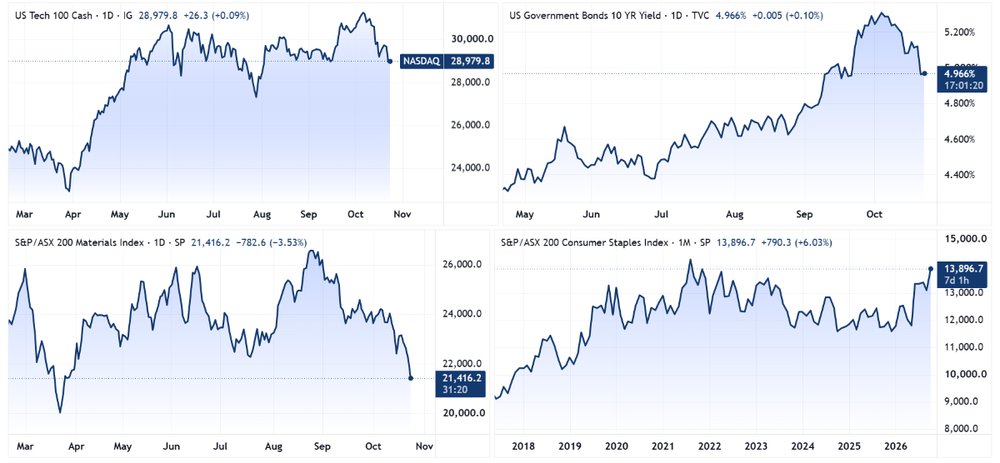
In the crowded chart below, we've got:
Top left: Nasdaq rolling over
Top right: US 10-year yield also rolling over and below the key 5.0% level
Bottom left: Aussie Materials sector smashed
Bottom right: Aussie Staples sector nearing all-time highs
Best of Livewire
Here are some of my favourite reads from our friends at Livewire.
Australia’s comeback is coming: Ten Cap’s Jason Todd thinks the ASX could beat the US in 2027, with rate-sensitive cyclicals leading. Jun Bei Liu likes Lottery Corp, Codan and Ansell.
Buy Hold Sell – 6 consistent dividend growers: Soul Patts is the ASX’s only dividend aristocrat, but AUB, CAR, ResMed and Charter Hall are closing in. Picks: Dalrymple Bay and Dicker Data.
Airlie’s 3 lessons from America’s biggest AI conference: Emma Fisher says the real question isn’t whether AI spending peaks, but who keeps the savings. Pricing power decides it, which favours James Hardie, Lottery Corp and Aristocrat.
104 years, countless cycles: Whitefield’s Angus Gluskie still has 30% in the big four and nearly 15% in CBA. He’s moving to quarterly dividends at a 6.4% grossed-up yield.
Earnings are up 30%, so why are valuations falling? Fidelity’s PMs say the hyperscalers’ balance sheets have been funding the earnings growth, and the market knows it can’t last. Four picks outside the AI trade.
Last laughs