Banks in freefall, gold keeps ripping and what CEOs are saying
Hi there!
My brain has turned to mush after trawling through countless results, transcripts and analyst notes. Hopefully what's left of me can still conjure up something interesting for this weekender.
It was a huge week for markets, beyond the already-massive lineup of FY26 results. The ASX continued to grind lower against a challenging backdrop, as the US–Iran conflict looks set to keep going back and forth, which has energy stocks betting the oil price spike is anything but a pump and dump. The US Treasury dropped some big news of its own (more on that later), giving gold, which had already stabilised, a fresh kick higher. And Moderna, a name you probably haven't heard since COVID, recorded the largest one-day move by an S&P 500 company, up 176% after a successful Phase 3 trial for its mRNA cancer vaccine.
More broadly speaking, markets feel rather dicey (the ASX 200 is down in seven of the last eight sessions) compared to 2-3 weeks ago, but it has become a selective one, with plenty of love for healthcare, energy and miners right now.
Let's dive in.
Investor sentiment survey
.png)
Woah, an almost perfectly even three-way split, with each camp within 0.4 percentage points of the others The bull-bear spread of the last five weeks now reads: +5.8 → −12.4 → −21.5 → −23.7 → +6.4 → +0.3, flipping from deep pessimism, to now equilibrium.
Over the next three months, do you expect the Australian stock market to be:
We have to talk about yields
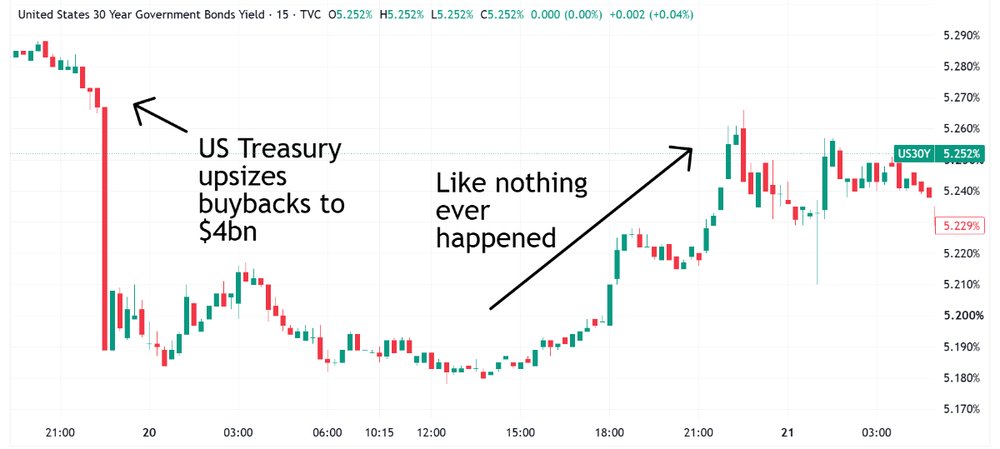
It's probably the biggest story of the week. The US Treasury Department plans to double its purchases of long-dated bonds to at least US$4 billion per operation. The move came as a surprise, given the buyback schedule was only published around two weeks ago.
What does this actually mean? The Treasury is effectively buying longer-dated bonds, the 30-year in particular, in an effort to ease upward pressure on long-term interest rates. The US 30-year yield traded as high as 5.33% this week, its highest since June 2007. Market commentary has been blunt, calling it "big talk for little action," or the equivalent of "bringing a knife to a gun fight."
The initial announcement drove a sharp move in bond yields:
US 10-year yield down 6 bps to 4.64% (still stuck in its trading range of the past four weeks)
US 30-year yield down 10 bps to 5.18% (a sharp pullback, but only a two-week low)
Gold also ripped 4.3% to US$4,522/oz, suggesting the market viewed this as another episode of financial repression (basically more Ds – deficits, devaluation and debt).
The next day, yields V-shaped straight back to pre-announcement levels. The market's message is clear, it will take a lot more than this to tame the beast.
Against a backdrop of mounting intervention, and with US debt crossing US$40 trillion for the first time, owning real assets looks increasingly like the way to go. It's also why gold keeps trending higher, even after a massive one-day move.
Banks in freefall
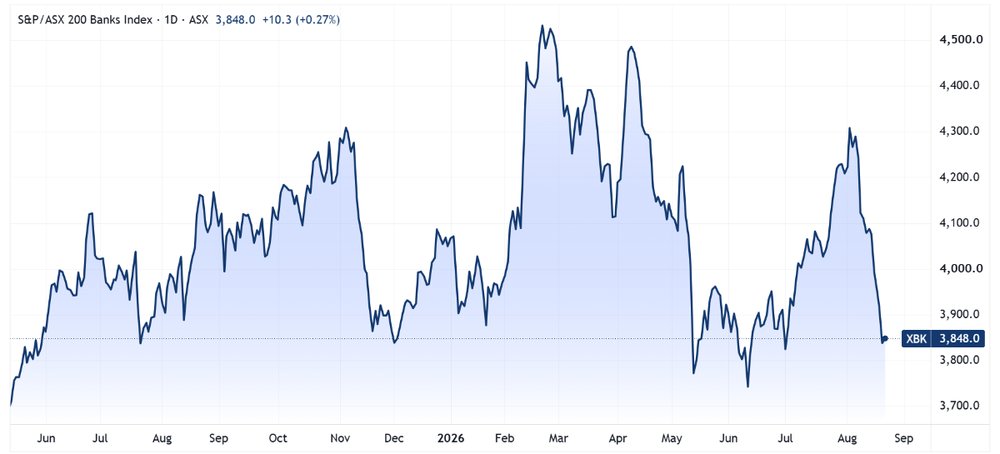
The S&P/ASX 200 Banks Index has finished lower in ten of the last thirteen sessions, down 10.5% in total. Quarterly updates and FY26 results across the Big Four, Judo, AFG, Pepper Money and others have compounded into a downbeat outlook for the residential mortgage sector.
But if you didn't know the headlines, and just looked at the price chart, you'd call this just another garden-variety ~10% drawdown. Over the past ten months, the index has already been through three 10-15% pullbacks.
Nov-Dec 2025: A ~11% pullback, kicked off by CBA's 1Q26 update, which was only marginally soft, but investors zeroed in on rising costs and ongoing margin pressure
Feb-Mar 2026: Onset of the US-Iran war, though the sector V-shaped back near highs after the early April ceasefire announcement and a better-than-expected Q3 from Bendigo Bank
Apr-Jun 2026: CBA recorded its largest one-day decline on record (down 10.4% on 13 May), despite a relatively in-line result, after it lifted collective provisions in anticipation of macroeconomic headwinds
To be fair, this selloff has a genuine catalyst, with most players flagging a 10-15% drop in mortgage applications post-budget. The question is whether that makes this good buying or the start of a prolonged stretch of pain for banks.
What CEOs are saying
A bottomless pit of earnings call this week. Here's a handpicked list of what caught my eye. Commentary from industrials and data centres suggests the industry is running absolutely flat out.
Pepper Money on the mortgage market slowdown: Management pointed to federal changes to CGT, negative gearing and SMSF residential lending having "a marked impact", with Equifax mortgage inquiry data down 20% in the three months to July versus a year earlier and down 15% since the May budget. The CEO flagged a "complete halt" of SMSF residential lending with those applicants shifting to commercial SMSF, offset by rising non-conforming and owner-occupied applications, plus strength in refi, debt consolidation and construction lending.
Hub24 on superannuation inflows: "Superannuation will become more attractive, and we're yet to see that come through ... I would expect that over time, more people will top up their super more than before, and that's a very large part of our business"
Super Retail on the trading backdrop: A strong first half was disrupted by the fuel crisis over the key Easter period, with the CEO stressing "the consumer is doing it really tough" and cautioning "I would not be banking too much" on margin upside.
Vicinity on retail and luxury sales: Portfolio moving annual turnover growth was 3.3%, with management calling sales "quite resilient" but choppy, and July finishing at around 3% comp growth, an uptick on May and June.
JB Hi-Fi on PC prices and consumers: "In some brands, that can be in excess of 50% price rises ... the demand for hardware used in the AI data centers is sucking up a lot of the memory supply… customers are making a choice around where they're willing to spend money ... they're trading down by spending a similar amount as they did last year to get a product with less specs"
Temple & Webster on demand conditions: "We did see slight weakness in conversion... down from 3% a year before... People are still browsing, but there is just that little bit more time taken to make a decision in this environment"
NRW on competitive dynamics: The Minerals, Energy and Technologies (MET) tender market is full, "there is no capacity left in that market because all of those competitors are absolutely full", leaving NRW well placed on pricing
DigiCo on market conditions: US data centre moratoria have spread beyond 20 states and "a lot of that overflow capacity and demand is materialising here in Australia," with power and water access now the binding constraint
Industrials – Rallies vs. results
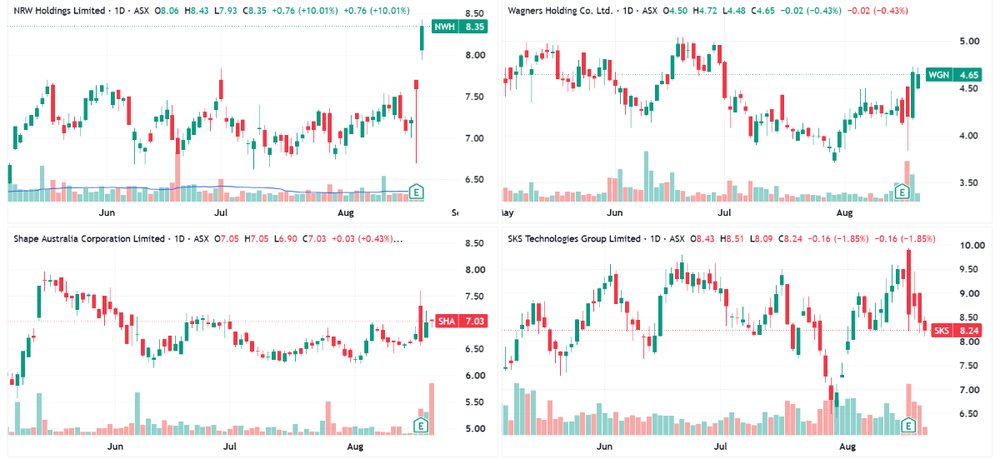
There's something very, very odd happening with industrial names. Most have run up massively over the past 12–24 months, delivering insane earnings growth, with order books up sharply year-on-year and at record levels. But the share price action around results has been bizarre.
Take NRW Holdings. On the day of the result (20-Aug), the stock opened up 6.8% ($7.70), briefly tumbled 7.2% ($6.69) and finished 6.8% ($7.59) higher. The next day, it rallied ~10% to fresh all-time highs. The result featured:
Revenue up 31.4% to $4.3bn (1% beat)
Underlying NPAT up 43.6% to $182.7m (4% beat)
FY27 guidance of $4.6-4.8bn revenue and $320-330m EBITA, ~85% secured
Wagners was another one, which sold off 3.9% the day before its FY26 result. Results day itself was insane, with the stock opening 9.1% higher at $4.52, briefly falling 7.2% to $3.84 and closing fractionally higher. The next day, it rallied 11.1% to $4.67.
Names like Shape (SHA), Southern Cross Electrical (SXE) and SKS Technologies (SKS) tell the same story, incredible growth businesses, all experiencing massive swings before, during and after results.
Best of Livewire
Here are some of my favourite reads from our friends over at Livewire Markets.
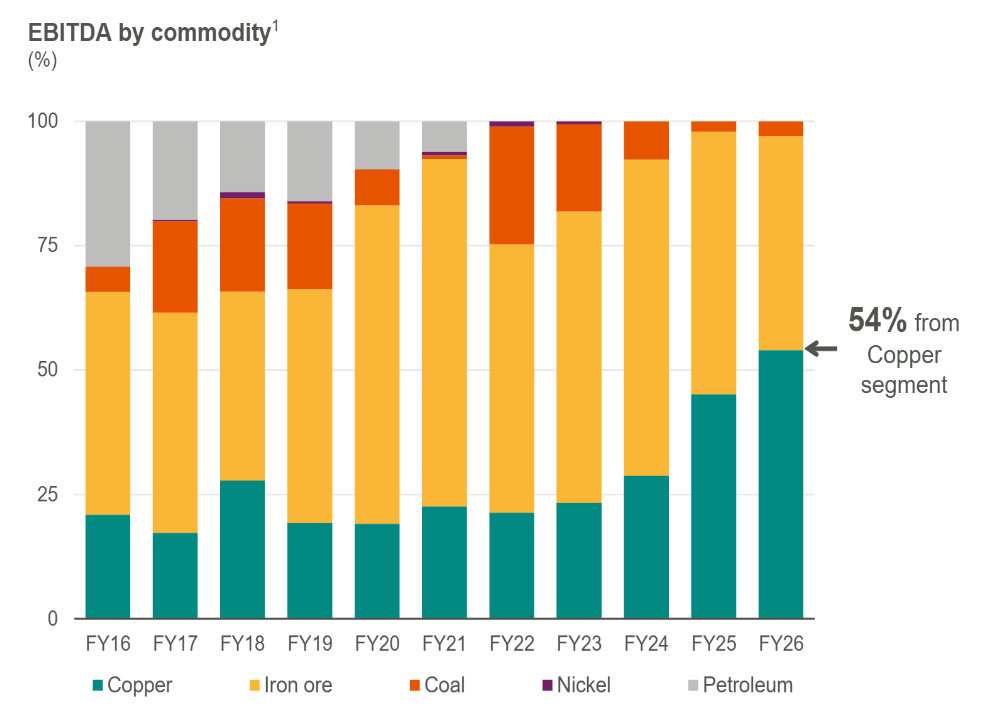
BHP CFO Vandita Pant on dividends, copper growth, and the next 18 months: Copper cleared half of group earnings for the first time (above) and BHP paid out US$8.7b, a 66% payout ratio and its biggest dividend in four years. Vicuña, Copper South Australia and Escondida all hit investment decisions in the next 18 months.
"An awesome result": CEO Andrew Alcock on HUB24's record: FUA rose 20% to $164.3b and underlying EBITDA 30% to $211.4m, but shares fell 7.25% as second-half inflows slowed to $8.2b. Alcock is targeting high-teens platform market share from 9.9%.
CSL rallies 18% on earnings beat: A small beat plus guidance for about 5% FY27 NPAT growth, double consensus, sent CSL up 18%. Ten Cap's Jun Bei Liu is a buy at 15x FY27, with Behring green shoots and a still-absent CEO the things to watch.
Buy Hold Sell: 5 giant ETFs rated: Dawes and Wielandt are buyers of VAS, VGS, IVV and NDQ, with QUAL a hold as income beats quality post-budget. Their warning is concentration and overlap you may not realise you own.
Last laughs
This is probably the greatest hedge fund quote of all time.