
Hi there!
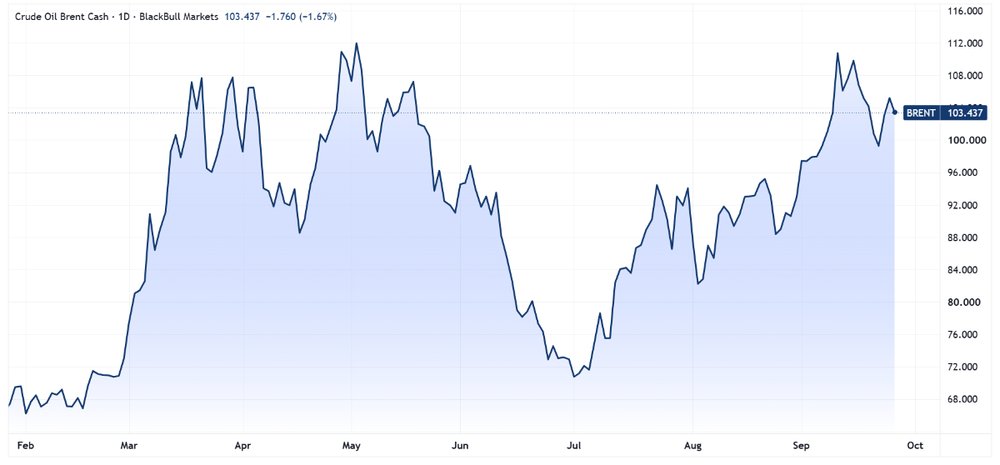
A soft, dull week for markets, and not much has changed. The path of least resistance remains lower against a tough macro backdrop, where the Australian 10-year yield sits around 5.39%, Brent has stopped its vertical climb but still trades above US$100 a barrel, and the RBA is widely expected to hike at next week's decision. There have been some better days, but even then it's usually just a sector or two, typically the banks and miners, lifting the benchmark.
At least there's only one week of September left.
Let's dive in.
Investor sentiment survey
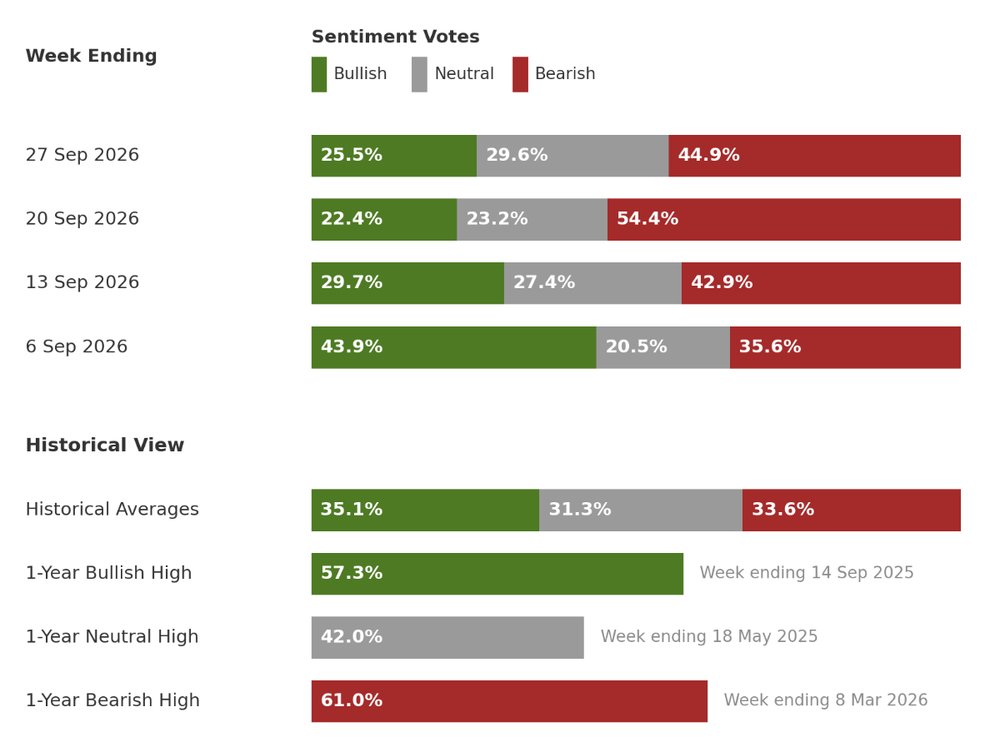
Fear has eased from last week's extreme but remains firmly elevated. Bearishness fell 9.5 percentage points, from 54.4% to 44.9%. That is a sizeable drop, but the reading still sits in the 89th percentile.
Over the next three months, do you expect the Australian stock market to be:
Is Tuas now a growthy cashbox?
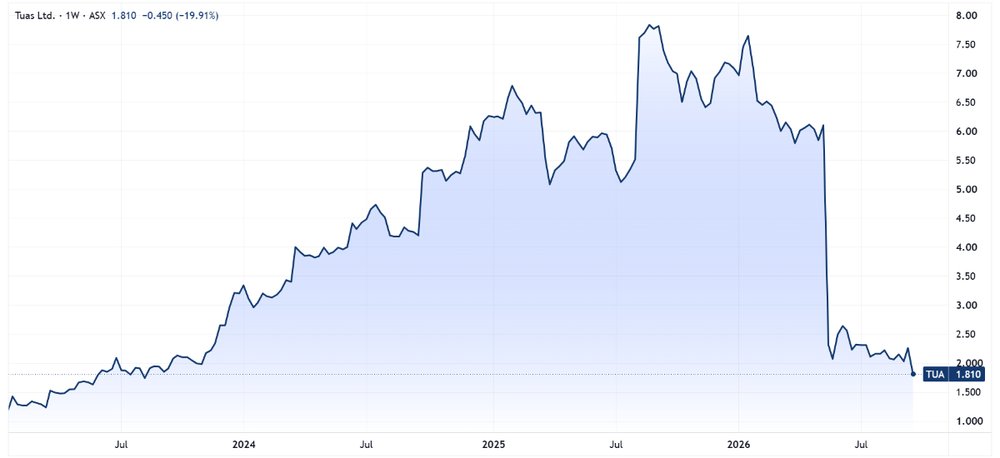
Tuas fell 23% on Wednesday to its lowest since August 2025, taking its year-to-date loss to almost 75%. The company reported a seemingly innocent FY26 result (comparisons below are to Morgan Stanley ests only):
Revenue up 24% to S$187.6m vs S$185.7m ests (1% beat)
Underlying EBITDA up 22% to S$83.7m vs S$83.0m ests (1% beat)
Underlying NPAT of S$29.6m vs S$22.7m ests (30% beat), up from S$6.9m in FY25
Mobile subscribers up 16% to 1.458m vs 1.505m ests (3% miss), implying net adds of about 204k against the 251k modelled
Gross mobile ARPU of S$9.42
The real concern is that Tuas' Singapore subsidiary, Simba Telecom, is under investigation by the Infocomm Media Development Authority (IMDA), Singapore's telecom regulator, over the "intermittent use of radio frequency spectrum outside its authorised licensing conditions."
That probe has already cost Tuas its biggest growth opportunity. The IMDA suspended its review of the proposed S$1.43bn acquisition of M1 because of the investigation, and Tuas has now confirmed the deal has lapsed and been terminated. The acquisition was central to Tuas' plan to move from low-cost challenger to dominant mobile player in Singapore.
What makes it more painful is that Tuas raised S$359.8m in August 2025, at no discount, to fund the deal.
So what does that leave investors with?
Ongoing share price volatility amid forced selling on regulatory concerns
Net cash backing of roughly $1.00 per share
A solid and growing Singaporean telco business
Though the next day (Thurs), Tuas rallied as much as 9.2% before finishing the session flat. That tells you there's still a clear divide between investors who see value and growth on the table and forced sellers due to the regulatory overhang.
Why Helloworld why?
Every now and then, a company makes a decision that leaves you pulling a face and asking why.
This week, it was Helloworld's $135m acquisition of 100% of Crown Currency Exchange. Crown operates 68 foreign exchange kiosks across Australia, and you've probably walked past one at a shopping centre or airport.
The price itself isn't terrible. Crown reported FY26 EBITDA of $22m, so Helloworld is paying about 6x. The problem is that Helloworld trades on an EV/EBITDA multiple of 3x ($225m market cap, $50m net cash and FY26 EBITDA of $60.2m).
In effect, Helloworld is spending well beyond its net cash on a retail FX kiosk business valued at double its own multiple. The synergies between the two look like a stretch, and a chunky buyback would likely have been more accretive.
Why model this mess?
Analysts love to model, even when the outcomes are so volatile that their work is out of date the next day. So credit to JPMorgan's analysts for finally saying what many have been thinking: what's the point of modelling this mess when everything can flip in a day?
In their note last week, they conceded:
On the lack of a baseline view "For the first time since the start of the Iran conflict, we don't have a baseline view. We simply don't know how to model the endgame"
On the economic red lines "Many of those lines have been crossed, yet the exit strategy is less clear, not more. Oil is above US$100 and the 10-year yield has a 5-handle"
On diesel "Diesel is at an all-time high of US$6.31 a gallon heading into winter... while inventories sit at all-time lows"
On the risk premium "We estimate September fair value at US$90, yet Brent is trading at US$106... the market is pricing in the risk of an additional 4 mbd of losses on top of the 10 mbd already disrupted"
That sums up the market we're in. The macro backdrop has settled into a fragile state, grinding equities lower, but things could change any day. Or they might not.
Best of Livewire
Here are some of my favourite reads from Livewire this week. We've just hosted our annual Livewire Live event, so there are plenty of fresh insights.
Buy Hold Sell – Attack and defence: Sean Roger (Perpetual) and Joseph Koh (Blackwattle) split on REA, Life360, Brambles and Transurban, but agree ResMed and Lottery Corp are buys. Picks: Soul Patts and Ampol.
Drill, baby, drill: Ben Griffiths says coal retires from 2028 and demand rises 50% by 2035, leaving gas as the only scalable answer. He's watching the Taroom Trough, Beetaloo and Bedout.
Yes to resources, no to Aussie consumers: L1's James Hawkins runs 10 stocks across three buckets — US dollar earners, resources and defensives. BlueScope, MinRes and Lottery Corp make the cut.
CBA will halve: Dougal Maple-Brown's other prediction, that CSL would double off its lows, has already landed. All CBA has to do is trade like its peers at 15x.
Soul Patts has 20% in cash: Todd Barlow says a 5.3% risk-free rate has lifted the bar for everything else. Listed equities have gone from 90% of the portfolio to about 40%.
3 top ASX stock ideas from Livewire Live: Bajic reckons WiseTech could triple as the SaaSpocalypse narrative flips, Hawkins likes TLC's unlucky jackpot run, and Jennings backs GenusPlus on the grid build-out.
Last laughs
%20Home%20_%20X.png)
The art of the deal they say, two pandas and a two-month trade truce extension. (Rare earths not included)