Wall Street panic sell-off sends VIX up almost 70%. Here’s what usually happens next
A Democratic sweep sparked an AI trade unwind and one of the biggest VIX spikes on record. Here’s why stocks tanked and what history says.


Source: Shutterstock
KEY POINTS
- A Democratic midterm sweep stoked fears of tighter oversight of AI and data centres, with voters backing data centre limits in 40 of 41 local ballot measures.
- Chip selling spread to all 11 S&P 500 sectors as hedge funds banked gains and retail was on track for its heaviest net selling since March 2020.
- The VIX surged almost 70%, its third biggest one-day jump since 1990. The S&P 500 was higher a month later after nine of the past 10 spikes above 50%.
Wall Street just went from a euphoric post-election rally, to its worst session since the April 2025 crash the next day.
A Democratic sweep of the midterms drove an initial dip in US futures on Wednesday morning, but stocks opened broadly higher, with the S&P 500 up 1.6% and the Dow surging 1,569 points or 3.0%. The next day was the complete opposite, with the S&P 500, Nasdaq and Dow down 4.3%, 5.5% and 3.4% respectively.
Here’s why stocks sold off.
A Democratic midterm sweep stoked fears of a slower AI buildout. Investors worried that Democratic control of Congress could bring tighter oversight of AI and data centres. Voters in Tuesday’s midterms sided with limits on data centres in 40 of 41 local ballot measures, and in Texas, Democrat Gina Hinojosa won the governor’s race after promising a data centre moratorium.
What started in chips spread to the whole market. A rotation out of semiconductor stocks turned into a broad rout, with all 11 sectors in the S&P 500 in the red.
Weak chip outlooks added fuel. Qualcomm and Arm both sank on underwhelming outlooks. Qualcomm missed estimates for smartphone chip revenue on sluggish demand and falling Apple-related sales.
Hedge funds locked in their gains. Nomura’s McElligott said the catalyst isn’t a sudden deterioration in fundamentals, but a frantic dash by hedge funds to lock in their profits before the end of the year.
Forced selling and a retail capitulation deepened the drop. Vanda pointed to a broader “buyers’ strike” among institutional investors alongside forced selling by systematic and leveraged investment strategies. Retail investors were on track for their biggest single-day net selling spree since March 17, 2020.
Goldman Sachs pointed to hedge funds whipsawing their own positions, noting they were "caught off guard by yesterday’s rebound, they’ve come back into the market. Hedge funds quickly resold some of the stocks they’d bought back yesterday, particularly the hyperscalers."
Gross exposure among Goldman’s prime brokerage clients, a measure of their total long and short bets, sits in the 97th percentile of the past five years. When funds are that stretched, falling prices force them to cut back, and that selling pushes prices lower again. Goldman said the most crowded parts of tech, media and telecoms are struggling to absorb it.
“The short-term price trajectory is particularly hard to predict,” said the analysts.
One of the largest VIX spikes on record
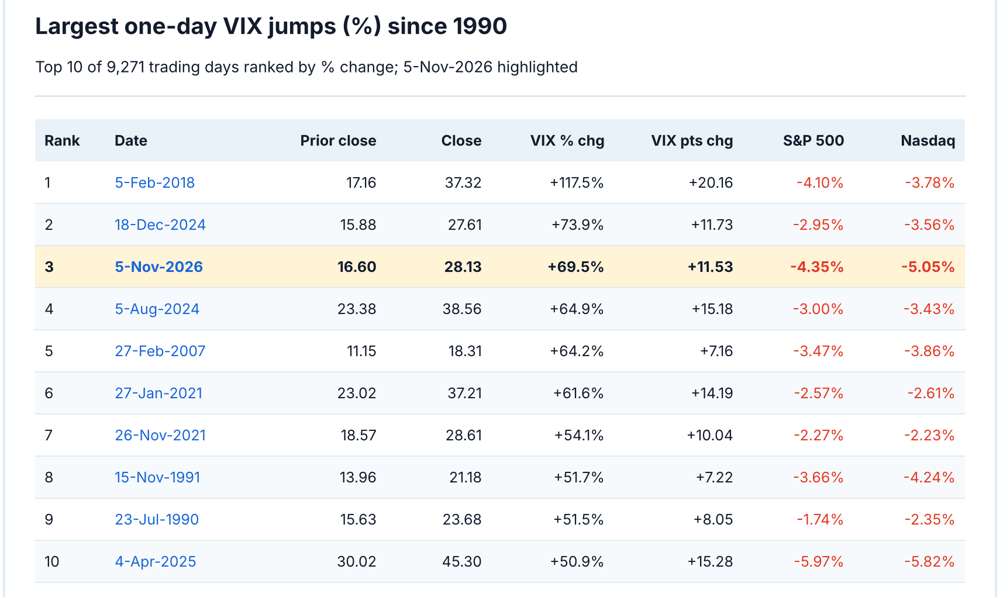
Fear rippled through Wall Street, driving the S&P 500 VIX up almost 70% to 28.1. This marks the third largest percentage increase since 1990.
None of the pandemic sell-offs appear in the top ten as the VIX never jumped more than 50% in a single session, but it rose 40% or more on four separate days within three weeks.
Source: Market Index
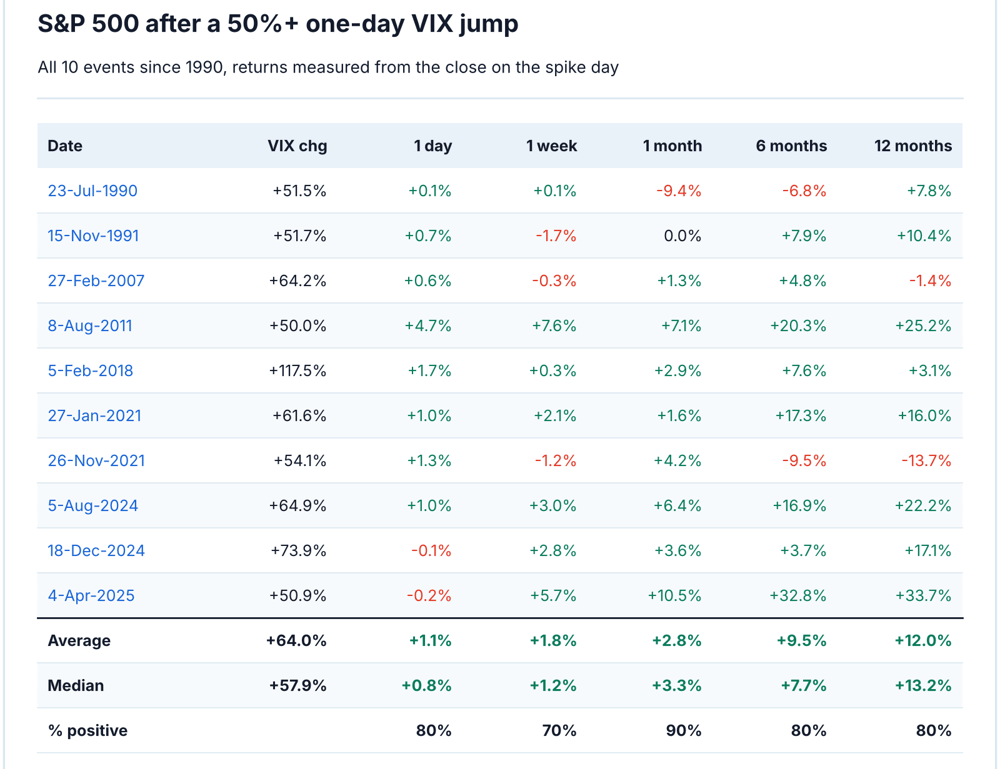
Fear spikes like this have historically been better moments to buy than to sell, with the S&P 500 higher a month later after nine of the past 10 occasions the VIX jumped 50% or more in a day.
Source: Market Index
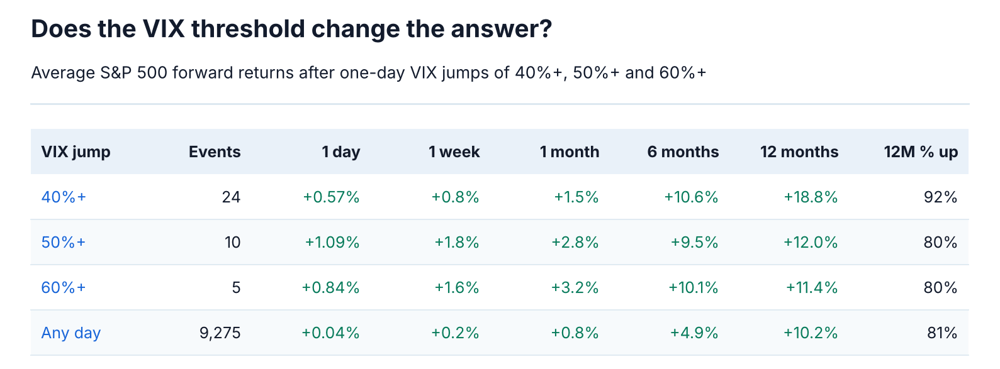
Whether you set the bar at a 40%, 50% or 60% VIX jump, the result is the same. The S&P 500 has typically been higher a month later, by roughly two to four times its usual one-month gain.
Source: Market Index
Closing thoughts
Wall Street enters a post-election AI trade unwind as investors price in tougher Democratic scrutiny of data centres. What started as a hit to chipmakers has spilled into the broader market, and triggered a flight to safety. Political pushback on the buildout could temper Big Tech’s capex growth and bring forward expectations of when that spending peaks. A slower AI infrastructure buildout would then cascade through the rest of the economy, which is why the selling didn’t stop at AI stocks.
Historically, such large one-day selloffs have offered attractive entry points for higher returns over the medium-to-long term. But in the moment, the instinct is almost always to sell and wait for the dust to settle. The volatility doesn’t help either, with the market’s best and worst days often landing right next to each other. And there’s always the small risk that this time really is different, and the selloff turns out to be the start of something bigger.