UBS lifts ASX 200 target to 9,400 after strongest earnings season since 2019
UBS raises its ASX200 year-end target to 9,400 after a much stronger-than-expected February reporting season.


Source: Shutterstock
KEY POINTS
- Earnings beats outnumbered misses 2:1 through February, with guidance upgrades running at a 3:1 ratio and the average company receiving a ~0.4% FY2026 earnings upgrade from analysts
- ASX 200 FY2026 earnings growth is now forecast at 13.6% year-on-year, up sharply from 3.0% six months ago, with UBS lifting its year-end index target to 9,400 from 8,900.
- The ASX 200 forward PE of 18.6x remains well above the long-run average of 14.9x, though UBS believes structural improvements in earnings quality justify holding the premium.
The ASX 200 closed February at a record high, rising 3.7% over the month in what UBS describes as the best February reporting season since 2019.
The gains were broad-based, led by Banks and Miners, with consumer-facing businesses and industrial stocks also contributing as the earnings season wrapped up with a clear skew towards beats and upgrades.
The scorecard
UBS's final tally from the reporting season shows earnings beats outnumbered misses by a ratio of 2:1, with the beat ratio holding through the back half of reporting when smaller-caps typically drag the numbers lower.
Guidance upgrades outnumbered downgrades by 3:1, and the average company received a 0.4% upgrade to its FY26 earnings estimate from analysts following the result.
The cumulative effect has been material. ASX 200 earnings growth forecasts for FY26 now sit at 13.6% year-on-year, up from 11.3% a month ago and just 3.0% six months ago. UBS says the upward momentum in earnings revisions is now running at its strongest pace since mid-2022.
Valuation: still elevated, but less stretched
The ASX 200 is trading on a forward price-to-earnings ratio of 18.6x, well above its long-run average of 14.9x. UBS acknowledges the premium looks rich in historical terms but argues much of it reflects structural change, including:
More stable and higher-quality corporate earnings
Less extreme business cycles
A structural decline in equity risk premiums
On that basis, the analysts expect that current multiples can be sustained, with gradual earnings upgrades doing the work from here.
UBS lifts year-end target to 9,400
Off the back of the earnings season, UBS has raised its ASX 200 year-end target to 9,400 from 8,900. The investment bank remains constructive on equities and holds the view that continued, albeit gradual, earnings upgrades will drive index performance from current levels.
The upgrade comes despite UBS's economists flagging that the RBA may be forced to raise rates again in May, given the economy has been running too hot. The analysts believe that rate hikes, at this scale, are unlikely to materially dent company profits, pointing to the 2022-23 cycle where 13 consecutive rate increases left corporate earnings largely intact.
Consumer spending holding up
While some retailers' trading updates fell short of expectations, UBS notes that companies were quick to flag the distorting effect of November's Black Friday sales shift on early-year numbers.
More telling were comments from property landlords: Vicinity Centres and HomeCo both reported a recent uptick in foot traffic, and Telstra's ability to push through mobile price increases was flagged as further evidence that household spending has not cracked under higher rates.
AI moving from promise to profit impact
UBS says February marked a turning point in how listed companies are talking about AI. After two years of investment announcements with little to show for them, a range of household names reported quantifiable productivity and profitability gains from their AI programs.
Companies citing tangible AI impacts included CBA, Telstra, Breville, Seek, WiseTech, Woolworths, Coles and IDP Education. UBS expects the period of share price volatility around AI developments to continue as the market works out what the technology ultimately means for earnings.
Volatility and the stock picker's market
Twelve ASX 100 companies moved more than 10% in absolute terms on their results day, a continuation of what UBS describes as a structural step-up in single-stock volatility compared to the pre-2020 era.
The combined weighting of BHP and CBA in the ASX 200 is at an all-time high, which UBS flags as a source of index-level noise for investors.
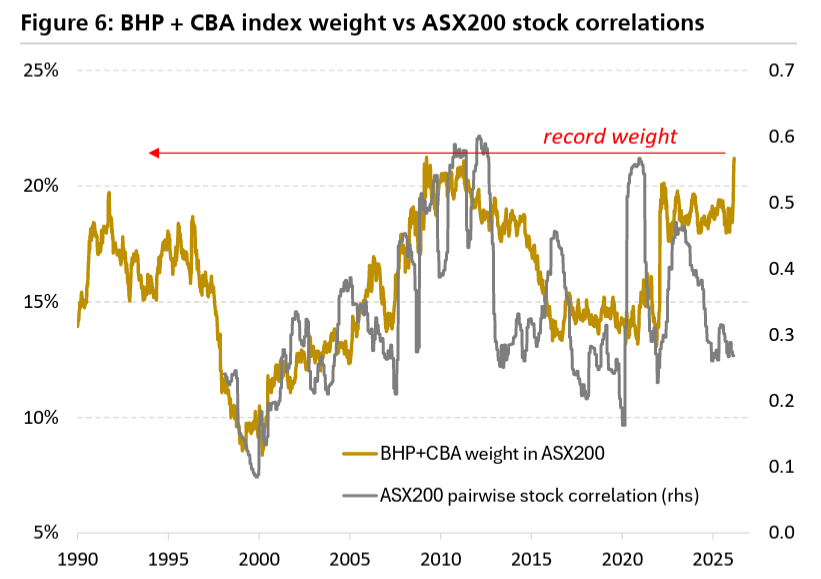
Source: UBS
Beneath the surface, however, stock price correlations are low and declining, and the dispersion in returns across the market remains wide, conditions UBS views as favourable for active stock selection.
Last month I pulled together year-to-date performance data for ASX 200 constituents through 20 February. At the time, the index was up 5% for the year but beneath that, 53 stocks had gained more than 10%, while 41 had fallen by more than 10%. The winners were largely miners and the losers came from mostly Tech and Healthcare sectors.
.png)
Source: Author's own calculations