The catalyst bringing life back into BHP, Rio Tinto and Fortescue (and taking the life out of CBA)
Iron ore heavyweights are trending higher, while Commonwealth Bank is down almost 6% in the last two sessions. Here's why.

Source: Shutterstock
Mentioned
KEY POINTS
- China's 1.2 trillion yuan Tibet mega-dam project drove iron ore prices to four-month highs near US$100/tonne and pushed copper to record levels, signaling strong commodity demand ahead.
- Australian mining giants BHP, Rio Tinto and Fortescue have surged 9-15% since late June to multi-month highs, supported by strong quarterly results and the China infrastructure announcement.
- A clear rotation pattern has emerged where Commonwealth Bank falls sharply (down 5.6% in two days to May lows) when mining stocks rally, suggesting defensive-to-cyclical investor rotation.
On Monday, Chinese Premier Li Qiang launched development of a colossal 1.2 trillion yuan (US$167 billion) mega-dam in Tibet — a project of such scale that analysts forecast it could boost China's GDP growth by almost 0.1 percentage point in its first year of construction alone.
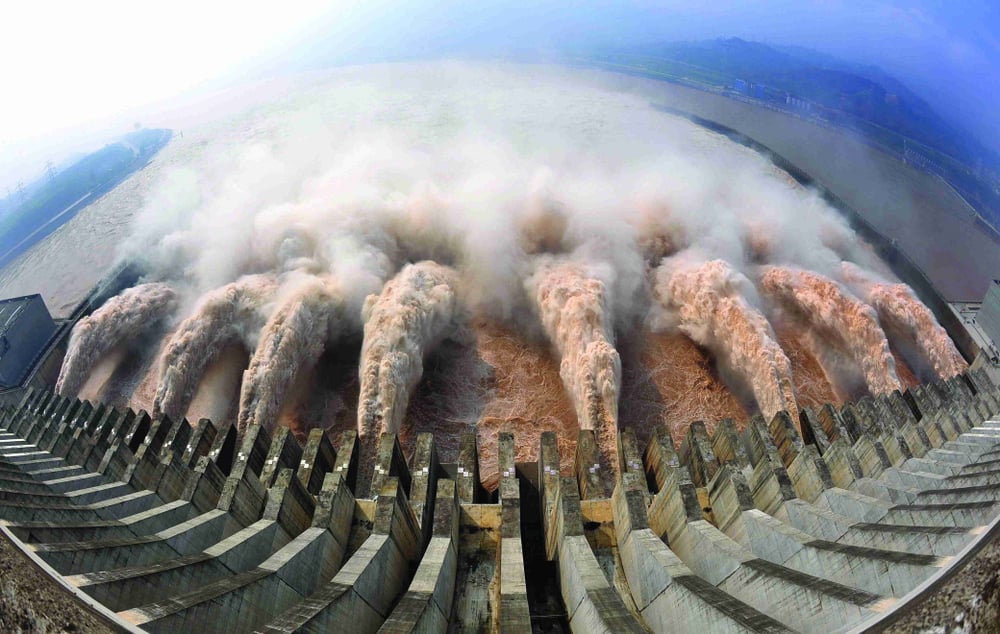
The dam represents a transformative leap in clean energy capacity, expected to generate approximately 300 billion kWh annually. To put this in perspective, that's nearly triple the output of China's Three Gorges Dam on the Yangtze River, currently the world's largest hydropower facility, and enough electricity to power Australia 1.1 times over, based on 2023 consumption figures.
The news drove iron ore prices to a near four-month high on Monday, while also placing upward pressure on other key commodities like copper, aluminium and nickel.
Commodity Markets Rally
Singapore iron ore futures gained 1.2% on Monday, nearing the key US$100 level and trading at the highest level since 3 April.

Singapore iron ore futures chart (Source: TradingView)
Copper prices advanced 1.1% to US$5.66/lb, marking the highest closing price on record.
Bond Markets Signal Stimulus Expectations
The mega-project's implications extended beyond commodities. China's 30-year government bond futures tumbled as much as 0.5% on Monday to six-week lows, as traders interpreted the announcement as a signal that authorities are preparing to roll out additional stimulus measures to combat deflation, according to Bloomberg.
"The bond market is feeling some pressure as traders took the mega project as a sign authorities will seek to roll out more stimulus and boost demand," Yang Hao, an analyst at Nanjing Securities, told Bloomberg.
Mining Giants Surge
BHP, Rio Tinto and Fortescueshares gained 0.4%, 1.2% and 1.4% on Monday. While these gains may appear modest, it's worth considering that the broader ASX 200 finished the session down 1%.
The momentum continued on Tuesday, with all three majors advancing around 2%. This week's resurgence, coupled with strong quarterly reports and buoyant commodity prices, has driven these heavyweights up 9-15% since late June, pushing them to 2-4 month highs.

BHP (orange), Rio Tinto (red) and Fortescue (blue) | Source: TradingView
The recent rally builds on solid operational performance. BHP reported a stronger-than-expected Q4 with production beats across copper, iron ore, metallurgical coal, and energy coal. Record copper production at Escondida and Western Australian Iron Ore operations were key contributors, while FY25 guidance met or exceeded expectations across all divisions.
Rio Tinto similarly delivered a solid half-year update last week, with slight iron ore production beats and massive copper outperformance thanks to higher grades and throughput.
All-in-all, it seems like iron ore miners are finally reaching a sweet spot. Prices are stabilising around the key US$100 level, China's fiscal support prospects appear stronger than ever, and a mega infrastructure project promises to jolt metals demand just when the market needs it most.
CBA Crumbles
While miners rallied, Commonwealth Bank (ASX: CBA) painted a different picture, tumbling 5.6% over the past two days to May lows. This isn't coincidental — it reflects a dramatic rotation between two of Australia's largest companies.
Analysis of trading patterns since August 2024 reveals a clear inverse relationship: when CBA declines 2% or more, BHP often rallies 3-4% on the same day.

Source: Author's own research | 3 July 2025 performance as at 11:00 am AEDT
For months, CBA has proven remarkably resilient, defying skeptics who questioned its premium valuation and defensive positioning. The bank has weathered interest rate volatility, economic/tariff uncertainty, and countless rotation attempts. But this infrastructure mega-project, coupled with resilient iron ore prices and operational excellence may represent something different entirely.
Could this finally be the straw that broke the camel's back?