The ASX 200 is getting smashed. These charts will tell you why
Global markets are on the backfoot as bond yields break out, oil soars above US$95 and Fed hike odds double.

Source: Shutterstock
KEY POINTS
- Bond yields broke out globally. Australia's 10-year hit 5.19%, the highest since May 2011, while Japan's 10-year reached 3.01%, a level unseen since 1996.
- Fresh US-Iran strikes near the Strait of Hormuz pushed Brent 4.98% higher to US$95.20. US diesel futures jumped 6.0% to record highs, signalling extreme product tightness.
- Fed hike odds for this month's meeting surged to 68.2% from 36.6% a week ago. Pricing now leans towards two 25 basis point hikes by year end.
Stocks didn't stand a chance on Wednesday as bond yields continued to push multi-year highs, oil prices rallied on a new round of US-Iran strikes and Wall Street dipped back to a near one-month low.
The ASX 200 fell as much as 1.45% before clawing back to close down 1.0%. The selloff was concentrated in rate-sensitive and growth-oriented corners of the market, with Tech down 3.5%, Materials down 3.3% and Real Estate off 0.9%.
There were three macro forces at play, and none of them were working in the market's favour.
Bond yields are breaking out
Bond yields, globally, are breaking out to multi-year, if not multi-decade highs.
US 10-year yield at 4.80%, the highest since October 2023
Australia 10-year yield at 5.19%, the highest since May 2011
Rate-sensitive Australia 3-year yield at 4.79%, the highest since March 2026
Japan 10-year yield at 3.01%, the highest since 1996
Why it matters: A breakout for longer-dated yields signals either that rate cuts are being pushed further out, or that investors are demanding more compensation for fiscal risk and bond supply, neither of which helps stocks. Higher yields also lift the discount rate on future earnings and offer investors a more attractive risk-free alternative, squeezing equity valuations.
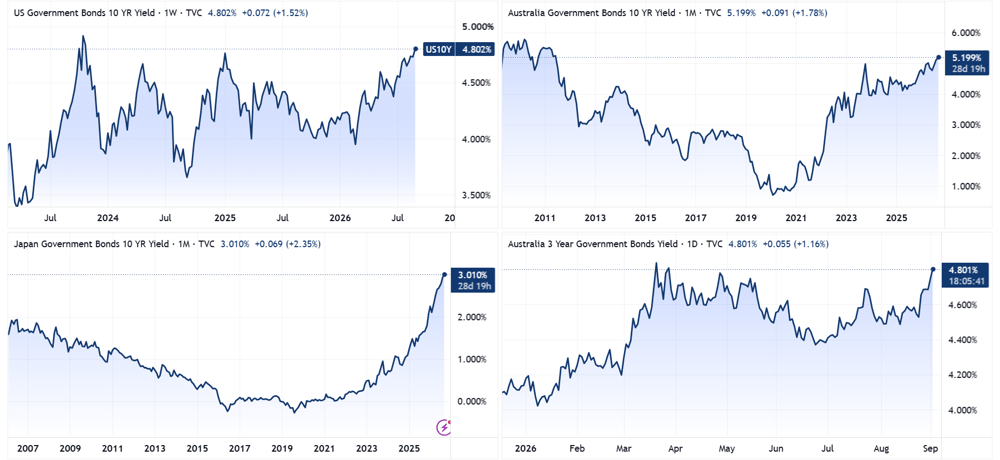
US 10-year yield (top left), Australia 10-year yield (top right), Japan 10-year yield (bottom left) and Australia 3-year yield (bottom right) | Source: TradingView
US-Iran escalate, oil hits US$95
US and Iranian forces traded fresh blows overnight, with American strikes on IRGC air defence, radar and mine-laying assets around the Strait of Hormuz prompting Iranian missile attacks on US bases in Jordan and Bahrain. This drove Brent up 4.98% to US$95.20 a barrel on Tuesday, the highest since 24 July. Not only did oil prices spike, but a downstream barometer like US diesel futures surged 6.0% to record highs.
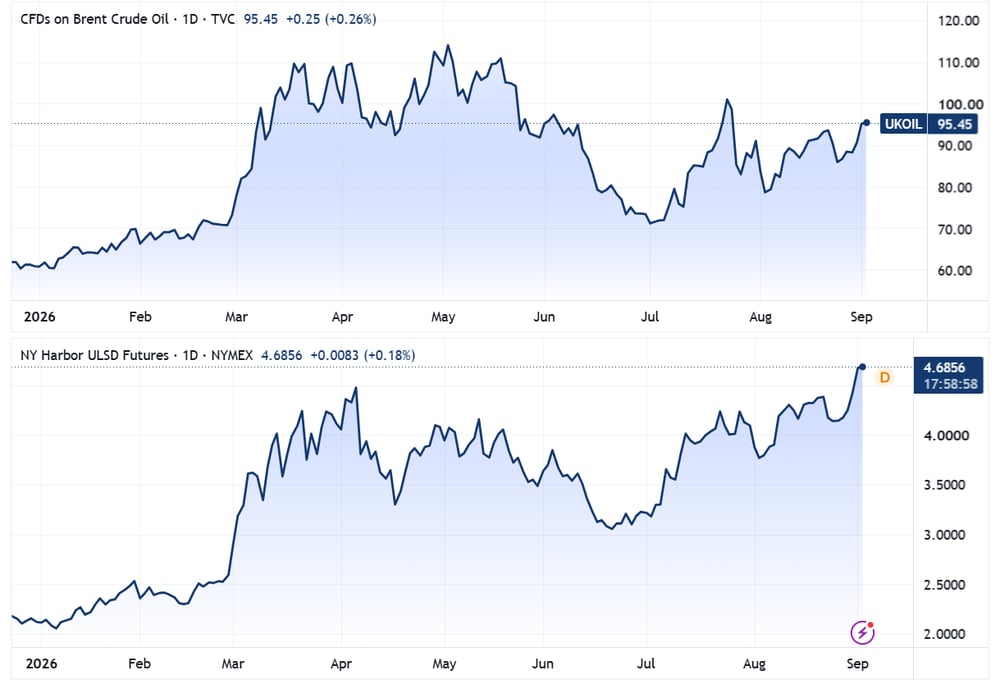
Brent crude (TOP) vs. US NY Harbor ULSD futures (bottom) | Source: TradingView
Why it matters: Brent is still roughly 20% off its May highs, but a key downstream barometer has already surged to fresh all-time highs, pointing to extreme tightness in refined products. That will flow through to upcoming economic data (and at the servo), with the latest releases already flagging upward pressure on energy and cost inflation.
Eurozone CPI (1-Sep): Headline inflation rose to 3.3% in August from 2.9% in July, with energy the largest contributor at 14.3% against 10.3% a month earlier.
US ISM Manufacturing PMI (1-Sep): Slipped to 54.6 in August from 55.6, but the prices index held at 71.1, a 23rd straight month of rising raw material costs.
China NBS (31-Aug): Manufacturing PMI improved to 49.8 from 49.2 but stayed in contraction for a second month. Input cost inflation accelerated to a three-month high of 56.6 from 53.2, while output prices swung back into expansion at 50.4 from 47.8.
Australia CPI (26-Aug): Headline inflation eased to 3.5% in July from 3.8%, though automotive fuel jumped 7.5% after three straight monthly falls, driven by higher world oil prices and the partial unwinding of the federal government's fuel excise relief.
Fed rate hike expectations firm
Odds of a Fed hike at this month's meeting have surged to 68.2% from 36.6% a week ago, according to CME's FedWatch tool. Pricing now leans towards two 25 bp hikes by year end, and three has overtaken no change as the more likely outcome.

Source: CME Fedwatch Tool
The bottom line: Global growth worries are back, with the rates picture flipping from a hopeful hold to as many as two hikes by year end as higher oil prices harden inflation expectations. That piles more pressure on an already weary consumer, and with bond yields at their most uncomfortable levels in decades, there's little here to underwrite near-term upside.