Stock market crash 2025: What's falling and what to do from here?
The S&P/ASX 200 plummeted 6.5% in early trade on Monday, marking the steepest one-day decline since March 2020.

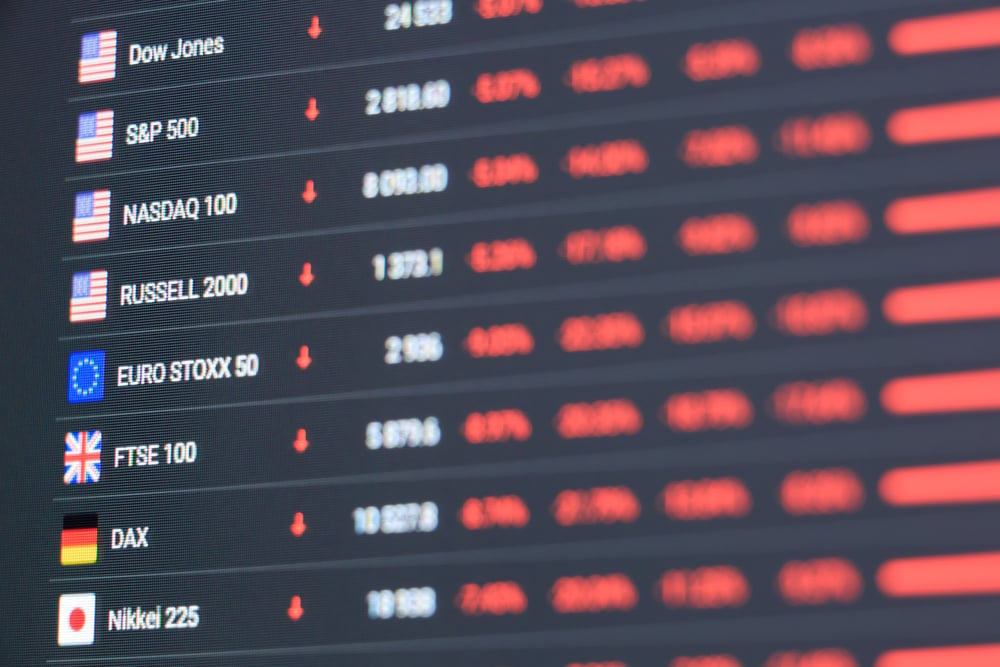
Source: Shutterstock
KEY POINTS
- The S&P/ASX 200 fell as much as 6.5% in early trade on Monday, marking its worst day since March 2020
- Financials (-7.1%), Materials (-7.7%), and Energy (-8.2%) led ASX 200 losses, while Staples (-2.6%) and Health Care (-3.5%) showed relative resilience amid the selloff
- Technical and sentiment indicators hint at a short-term bounce, but macroeconomic headwinds and tariff uncertainty point to more pain ahead
The S&P/ASX 200 plummeted 6.5% in early trade on Monday, marking the steepest one-day decline since March 2020.
The selloff comes as fears of a global trade war and recession intensify, triggered by China’s retaliation to President Trump’s latest 'Liberation Day' tariff barrage. Beijing imposed a 34% tariff on all US imports effective this week, escalating tensions after the US rolled out its own aggressive measures. Despite the economic fallout concerns, White House officials have stressed there will be no last-minute relief from reciprocal tariffs.
Global responses have been mixed. Canada countered with a 25% tariff on US-made vehicles, while the European Union is poised to unveil its retaliation plan this week — potentially targeting American tech giants like Alphabet and Meta. Meanwhile, leaders in Taiwan, Vietnam, and India have opted against immediate retaliatory tariffs, holding out hope for trade agreements.
ASX 200 dives, Volatility spikes
The ASX 200 is down 15.8% from its February 14 record high and trading at levels not seen since December 2023. What was once a 4.3% year-to-date gain has evaporated, leaving the index down 12% for 2025.

S&P/ASX 200 slides back to December 2023 levels (Source: TradingView)
Every sector felt the sting, with Financials (-7.1%), Materials (-7.7%), and Energy (-8.2%) hit hardest. Defensive sectors like Staples (-2.6%), Telecommunications (-2.9%), and Health Care (-3.5%) held up better, though still in the red.

ASX sector heat map (Source: TradingView)
The VIX Index, a gauge of expected 30-day volatility for the S&P/ASX 200, spiked to 27 — levels reminiscent of June 2022, after the RBA’s surprise 50-basis-point rate hike, and the pandemic panic of March 2020. The surge reflects deep unease among investors as markets grapple with uncertainty.

S&P/ASX 200 VIX Index (Source: TradingView)
What Happens Now?
The relentless selling has pushed the ASX 200 into deeply oversold territory, setting the stage for a potential short-term bounce. Similar signals are flashing in the U.S., where oversold conditions often precede relief rallies. For instance:
The AAII sentiment survey revealed 61.9% of participants are bearish — the third-highest reading ever, surpassed only by the bear market lows of October 1990 (67%) and March 2009 (70%).
Just 6.8% of NYSE-listed stocks are above their 20-day moving averages, the lowest since September 2022, when markets bottomed out a month later.
The S&P 500 VIX hit 45 on Friday. Historically, in the 12 instances since 1997 when it crossed that threshold, the S&P 500 averaged a 2.57% gain the next day (positive 75% of the time) and a 4.28% rise a week later (positive 83% of the time).
CNN’s Fear and Greed Index plunged to 4, a rare single-digit reading signaling extreme fear on a scale from 0 (maximum fear) to 100 (maximum greed).
The ASX 200’s track record following a VIX spike paints a less-than-rosy picture. Since 2018, the VIX has surged ten times, and the market’s forward performance has been underwhelming. On average, returns stay negative across all time frames — except at the 24-month mark. This suggests that a volatility shock, coupled with its underlying trigger, often leaves the market in an uncertain and weak state.

S&P/ASX 200 performance after VIX spike (Source: Market Index)
While an oversold bounce could still be on the horizon, the broader macroeconomic risks loom large. JPMorgan published a report titled "There will be blood", warns of severe fallout:
The tariffs mark the largest US tax hike since 1968
Tariff shock to be magnified by retaliation, supply chain disruptions and a sentiment shock
The risk of recession in the global economy this year is raised to 60%, up from 40% earlier
Scenario where the rest of the world muddles through a US recession is possible, but less likely than a global downturn
More fiscal and monetary easing expected but will only modestly cushion the shock
Past bear markets offer a sobering perspective. The ASX 200’s peak drawdowns during COVID-19, the Global Financial Crisis, the Dot-Com Bubble, and the 1987 crash reached 39%, 54%, 21%, and 50%, respectively. While such extremes remain speculative, they underscore the potential severity if the economy unravels further.
This selloff, however, is man-made — rooted in policy rather than structural collapse. Should trade negotiations gain traction and a deal emerge, markets could snap back sharply.
Looking back, the ASX 200 fell as much as 39% between February 20 and March 23, 2020. Yet, the market logged two rallies of 3.1% and 5.8% on March 10 and 17, respectively.
For now, with no trade talks in sight and retaliation escalating, the path of least resistance points downward. We’re in a high-volatility environment where brutal selloffs and fleeting rallies can coexist — leaving investors braced for a path of mostly pain and little opportunity.