Slowing growth, sticky inflation: Is Australia sliding into stagflation?
A major investment bank says Australia’s entering a stagflationary phase that markets haven’t priced in – here’s what it could mean for you.


Source: Market Index using ChatGPT
KEY POINTS
- Stagflation – the toxic mix of stalling growth and stubborn inflation – has haunted economies since the 1970s oil shock, when central banks found interest rates couldn’t fix both problems at once.
- New research from Morgan Stanley warns Australia is now entering a stagflationary phase, as oil prices, labour costs, weak productivity and a softer dollar converge.
- This article explains what stagflation actually is, the damage it can inflict on households, the economy, and the share market, and what policymakers must do to stop Australia getting stuck in its grip.
Australians of a certain vintage remember the 1970s not just for flares and cassette tapes, but for a peculiar kind of economic misery: prices rising fast while jobs disappeared and growth ground to a halt. Economists gave this condition a name – stagflation – because nothing in the textbooks at that point explained how weak growth and high inflation could occur together.
For most of the past five decades, Australia has avoided another serious bout of 1970s-style stagflation: recessions brought falling prices, booms brought rising ones, and the two rarely turned up at once for long.
But new research from investment bank Morgan Stanley warns that the next stagflationary event may be upon us. In its Asset Allocation Insights note published 5 August, Morgan Stanley delivered a blunt assessment of where the Australian economy is headed:
Australia is entering a stagflationary phase, an uncomfortable mix not yet priced by markets. Softening growth and persistently elevated inflation are converging, driven by higher oil prices, elevated labour costs against weak productivity, a softer AUD, and fiscal settings that have entrenched cost pressures.
– Morgan Stanley, Asset Allocation Insights – Joining the Dots: Half-Time, Full Speed – The Capex Cycle Holds, 5 August 2026
It’s a call worth taking seriously because of just how serious the impacts of stagflation are on households, and for investors – the share market. This article explains what stagflation actually is, how dangerous it can be to an economy, and what governments and regulators must do to keep Australia from getting stuck in it.
What is stagflation, and why is it so hard to fix?
Two ideas sit underneath the word “stagflation”: economic growth and inflation.
Economic growth, usually measured as gross domestic product (GDP), tracks the total value of goods and services an economy produces. Rising GDP generally means businesses are hiring, investing, and selling more – the kind of environment that lifts wages and employment. Higher wages and employment mean consumers can spend even more or borrow to invest, and governments also win from lower spending on social security and greater tax revenues which can be invested back into growing the economy further.
Inflation measures how fast prices are rising. A little inflation, typically 2–3% a year, is considered healthy: it reflects reasonable demand and gives businesses room to lift wages and reinvest. Central banks, including the Reserve Bank of Australia (RBA), target this band for exactly that reason.
Under normal conditions, growth and inflation move together – strong growth pushes inflation up as demand outpaces supply, weak growth cools it. That relationship underpins how central banks operate: raise rates to slow an overheating economy or cut rates to support a weakening one. One lever. That can be pulled in one direction. To solve one problem.
Stagflation breaks that relationship. Growth stalls while inflation stays stubbornly high – a combination that shouldn’t, in theory, persist for long. It’s typically triggered by a supply-side shock rather than a demand boom: something that pushes costs up across the economy – e.g., higher energy, labour, or imports – while choking off activity at the same time.
The 1970s oil embargo is the textbook case: petrol prices spiked, pushing up transport and manufacturing costs, slowing household consumption, causing workers to demand higher wages, which hurt business profits, so they increased their prices and cut employment, which increased prices and slowed household consumption, and… well, you can see where it’s headed. Growth down, inflation up.
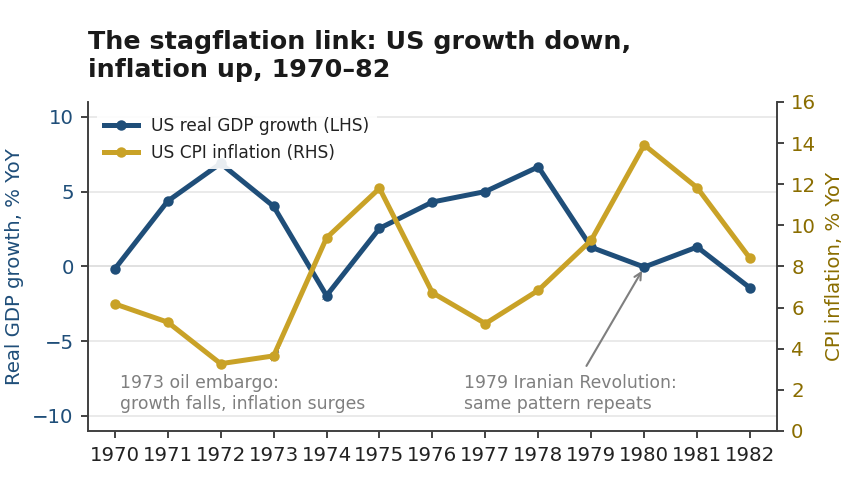
Source: US Bureau of Economic Analysis (real GDP growth); US Bureau of Labor Statistics (CPI inflation).
That’s what makes stagflation so hard to fix. Raising rates to fight inflation only deepens the growth slump, while cutting rates to support growth simply pours more fuel on the inflation fire. No single policy lever solves both problems – and this is precisely the bind Morgan Stanley believes Australia is now approaching.
The impacts of stagflation – from grocery bills to portfolios
Real incomes get squeezed: When prices rise faster than wages – which is common in a stagflationary environment – households can afford less with every pay cheque. Cost-of-living pressure builds (sound familiar?), and discretionary spending is usually the first casualty as households prioritise essentials like housing, food, and fuel over everything else. Consumer spending accounts for around two-thirds of GDP, so when spending slows, the economy can take a major hit.
Central banks’ ‘one-lever-one direction solution’ fails: A central bank facing stagflation cannot simply cut rates to support jobs and growth, because doing so risks reigniting inflation that is already above target. Nor can it aggressively hike rates to smash inflation, because that would deepen the growth slowdown and risk a recession. The result is a central bank stuck on hold for longer than markets would like, unable to offer the usual support when the economy needs it most.
Company profits suffer: Businesses face rising input costs – wages, energy, and imported materials – at the same time as softer sales volumes. Passing on their cost increases risks losing customers, but absorbing them hits profitability. Businesses with limited pricing power or high fixed costs are usually hit the hardest.
Share markets tend to fall: Equity valuations are built on expected earnings growth discounted back to today’s dollars. Stagflation attacks both sides of that equation. Lower spending hurts revenues while higher input and interest expense boost costs – earnings growth slows. Discount rates are generally based on official cash rates, and as cash rates are typically higher during stagflationary periods, the more punitively company earnings tend to be priced. Investors are less willing to pay up for a dollar of earnings. High growth, high P/E ratio, and consumer-facing cyclical stocks are usually repriced the hardest.
A weaker currency can deepen the problem: Stagflation risk can itself weigh on a country’s currency, as international investors demand better growth prospects elsewhere. A softer currency then raises the cost of imported goods – fuel, machinery, and technology – adding further inflationary pressure at exactly the moment the economy can least absorb it. It’s a feedback loop that can make a mild stagflationary episode harder to escape.
Is Australia about to experience stagflation?
Morgan Stanley’s case rests on pressures building at home and pressures arriving from offshore, both feeding the same mix of softer growth and sticky prices.
Inflation is proving more stubborn than headline measures suggest: Australia’s June-quarter trimmed mean inflation – the RBA’s preferred measure – came in at 3.6% year-on-year. That was a downside surprise against forecasts, but still well above the RBA’s 2–3% target band, keeping the policy dilemma intact.
Growth, meanwhile, is losing momentum: Morgan Stanley forecasts GDP growth of just 1.2% year-on-year by December 2026, a sharp deceleration from 2.6% a year earlier and below both consensus and the RBA’s own projections. The labour market’s headline strength – employment rose 76,000 in June, participation near record highs – masks cracks beneath: unemployment ticked up to 4.43%, underemployment rose to 6.5%, and forward indicators such as job ads continue to soften.
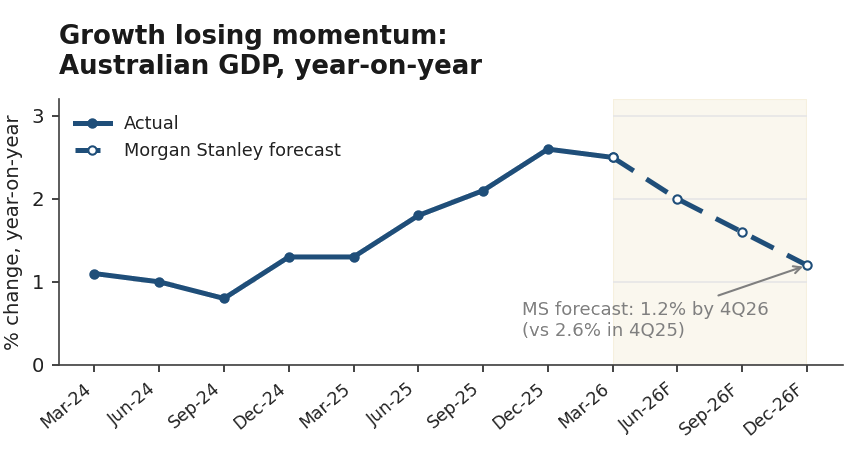
Source: ABS; Trading Economics; Morgan Stanley Research (forecast from 2Q26).
Feeding into this is a productivity problem: Regulated minimum wage increases and elevated labour costs are running ahead of productivity growth, Morgan Stanley notes, entrenching cost pressures rather than resolving them. Fiscal settings – government spending and cost-of-living measures – have locked in further pressure, in the bank’s view. Layered on top is a housing correction, with Morgan Stanley expecting house prices to decline through the remainder of the year, a shock that weighs heavily on consumer spending given how much household wealth sits in property.
External factors compound the squeeze: Renewed conflict in the Middle East drove oil prices higher, spiking fuel prices and freight costs for a net oil importer like Australia. The Australian dollar has also softened, slipping from above 72 US cents in May to below 70 US cents on stagflation concerns. Though Morgan Stanley regards the dip as temporary and retains a longer-term target of 75 US cents by the end of 2026 – even a temporary dip means dearer imports in the interim, adding to inflation just as growth slows.
Morgan Stanley expects the RBA to hold rates in August with hawkish messaging: The bank doesn’t expect meaningful cuts until the second half of 2027, when it expects inflation and growth to finally weaken together – the alignment a genuine dovish pivot requires.
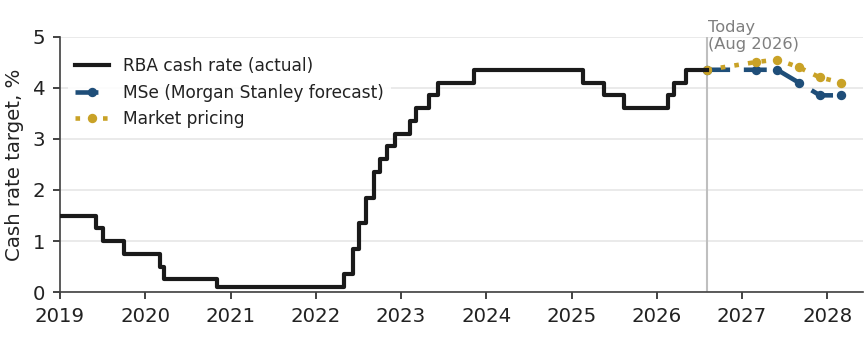
Source: RBA; Bloomberg; Morgan Stanley Research forecasts. Market Index reconstruction of Morgan Stanley Exhibit 1 (RBA Review - Welcoming the Slowdown, 16 June 2026); forecast paths approximated from published research.
On Australian shares, Morgan Stanley holds a near-maximum underweight relative to international markets: But it does favour resources and capex-exposed industrials, preferring them over banks and domestic cyclicals. Morgan Stanley sees earnings risks rising for the banks, but also consumer discretionary, and other housing-exposed names, noting that the current earnings season – now underway – will test whether this slowdown is already in the price.
Conclusion: forewarned equals forearmed
Stagflation doesn’t announce itself with a crash. It arrives quietly, through a slower pay rise here, a dearer tank of petrol there, and a central bank that keeps saying “not yet” to hikes to solve the inflation problem and cuts to help consumers. By the time it’s obvious in the headline numbers, households and portfolios have often already absorbed months of damage.
That’s why Morgan Stanley’s warning is worth heeding now. Importantly, the bank frames the current stagflationary episode in Australia as a phase rather than a permanent state – a serious near-term risk, not a structural verdict. Regardless, avoiding that outcome, or shortening it, will ease the pain for all of us.
This part is in the hands of policymakers. A forward-looking response to avoiding stagflation in Australia would likely need to include:
The RBA holding its nerve before easing. Cutting rates prematurely risks reigniting the price pressures that created the problem – but the central bank must stand ready to move once inflation and growth genuinely soften together.
Fiscal settings that stop entrenching cost pressures. Cost-of-living support should target those who need it most, not broad-based spending that fuels demand-side inflation further.
A genuine productivity push. Wage growth that outpaces productivity feeds directly into stagflation. Federal and state governments must invest in growing skills, technology, and business efficiency to help lift output faster than wages.
State governments easing supply-side constraints. Faster planning approvals, more housing supply, and less red tape for business investment help absorb cost pressures rather than compound them.
Reduced exposure to imported energy shocks. Diversifying Australia’s energy mix and supply chains lessens its vulnerability to the kind of oil price spikes doing much of the damage today.
None of this guarantees Australia will avoid a stagflationary phase. But households, businesses, and policymakers who understand the mechanics now will be far better placed than those who wait for the official statistics to confirm one is already underway.
This article draws on institutional research from Morgan Stanley (June and August 2026), and data from the ABS, RBA, Trading Economics, US Bureau of Economic Analysis and US Bureau of Labor Statistics.