RBA set to inflict fifth interest rate hike on Cup Day, number six is now a 50-50 bet
Hotter-than-expected inflation data has pushed RBA rate hike bets to a new cycle high, a guide for mortgage holders as to what comes next.

Source: Source: Claude using licensed stock images.
KEY POINTS
- The RBA has lifted its official cash rate (“OCR”) four times this year to 4.60%, and market forecasts of two more 0.25% hikes have gathered pace this week.
- Underlying inflation rose to 3.7% p.a. in the September quarter, well above the RBA's forecast, and senior RBA officials responded by saying the number is "too high".
- We break down what mortgage holders and ASX investors need to know about the most likely future path of local interest rates – strap in, it’s going to get worse before it gets any better!
You already knew inflation in the Australian economy is rampant. You feel it at the bowser, at the checkout, and when you tear open those utility bills. If you have a mortgage, you’re also copping it on your home loan repayments.
The September quarter CPI data released yesterday was the opposite of what most of us wanted. Australian inflation is getting worse, not better, and that means the pressure will be squarely on the Reserve Bank of Australia (“RBA”) at its next meeting on Cup Day next week.
In this article, we look at how far financial markets moved to price further interest rate hikes, the risks either side, and when – in the distant future – mortgage holders can expect some interest rate relief.
Hike number 5 locked in, number 6 is a coin flip
The ASX 30 Day Interbank Cash Rate Futures market is where banks, hedge funds and asset managers bet on the path of the official cash rate.
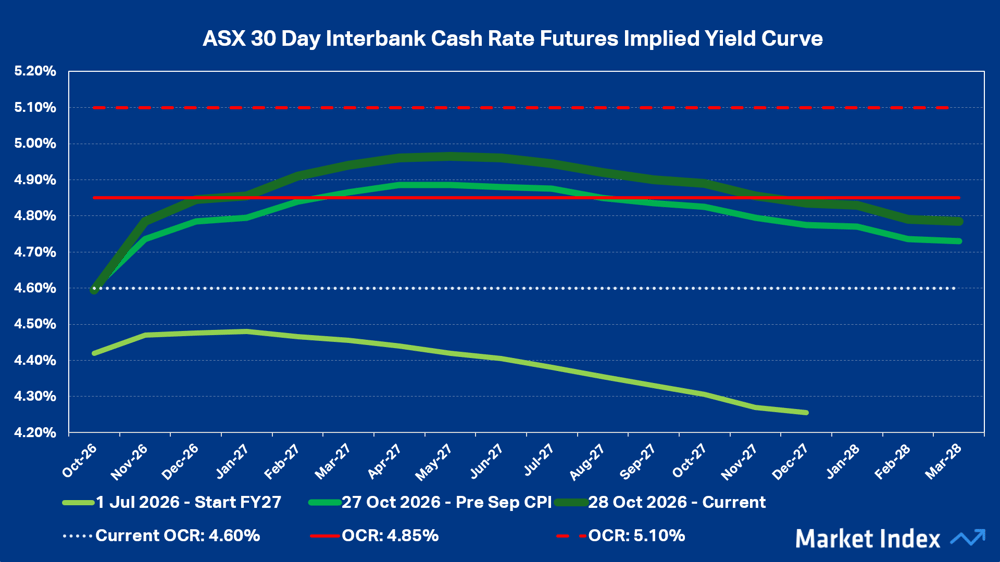
Chart: ASX 30 Day Interbank Cash Rate Futures Implied Yield Curve. Source: ASX24 futures data
Before the September CPI release, the November contract implied roughly a 60% chance of a 25 basis point hike at next Tuesday's meeting. At yesterday's close, that had risen to about 84%. The December contract tells an even clearer story: at 4.85%, it now fully prices a typical RBA hike by year’s end, up from around 74% the day before.
The bigger shift is further out. The curve now peaks at about 4.97% in May 2027, roughly a 48% chance of a second hike to 5.10%, up from just 14% before the CPI print – a long shot now turned into a coin flip.
What the curve doesn't show is a quick reversal. Futures price modest easing from mid-2027, but the March 2028 contract still sits at about 4.79%, above today's 4.60%. Cast your mind back to 1 July, the start of the financial year, and the curve was pricing roughly one cut by the end of 2027.
UBS: November "very likely", risks skewed to more
In a research note on the September CPI numbers, UBS said the September quarter trimmed mean was well above the RBA's own forecast path, which in its August Statement on Monetary Policy had underlying inflation easing to 3.3% by December. The investment bank also pointed to the RBA's appearance before Senate Estimates yesterday, where Deputy Governor Andrew Hauser said "these numbers are too high" and Governor Michele Bullock said upside risks to inflation are "materialising". UBS now sees a 25 basis point hike to 4.85% next week as very likely.
The bank's economics team, led by George Tharenou, sees risks skewed to the upside, judging two hikes from here, to 5.10%, more likely than none. If a second hike comes, UBS favours February 2027 over December. Even a surprise hold next week, it argues, would likely be a "hawkish hold" setting up a December move.
Morgan Stanley: one and done
There’s some hope for mortgage holders that it’s a case of one more and not two more. Morgan Stanley has switched its call, now also expecting the November hike, but with some dissenting votes from more cautious Board members. Where Morgan Stanley parts ways with UBS is what follows Cup Day. It sees demand in the Australian economy already softening, and tentative signs this is flowing through to inflation. This should be enough to keep the RBA on hold after November, the investment bank says, with global price pressures the key risk.
What comes next
The first test arrives next Tuesday, when the size of any dissent on the Board will be as telling as the decision itself. A split vote would suggest the bar for a second hike is higher than the futures curve implies. Beyond that, October CPI, September quarter GDP and the RBA's updated forecasts in the November Statement on Monetary Policy will decide whether the second hike firms or fades.
Fuel prices remain the swing factor, with UBS's daily tracker pointing to another sizeable rise in October. That makes crude oil the one to watch – a resolution of supply disruption through the Strait of Hormuz would take a lot of heat out of the bowser. Just as prices and interest rates escalated quickly, relief could come faster than the market currently expects if the factors behind this burst of inflation recede.
References: UBS Global Research, Australian Economic Comment, 28 October 2026 (George Tharenou, Stephen Wu, Izzy Lowe, Tatiana Bodrova); Morgan Stanley Research, Australia Macro+, 28 October 2026 (Chris Read, Chris Nicol, Antony Conte, Isabel Black); Australian Bureau of Statistics, Consumer Price Index, September quarter and September 2026; Reserve Bank of Australia, 2026 Monetary Policy Board meeting dates; ASX 30 Day Interbank Cash Rate Futures closing prices via TradingView, compiled by Market Index.